There is a very specific kind of online ad that never seems to die. It promises a free store, winning products, easy money, and a shortcut to ecommerce success that sounds almost insultingly simple. Click here, sign up now, keep reading before the offer disappears, and suddenly you too can have a fully loaded online business handed to you like a set of car keys.
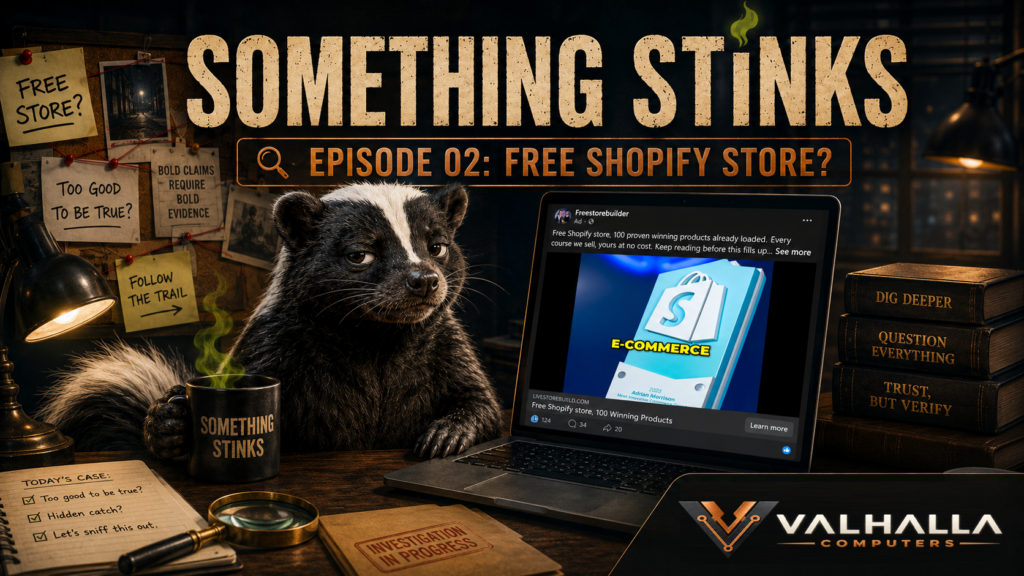
This time, the claim making the rounds is a free Shopify store with 100 winning products already loaded. That sounds incredible on the surface. It is also exactly the kind of promise that should make a business owner, entrepreneur, or anyone with a functioning brain stop, squint at the screen, and ask a very important question:
Where’s the catch?
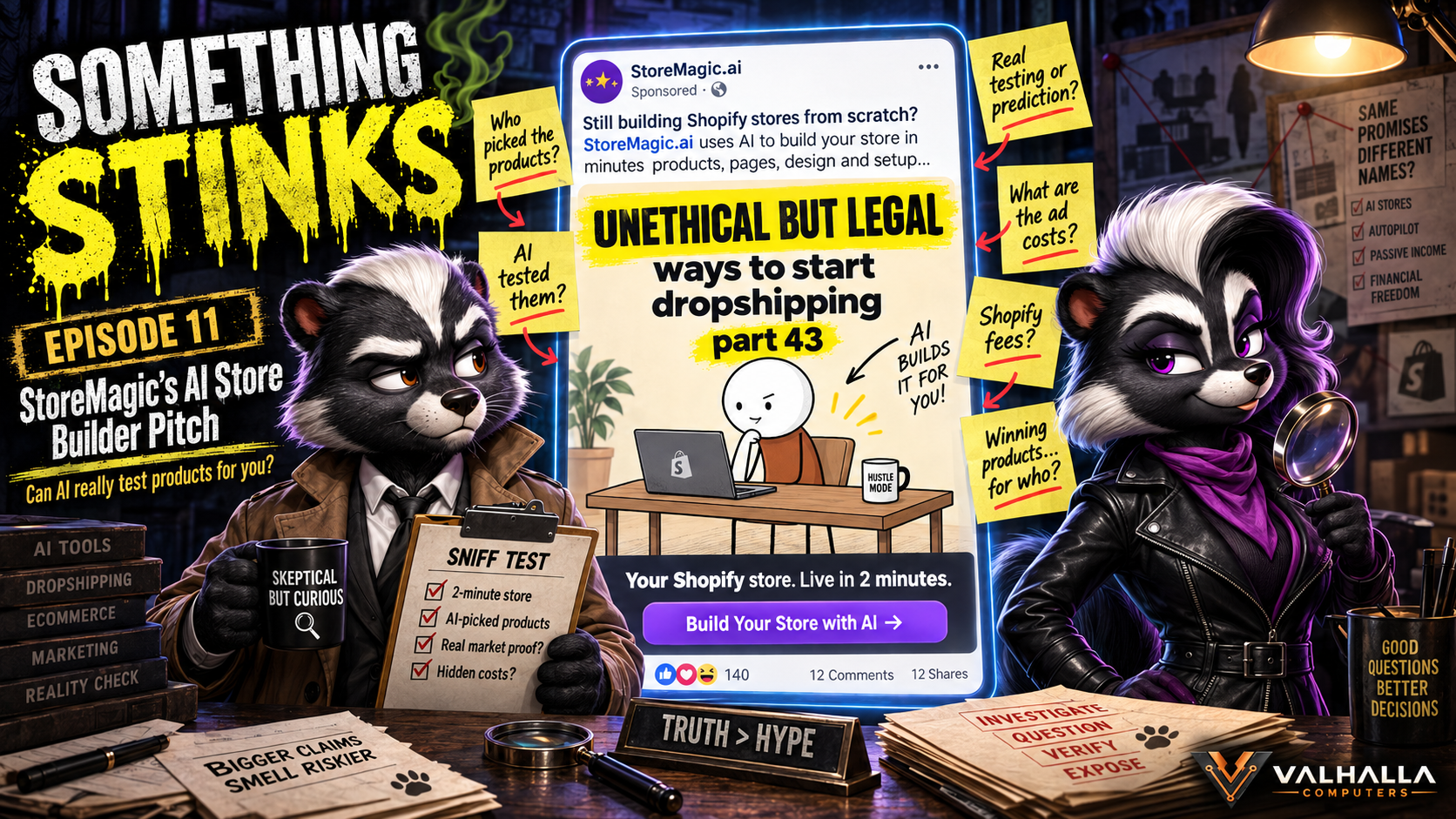
Welcome back to Something Stinks, the Valhalla Computers series where we take the flashy AI promises, ecommerce miracle claims, “free” business shortcuts, and too-good-to-be-true ads cluttering your feed and drag them into the light.
We are not here to scream “scam” every time someone advertises online. Sometimes the product is legitimate. Sometimes the offer is real. Sometimes the thing being sold can genuinely help the right person.
But there is a major difference between a useful service and a carefully constructed sales funnel designed to get people in the door with one promise and then keep squeezing them with upsells, pressure, vague claims, and manufactured confidence.
And that is where this one starts to smell funny.
The Headline Promise
The hook is powerful because it speaks directly to people who want to make money online but don’t know where to start. A free Shopify store. One hundred “winning” products already loaded. Sometimes a free course. Sometimes a promise that everything is basically done for you.
To a beginner, that sounds like the hardest part has already been handled.
But the first thing you have to understand is that a store is not a business just because it has products inside it. A Shopify installation with items loaded into it is not success. It is not traffic. It is not trust. It is not branding. It is not fulfillment. It is not customer service. It is not ad strategy. It is not profit.
It is a shell.
And very often, that shell is just the bait.
What People Are Saying Matters
One of the reasons this ad stood out is because the comments under it are more revealing than the ad itself. That is often where the real story begins to show through.
Some comments suggest that after the initial promise, buyers quickly find themselves being pushed toward additional levels, upgrades, webinars, coaching, “VIP” help, or premium services that cost far more than the original offer implied. Others mention confusion, technical problems, incomplete follow-through, being removed from webinars, or promises that did not play out the way the ad made them sound.
That pattern matters.
Because when multiple people independently describe a similar experience, the smell gets stronger.
At minimum, it suggests the “free store” pitch may be functioning less as the product and more as the top of a funnel.
And there is a huge difference between:
“Here is a free store.”
and
“Here is the first step in a multi-stage upsell machine.”
The Free Store Isn’t the Business
This is where a lot of dream sellers make their money. They are not really selling the store. They are selling the fantasy attached to the store.
The fantasy sounds like this: the hard work has already been done, the products are proven, the setup is handled, the winners are already selected, and you are only a few clicks away from income.
But real ecommerce does not work that way.
Even if someone handed you a fully functioning Shopify store right now, you would still need to answer the questions that actually determine whether you make money:
Who is your target customer?
Why would they trust your store?
What makes your products different from the thousands of identical stores online?
How will anyone find your site?
How much will it cost to drive traffic?
Who handles customer issues, refunds, or chargebacks?
What happens when “winning products” stop winning?
A free store can save setup time.
It cannot replace strategy, operations, trust, or business sense.
Then Comes the Upsell Ladder
This is one of the oldest tricks in online business, and it keeps working because it is built around emotion. The ad gets people excited. The “free” offer lowers resistance. Once the person is invested, curious, or already paid something small, the funnel begins to unfold.
Suddenly the real value is in the next level.
Then the next level after that.
Then the special coaching.
Then the inner circle.
Then the done-with-you package.
Then the VIP offer.
Then the “serious people only” tier.
And before long, the original “free” or low-cost promise is just the trail of breadcrumbs that led to a much more expensive destination.
That does not automatically make every funnel dishonest. But it absolutely means people should stop confusing a lead magnet with the full reality of what they are getting into.
The Testimonial Problem
This is another part that deserves more attention than it usually gets.
A lot of these ads rely heavily on social proof. Screenshots. Success stories. People saying they made money. Students smiling. Big claims about results. Comments that appear to validate everything the ad is saying.
And yes, sometimes those testimonials are real.
But this is where people need to be very careful.
Some online promotions use testimonials that are:
cherry-picked from the best possible outcomes
paid for or incentivized
exaggerated
stripped of important context
impossible to independently verify
presented in a way that suggests typical results when they are anything but typical
In some cases, confidence is being built not through transparency, but through performance. The goal is to make you feel safe enough to follow the flock.
That is why smart buyers do not stop at the glowing claims. They look for the dissatisfied comments, the repeated complaints, the refund issues, the unexpected costs, the vague answers, and the gap between what is promised publicly and what is revealed later.
If the sales page is a stage, the comments section is often where somebody knocks over the scenery and you get to see the plywood behind it.
The “Winning Products” Angle Deserves Side-Eye Too
The phrase winning products sounds strong because it implies certainty. It suggests someone has already done the market research, found proven items, and handed you the good stuff.
But products do not stay “winning” forever. Markets saturate. trends cool off. competitors copy listings. ad costs rise. suppliers change. customer expectations evolve. what worked for one seller under one set of circumstances may fail completely for another.
So when a program leans heavily on the promise of “100 winning products,” what you should really hear is:
“Here are 100 products somebody believes may help sell the dream.”
That is not the same as guaranteed opportunity.
The Something Stinks Verdict
VERDICT: THE FREE STORE MAY BE THE BAIT, NOT THE BUSINESS.
Could a person receive a store template, some products, and an introduction to Shopify?
Possibly, yes.
Could that be useful to the right beginner in the right context?
Also yes.
But if the real customer journey involves escalating upsells, pressure-based funnels, vague expectations, unclear support, and confidence boosted by carefully polished testimonials, then the headline is not telling the whole story.
And that is the problem.
Because once again, what is being advertised most aggressively is the easy dream, while the difficult reality shows up later, usually right around the moment someone reaches for their wallet.
One Last Sniff
There is nothing wrong with selling a course. There is nothing wrong with selling coaching. There is nothing wrong with providing store setup help, ecommerce guidance, or product research.
What is wrong is when the advertisement makes the starting point sound like the destination.
A free store is not a business.
Preloaded products are not profit.
Testimonials are not proof of typical results.
And a sales funnel is not the same thing as a clear, honest offer.
If an ad promises business success with suspicious ease, stop and look past the headline. Read the comments. Look for repeated complaints. Watch for the upsell ladder. Be skeptical of polished testimonials that sound too perfect. Ask what happens after the “free” part.
Because sometimes the real product is not the store.