Digging Deeper Episode 04: Tripo 3D — Free to Create, Paid to Use?
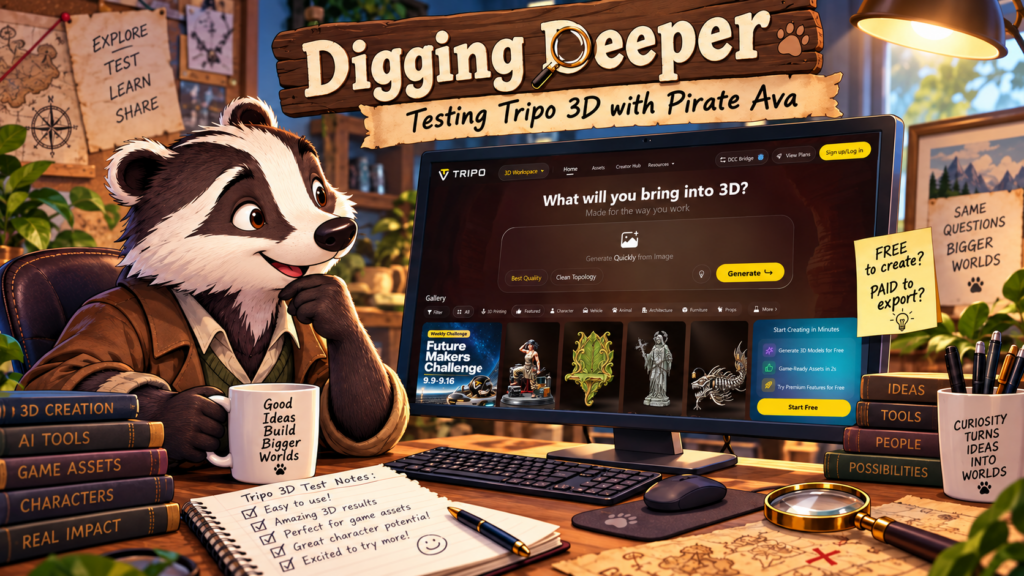
One of the reasons I moved this series from “Something Stinks” to “Digging Deeper” is because not every ad deserves to be dismissed on sight. Some deserve to be tested. Tripo 3D turned out to be one of those cases. Rather than simply looking at the marketing and making assumptions, I decided to create an account, upload one of my own character images, and see exactly what happened when I tried to turn a 2D design into a printable 3D model. That gave me a much better answer than a surface-level reaction ever could, because in this case the truth is more interesting than the clickbait.
The first thing I noticed was that Tripo wasted absolutely no time trying to sell me something. Almost immediately after creating the account, I was greeted with an offer pushing a discounted upgrade. That alone is not unusual in the AI space right now, but it does matter because it sets the tone. The company clearly wants new users to understand from the beginning that there is a paid tier and that the free account is only one part of the experience. I clicked that first offer away because I wanted to see what the platform would actually let me do before deciding whether any upgrade was worth considering.
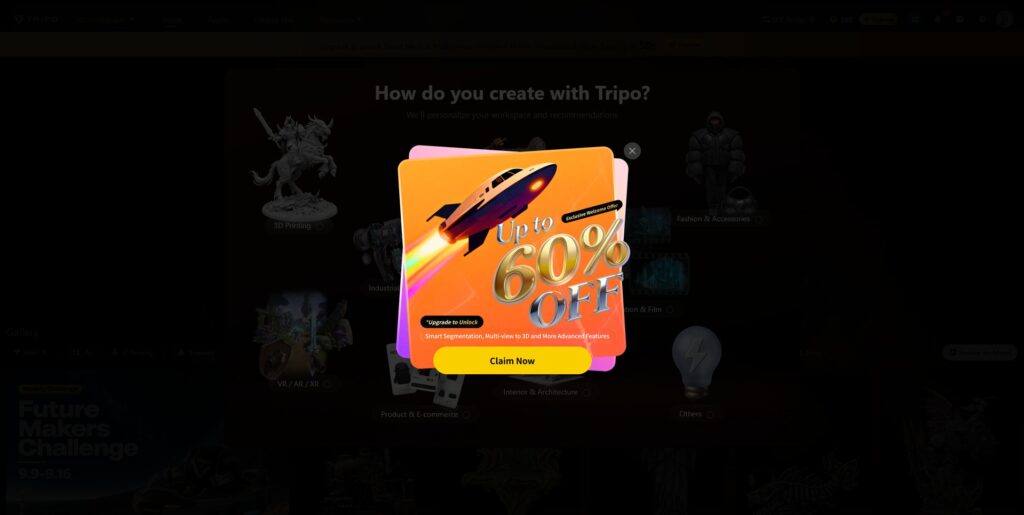
After that first popup, I continued through the onboarding process and ran headfirst into more upselling. Again, I was able to close it and keep moving, which is important. The site did not completely block me from testing the product. Once I got into the actual workspace, I found I had 200 starting credits, and according to the interface that was enough to create at least one model. That was the moment where the whole test became legitimate. If a platform claims you can create something for free, then the real question is simple: can I get in, use the tool, and produce a result without putting in a credit card? In this case, the answer was yes.


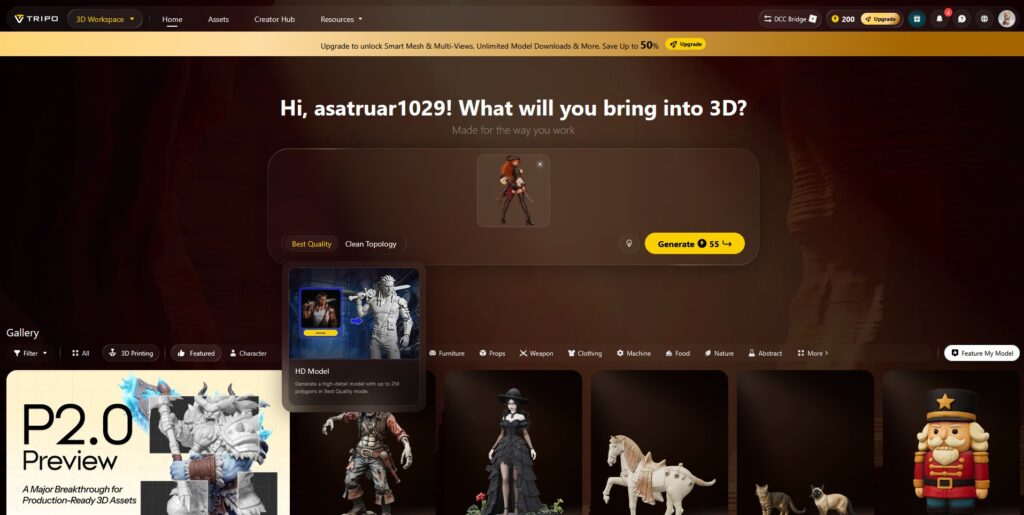
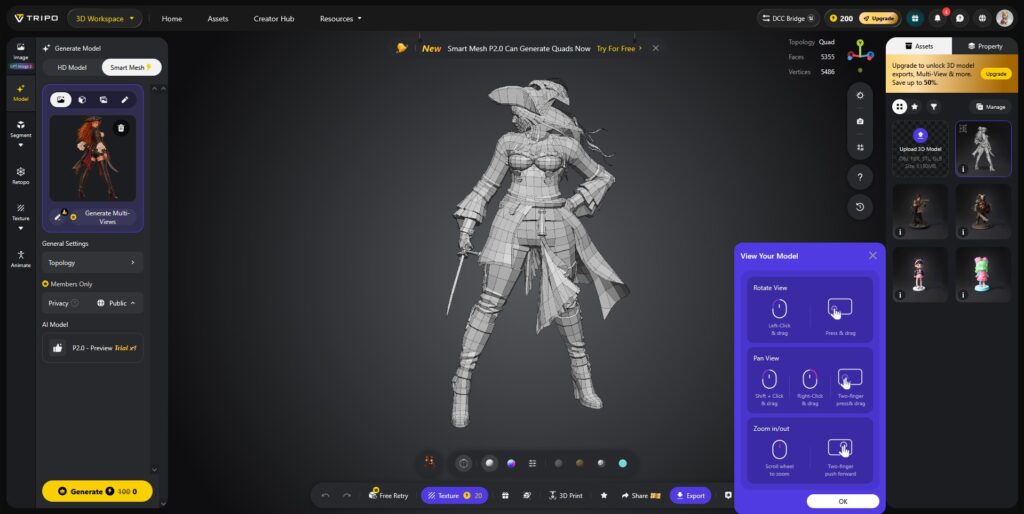
For the test subject, I used one of the pirate Ava images I had prepared earlier. Since the image already had a clean transparent background, it made for a solid candidate to see how well Tripo could interpret clothing, pose, hair, and accessories. I uploaded the image and started with the Smart Mesh option. Tripo processed the image quickly, and almost immediately I had a 3D model I could rotate and inspect inside the viewer. The controls felt familiar, especially if you have ever used a slicer or any basic 3D viewing environment. So from a pure usability standpoint, the experience was easy enough to figure out.

The problem was not speed. The problem was quality. The first Smart Mesh result was rough, visibly blocky, and full of artifacts that clearly did not belong there. It technically captured the general character shape, and I could absolutely recognize that it was my pirate model, but it did not look like something I would want to send straight to a printer. In that mode, Tripo felt more like a fast concepting tool than a finished production tool. If the goal is just to prove that an image can become a model, Smart Mesh does that. If the goal is to produce something that looks polished and ready for physical output, it left a lot to be desired.
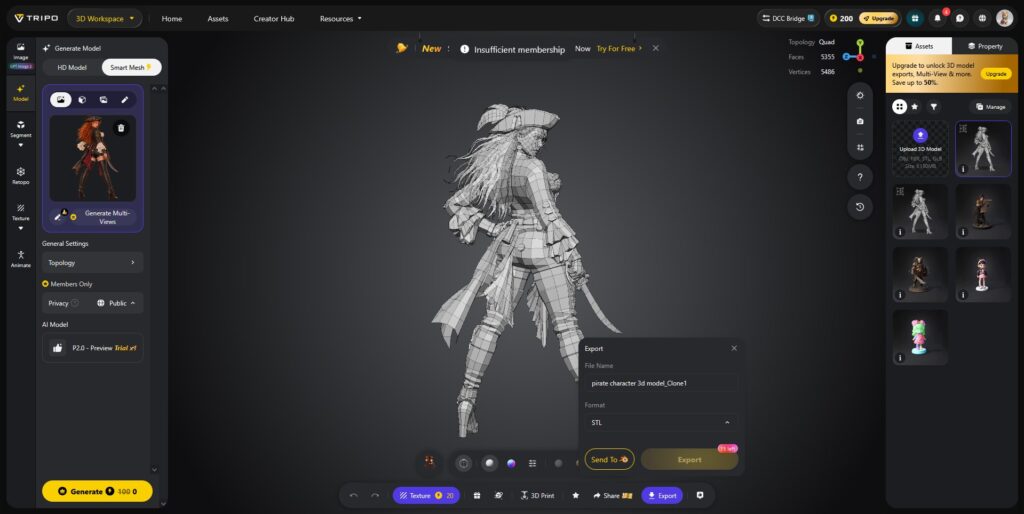
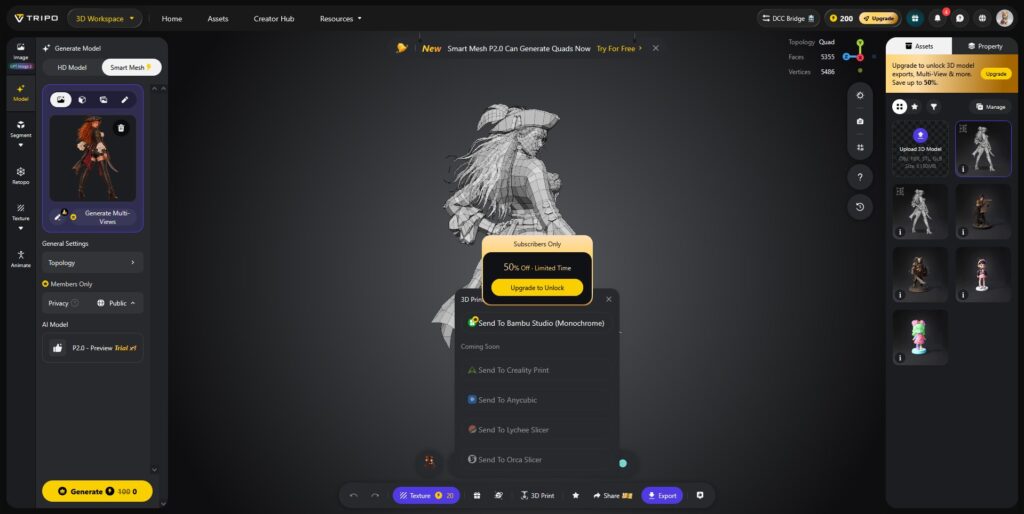
While poking around the interface, I discovered the next major catch. Yes, Tripo let me create the model for free. Yes, it let me spin it around, inspect it, and see the result. But when it came time to export the file or use the built-in 3D printing options, the platform made it very clear that those features were reserved for upgraded accounts. That changes the meaning of the ad considerably. “Free to create” is true in a narrow sense, but “free to actually use as a working asset” is another story. If you want the model file in your hands, if you want to print it directly, or if you want to move it into a real production pipeline, the free experience stops short.
That alone would have been enough to define the article, but the test got much more interesting once I tried the HD Model option. Tripo offered that mode for a far more reasonable credit cost than I expected, and the improvement was immediate. The model that came out of HD generation was dramatically better than the rough Smart Mesh version. The blocky surfaces were gone, the artifacts were cleaned up, the silhouette looked far more natural, and the overall shape finally crossed into the territory of something I would genuinely consider for printing. This was the moment where the platform stopped feeling like a toy and started feeling like a serious tool.
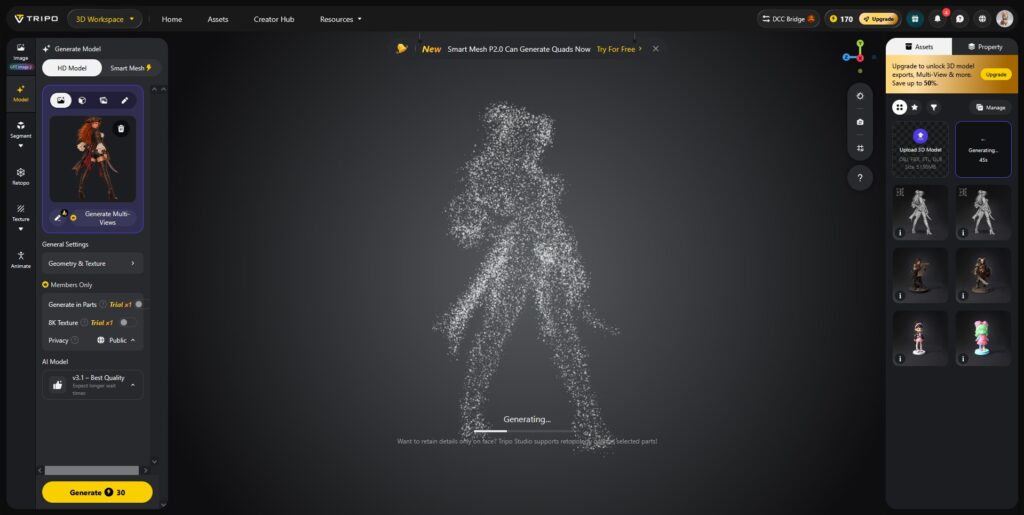
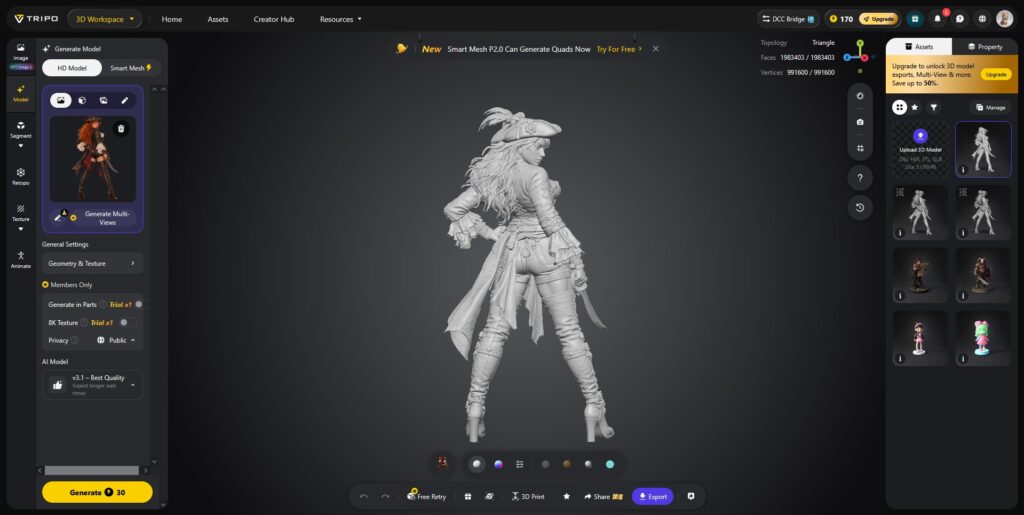
The more I rotated that HD model, the more impressed I became. Front, side, and rear views all held together far better than I expected from a one-image input. Hair volume, coat shape, hat profile, boots, and weapon placement all translated convincingly enough to make the model feel intentionally sculpted rather than barely reconstructed. It was not just “good for AI.” It was good, period. If somebody had shown me only the HD result without the earlier rough version, I would have assumed I was looking at the kind of output the platform was advertising from the start.
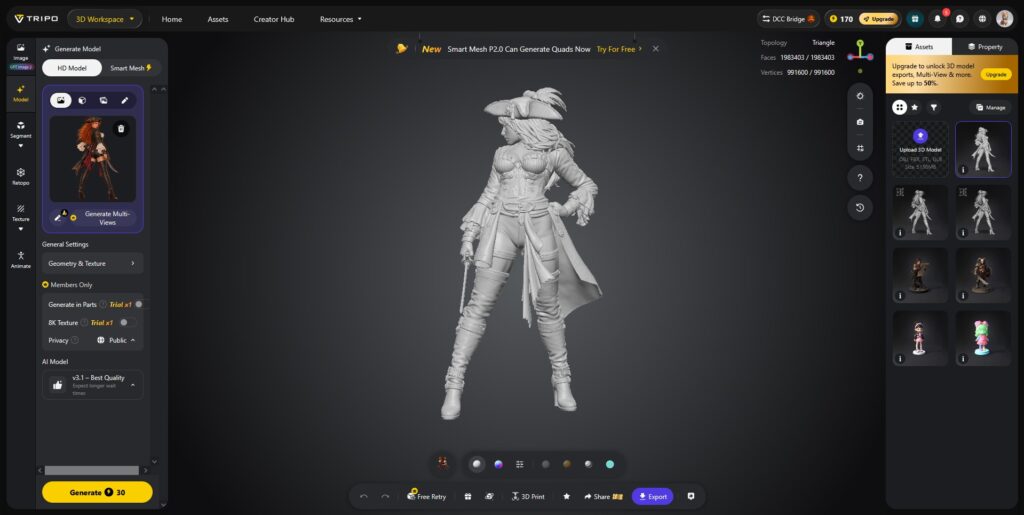
Once I kept exploring, I found Tripo could also generate a fully textured version of the character, which made the whole thing even more fun. Seeing the pirate Ava model come back with color, clothing detail, and a more finished presentation made the experiment feel less like a dry technical demo and more like a genuine creation workflow. The textured version is not what I would need for every print project, especially if I planned to print and paint the piece physically, but it absolutely adds value for previews, presentations, digital use, and showcasing a concept before committing to production.
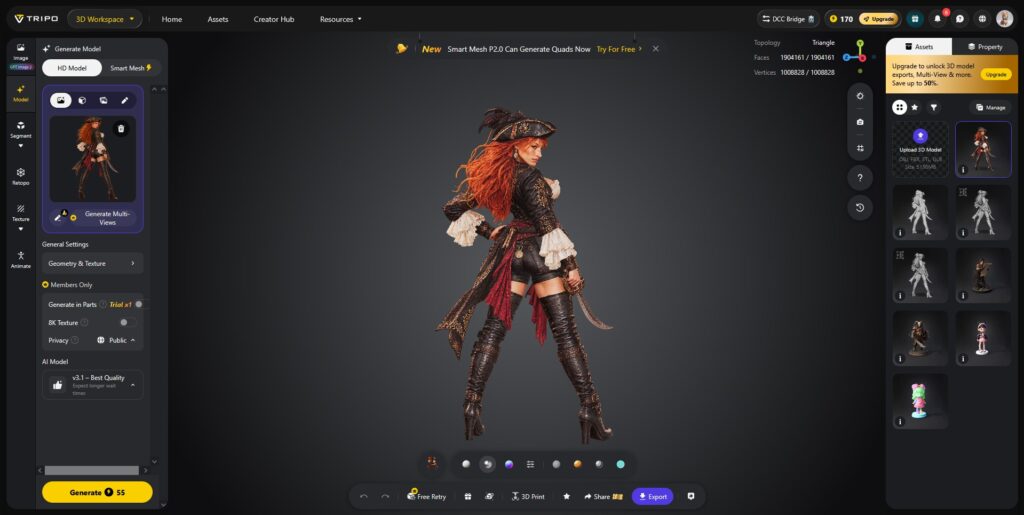
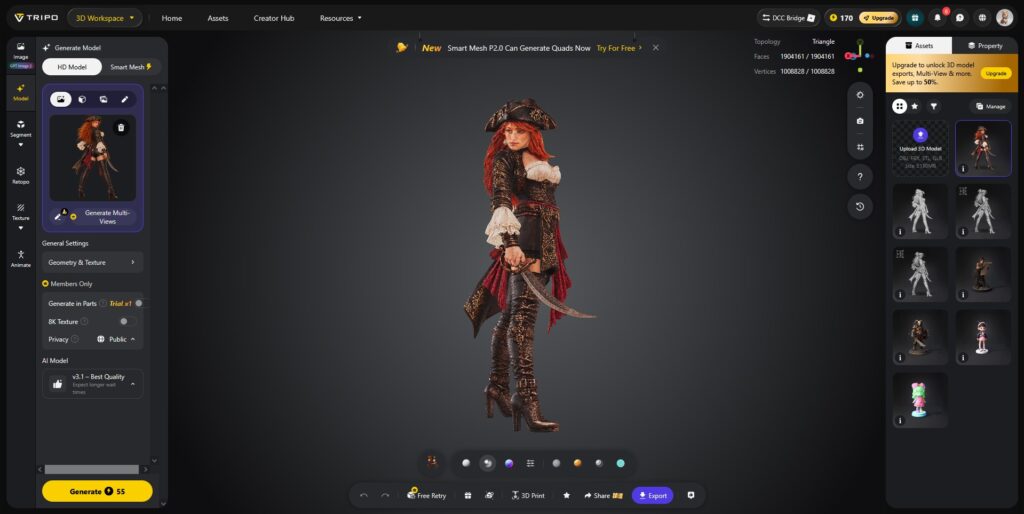
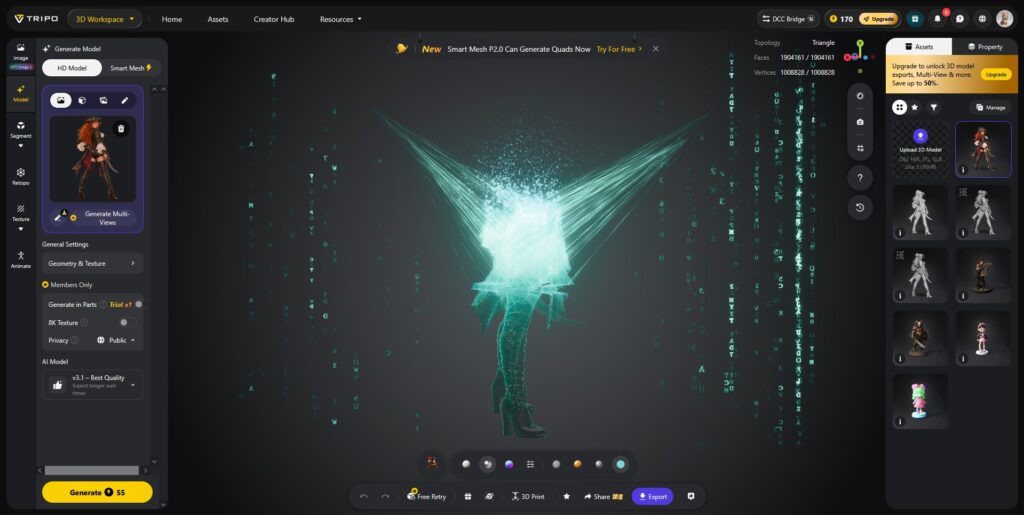
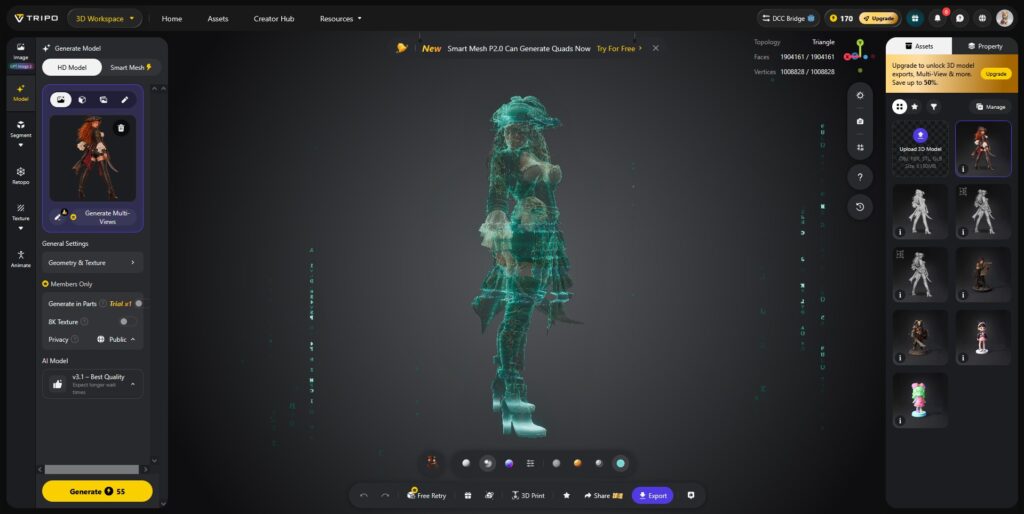
Then there was the hologram mode, which honestly just made me laugh. I do not know that I would call it a must-have production feature, but it was a neat little visual extra and proof that the platform is trying to present these models in multiple ways. Whether it is practical or just flashy window dressing probably depends on the user, but it definitely gave the project some sci-fi personality.
Now comes the part that matters most if you are thinking beyond simple experimentation. After looking into Tripo’s current terms and feature structure, the free-versus-paid distinction becomes much clearer. The free plan appears to be geared toward public, non-commercial use, and the platform itself draws a strong line between basic creation access and the broader rights or functionality that come with a paid tier. In plain English, that means the free plan is good for testing, learning, and proving the technology works, but it is not where you want to live if your goal is to build commercial assets, export files freely, or manufacture products from those files.
The paid tiers are where the tool begins to make more business sense. Based on the way Tripo frames its paid usage, those plans are the ones intended for broader commercial rights, exporting, and actual production workflows. That includes the kinds of uses people really care about: game assets, client work, printable models, and potentially even resale situations, assuming the user has the proper rights to the source material they started with. That last part matters. Even if a platform gives you broad usage rights, it does not magically erase copyright issues in whatever image or character you fed into the system. If the source belongs to somebody else, that can still be a problem. If the source is yours, the situation is much cleaner.
What makes this such a good Digging Deeper article is that the advertisement is not exactly lying, but it is also not telling the whole story. Yes, Tripo lets you create at least one 3D model for free. I proved that personally. Yes, the tool can produce a genuinely impressive result, especially in HD mode. I proved that too. But the real product is not merely “a free 3D model generator.” The real product is a platform that gives you a taste of the pipeline for free and then charges you when you want to actually take that model out into the world and do something meaningful with it.
That changes the verdict from suspicion to nuance. If someone only wants to experiment, play around, or see whether their character concept can become a model, the free access is legitimate and useful. If someone wants to actually export, print, sell, or commercially deploy those models, then the subscription is not some minor convenience layered on top. It is the actual gate between curiosity and practical use. In that sense, the ad passes the test, but only if you understand the asterisk attached to the word free.
For me, the most surprising part of this test was not the paywall. Honestly, that part was almost expected. The surprise was how good the HD model looked once I spent the smaller credit cost to generate it. The rough Smart Mesh version had me thinking I was dealing with another flashy tool that overpromised and underdelivered. The HD result completely changed that impression. That is why this one deserves to sit under Digging Deeper instead of Something Stinks. The truth is not that Tripo is fake. The truth is that it works better than expected, but the truly useful part of the experience begins where the free trial ends.
If I decide to take Pirate Ava any further, whether that means exporting her properly, testing actual print workflows, or seeing how far the platform can go with a commercial-use pipeline, there is clearly more ground left to cover.
to be continued…