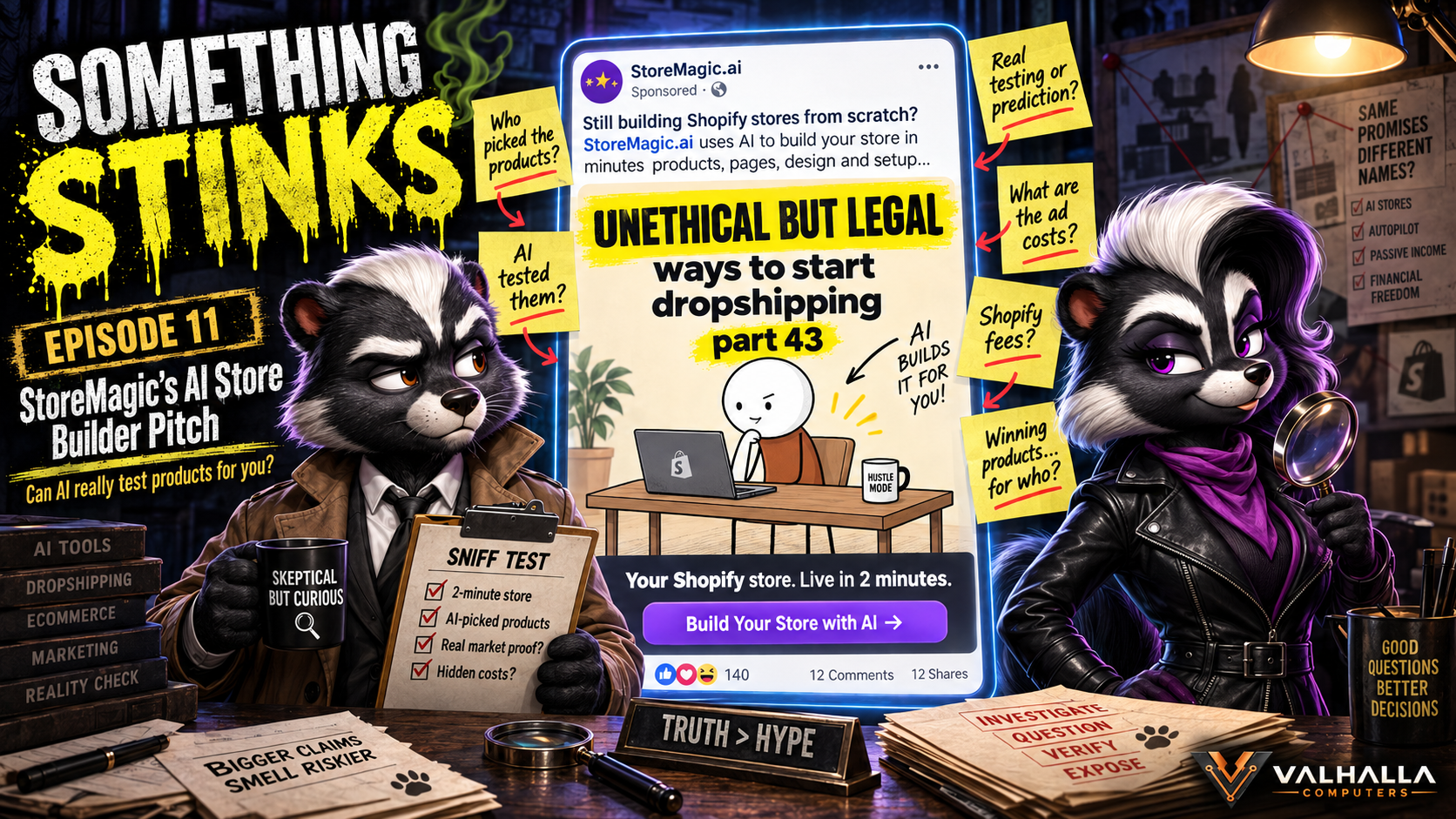
Something Stinks — Episode 01: “Build an Amazon Clone in Minutes?” Let’s Read the Small Print

There is a particular kind of advertisement becoming almost impossible to avoid online. AI will build your business in minutes. AI will replace an entire development team. AI will create your store before your morning coffee gets cold. And apparently, if some of these advertisements are to be believed, you can now build something comparable to Amazon in about the time it takes to microwave lunch.
Welcome to Something Stinks, a new series from Valhalla Computers where we take the miracle business opportunities, AI shortcuts, “completely free” tools, and too-good-to-be-true advertisements filling our feeds and look at what they actually offer.
We are not here to automatically call everything a scam. Sometimes the technology is legitimate. Sometimes the product is genuinely impressive. Sometimes the headline is even technically true.
But sometimes the giant headline and the small print are telling two very different stories.
And when that happens, something stinks.
The Claim: Build an Amazon Clone in Minutes
The claim that caught our attention this time is simple: modern AI can create an Amazon-style marketplace in minutes.
At first glance, that sounds ridiculous. Then you actually look at what tools such as Panda.new can generate and discover that there is some truth behind the excitement.
Describe the kind of application you want and AI can quickly produce something recognizable as an ecommerce marketplace. You can end up with product cards, navigation, categories, search features, customer-account screens and many of the visual elements people associate with large shopping websites.
That part is genuinely impressive.
AI website and application generation has advanced tremendously. Pretending otherwise simply because the advertisements sound exaggerated would be just as foolish as blindly believing every claim they make.
So can AI create something that looks like an online marketplace very quickly?
Absolutely.
Can it create Amazon in minutes?
That is where our skunk starts sniffing.
Time to Sniff Around the Small Print
Panda currently offers a free level, and it really is listed at $0. You can experiment with the platform, create projects and see the basic concept working.
The important details appear when you start looking at what that free version actually includes.
On the free level:
- The database functionality is a demo.
- Customer logins are a demo.
- The stored data resets.
- Payment processing is not included.
- Connecting your own custom domain is not included.
Those aren’t tiny technical details when the thing you supposedly built is intended to become an ecommerce business.
Imagine opening a physical store where the cash register is decorative, customer records disappear, and the sign over the building belongs to somebody else. You have certainly created something.
You just haven’t created something ready to operate as the business the flashy demonstration may have encouraged you to imagine.
That gives us one of the most important lessons in this entire series:
Free to build is not the same thing as free to run.
Want It to Actually Operate? Now We Start Paying
According to Panda’s current pricing, the Pro level begins at $24 per month.
That is where features most people would associate with running an actual customer-facing ecommerce application begin appearing: persistent databases and customer accounts, a custom domain, payment capability, removal of Panda branding and other upgraded functionality.
There is absolutely nothing inherently wrong with charging for those features.
Software costs money to build. Servers cost money. AI processing costs money. Databases, hosting, payment infrastructure and continued development all have real expenses attached to them.
The issue isn’t that Panda has a paid plan.
The issue is the enormous difference between “Look what I built for free in fifteen minutes” and “This is now ready to operate as an actual online business.”
The free version demonstrates the concept.
The paid version begins turning the concept into something operational.
Those are not the same thing.
And Even Then, You Haven’t Built Amazon
Suppose you pay the monthly fee. Now your application has a real database. Customers can have persistent accounts. You can use your own domain. You can accept payments.
Congratulations.
You have created a functioning ecommerce storefront.
You still haven’t created Amazon.
Amazon isn’t Amazon because its homepage has products, categories and a search box. Behind that familiar interface is an enormous collection of systems including:
- Inventory management
- Seller infrastructure
- Payment processing
- Fraud prevention
- Fulfillment and logistics
- Shipping systems
- Returns processing
- Customer support
- Security
- Recommendations and analytics
- Advertising infrastructure
- Vendor relationships
And then there is perhaps the most expensive part of the entire operation:

Trust.
Millions of consumers are comfortable entering payment information into Amazon because Amazon has spent decades building familiarity, infrastructure and customer confidence.
A newly generated ecommerce website does not inherit any of that simply because its product cards look familiar.
It still needs products people actually want. It needs customers. It needs marketing. It needs policies. It needs customer service. It needs someone to fulfill orders. It needs a reason for shoppers to choose it instead of the thousands of existing alternatives competing for their attention.
AI can generate the storefront surprisingly quickly.
It cannot generate the business behind it.
The Fifteen-Minute Business Myth
One of the strangest ideas emerging from the current AI boom is that reducing the time required to build a website somehow reduces the difficulty of building a successful business.
Those are two completely different problems.
Twenty years ago, launching a professional website could require substantial technical knowledge, custom programming and considerable expense. Today, WordPress, hosted platforms and AI tools have dramatically lowered that barrier.
That’s fantastic.
But removing the technical barrier does not remove every other barrier.
In fact, if almost anyone can generate an attractive store in fifteen minutes, simply possessing the website becomes less impressive.
The real differentiators become the questions the advertisement doesn’t usually spend much time discussing.
What are you selling? Why should anyone buy it? Who are your customers? How will they find you? Why should they trust you? What happens when something goes wrong? What proves that a legitimate business exists behind the attractive interface?
Those questions aren’t nearly as exciting as “BUILD YOUR EMPIRE IN MINUTES.”
They also can’t usually be answered in fifteen minutes.
To Panda’s Credit, They Actually Tell You
This is an important distinction because Something Stinks is not going to become “Valhalla Computers calls everything on Facebook a scam.”
That would be lazy.
Panda publicly lists its pricing and the limitations of its free plan. The database and customer-login functionality is identified as demo functionality. Payment processing and custom domains are not presented as free features.
So our problem isn’t that the technology is fake.
The technology is actually pretty fascinating.
What we are questioning is the psychological distance between these two ideas:
“I built something that looks like Amazon in minutes.”
and
“I built a viable ecommerce business in minutes.”
Those sentences sound remarkably similar when someone is selling the dream.
In reality, they are worlds apart.
The Something Stinks Verdict
VERDICT: IMPORTANT DETAILS OMITTED FROM THE DREAM.
Can AI generate an impressive ecommerce interface quickly?
Yes.
Can you experiment with the concept for free?
Yes.
Does the free level give you everything necessary to operate a normal customer-facing ecommerce business?
No.
Do several of the features necessary to turn the demonstration into a functioning business require a paid plan?
Yes.
And once you have those features, have you suddenly created Amazon’s infrastructure, reputation, audience and customer trust?
Not even close.
That doesn’t make the tool worthless.
It simply makes reality considerably less magical than the advertisement.
And that is exactly why Something Stinks exists.
One Last Sniff
AI is becoming an extraordinary tool for entrepreneurs and small businesses. We use AI ourselves. The technology is not the enemy.
Confusing what the computer generated with what is actually ready for customers is the problem.
A website can be generated in minutes.
A business cannot.
So the next time an advertisement promises that AI can create an empire before lunch, don’t immediately dismiss it.
But don’t immediately believe it either.
Scroll down.
Read the pricing page.
Look at the limitations.
Figure out what happens after the demonstration ends.
And always take a moment to sniff around the small print.
Because sometimes…
Something Stinks.
We clicked the ad so you don’t have to.