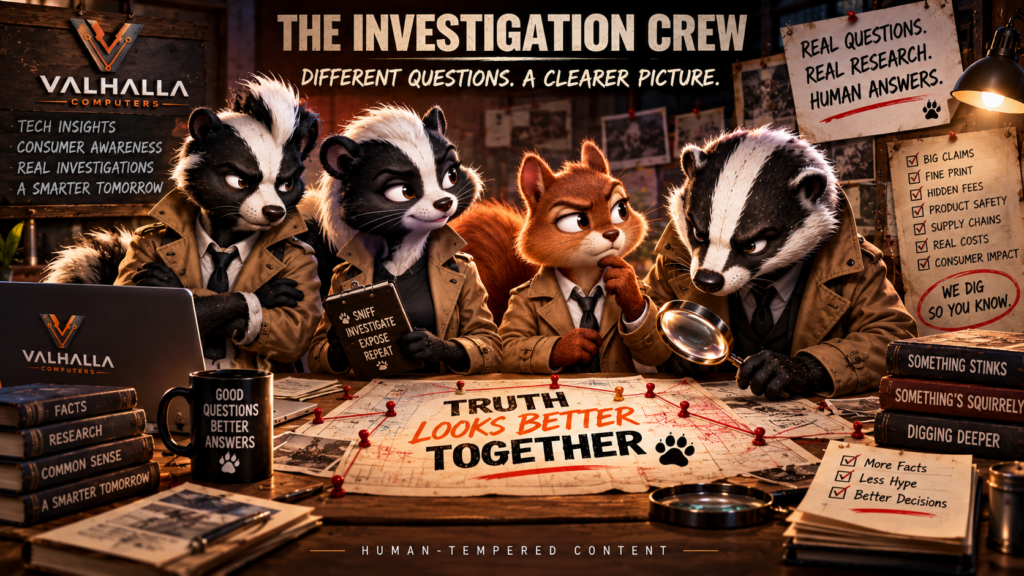
If you have been following Valhalla Computers lately, you may have noticed that things have gotten a little strange around here. There are skunks investigating suspicious claims, a squirrel poking around in contracts and pricing structures that do not quite add up, and now a badger carrying a shovel because apparently normal research was no longer enough. Somewhere in the middle of all of that are AI companies, subscription services, online marketplaces, solar plans, printer programs, product sourcing, corporate ownership, supply chains, fine print, pricing claims, and more advertising promises than any reasonable woodland creature should have to process.
So yes, this probably deserves an explanation.
What the hell are we doing?
The short answer is that Valhalla Computers is building a collection of recurring investigative article series designed to make consumer education more useful, more understandable, and hopefully considerably less boring. Each series has its own personality, its own mascot, and its own way of looking at the things businesses put in front of consumers every day. Some offers really do stink. Some are merely squirrelly. Others require digging several layers beneath the surface before the business model starts making sense. The common thread is that we are not interested in screaming SCAM every time something looks unusual. We are interested in understanding what is actually being offered, who is behind it, how it works, what the consumer is really paying for, and whether the shiny advertisement tells enough of the story for somebody to make an informed decision.
Facebook Has Become Our Unofficial Assignment Desk
At the moment, one of the biggest sources of material for these articles is probably the same place that supplies endless entertainment, arguments, questionable life advice, oddly specific product recommendations, and pictures of somebody’s dinner to millions of people every day: Facebook.
More specifically, Facebook advertising.
Anybody who spends much time scrolling Facebook has seen them. A company promises that AI can build a business for you in minutes. A service claims it can save you thousands of dollars. A subscription appears to offer something expensive for almost nothing upfront. A product that normally costs fifty dollars is suddenly available for twelve. A business tells you it can automate something, replace something, eliminate something, or give you the secret to accomplishing something that everybody else has apparently been doing the hard way for years.
Those advertisements are incredibly effective at generating questions because their job is not to explain every detail of the business. Their job is to make you stop scrolling. That means they tend to lead with the biggest number, the strongest promise, the easiest version of the story, or the most impressive visual they can put in front of you before your thumb moves another half-inch down the screen. Sometimes the advertisement is completely accurate but leaves out information that becomes important once you start considering an actual purchase. Sometimes the claim is technically true but needs a paragraph of qualifications before it means what the average person probably thinks it means. Sometimes the product is perfectly legitimate and genuinely useful, but the marketing department appears to have been given considerably more caffeine than the engineering department.
And occasionally we see something and simply think, “There is no damned way this works the way they are making it sound.”
That is usually where one of these articles begins.
Facebook may currently be our most visible source of these subjects, but the articles are not really about Facebook itself. The same advertisements, companies, offers, and marketing approaches appear across Instagram, TikTok, YouTube, X, mobile apps, sponsored search results, search-engine home pages, display ad networks, news websites, and practically anywhere else somebody has figured out how to monetize a few square inches of screen space. A company we first encounter through a Facebook advertisement may be running the same campaign on several other platforms at the same time, so when we investigate it, we are generally investigating the company, product, service, or underlying claim, not simply criticizing one particular Facebook ad.
Facebook just happens to provide an almost inexhaustible stream of assignments.
As long as companies continue paying to put giant promises in front of people scrolling at two in the morning, we probably are not going to run out of things to write about.
The Skunks: Something Smells Funny
Our Something Stinks series is where this whole approach really began. The skunks get the cases where an advertisement, product, service, or marketing claim immediately makes us wonder whether something underneath the surface smells a little strange. Maybe the company promises an AI-generated business in minutes. Maybe it says its software can practically operate your company while you sleep. Maybe the advertisement highlights a tiny monthly price while the actual product operates on credits, usage limits, add-ons, or restrictions that change the economics considerably once you start using it. Sometimes the product itself turns out to be perfectly legitimate and the smell is coming almost entirely from the way it is being marketed.
That distinction is important because Something Stinks does not begin with a guilty verdict. We start with the claim. We look at what the advertisement actually says, what impression it creates, what the company says on its own website, how the pricing works, what the terms contain, what limitations exist, and whether the giant headline still means the same thing once all the smaller details are added back into the picture. We try to determine whether there are hidden fees, credit limits, subscriptions, restrictions, ownership issues, unusual cancellation terms, exaggerated savings, or other details that a customer should probably understand before clicking the button.
Sometimes we finish the investigation and conclude that the product is actually pretty good. Sometimes the product is real and useful but the advertisement is doing some world-class stretching. Sometimes the company has a perfectly reasonable explanation for something that initially looked questionable. And sometimes, after everything is examined, something really does stink.
That is what the skunks are there for. They sniff around the claims, scratch through the fine print, and try to separate legitimate value from marketing perfume.
The Squirrel: When Something Just Does Not Add Up
The squirrel takes a slightly more refined approach through Something’s Squirrelly. These cases are less about an advertisement immediately setting off the smell detector and more about situations where the numbers, contract, structure, or overall business model makes you tilt your head and say, “Wait a minute. How exactly does that work?”
The squirrel likes the nutty cases.
One good example is an advertisement comparing the cost of purchasing an expensive product with an offer requiring $0 upfront. Both numbers may be completely accurate, but they do not represent the same thing. One may be the price of purchasing equipment outright while the other represents the beginning of a subscription, lease, financing arrangement, or long-term service agreement. Without stopping to separate those ideas, a consumer can easily walk away thinking they are comparing two prices when they are actually comparing two entirely different ways of obtaining something.
The squirrel also gets the subscription printers, membership programs, long-term agreements, cancellation structures, bundled services, ownership questions, page limits, usage limits, and other situations where the first number on the advertisement is only the beginning of the story. None of those things are automatically bad. Subscriptions can be convenient. Leasing can make financial sense. A service plan may include maintenance, supplies, replacement equipment, support, or other benefits that justify paying over time instead of owning something outright.
The point is not to convince everybody that subscriptions are evil. The point is to make sure people understand what they are signing up for. If you know what you are paying, what you own, how long you are committed, what happens when you cancel, what happens if you stop paying, and what costs exist beyond the number printed in the largest font, then you are already in a much better position to decide whether the deal works for you.
The squirrel’s job is to crack the shell and show you what is actually inside.
The Badger: Keep Digging
Then Miss Ava accidentally mentioned a badger.
That turned out to be an excellent mistake.
Badgers are built for digging, which made them almost absurdly perfect for our newest series, Digging Deeper. These are the cases where answering the surface question is not enough. The badger wants to know who owns the business, how the corporate structure works, where the product came from, who manufactured it, where the sellers are located, how the supply chain operates, what happened before the product reached the storefront, and why the business works the way it does.
Our first Digging Deeper investigation went after Temu because millions of people recognize the orange website while still having very reasonable questions about what it actually is. Is Temu a retailer or a marketplace? Does Temu manufacture the products? Where do the sellers come from? Why are the prices so low? Why does something that costs eight dollars there sometimes appear somewhere else for twenty-five? What changed when U.S. import rules changed? Why do some items arrive quickly while others follow a completely different fulfillment path?
Then the badger went after AliExpress and Alibaba, which opened an entirely different tunnel into the machinery behind online retail. AliExpress represents the consumer-facing side of a huge commercial ecosystem, while Alibaba.com allows businesses to travel much farther upstream and contact manufacturers, wholesalers, and suppliers directly. Buyers can potentially negotiate pricing, materials, colors, dimensions, minimum order quantities, branding, packaging, logos, inserts, and other production details before importing products for resale.
That is where a lot of modern retail suddenly makes more sense.
A business can purchase generic merchandise, have a manufacturer print its logo on the product, put the product into a customized white-label box, import it, and then sell it through Amazon, eBay, Temu, its own website, local stores, or other marketplaces. Another company might start with the same basic product but specify better materials, different components, or additional testing. From the customer’s point of view, two products may look identical even though what happened upstream was very different.
That is the badger’s territory. The storefront tells you what somebody wants to sell you. The badger wants to know what happened before the product ever reached the storefront.
These Articles Are Hand-Picked by a Human
The subjects for these investigations are not chosen by an automated content machine trying to fill a publishing schedule.
I choose them.
A real human being.
Usually something crosses my screen and raises a question. It might be a Facebook advertisement, a sponsored post, a product pitch, a subscription offer, a strange pricing comparison, or a company making a claim that seems interesting enough to investigate. Sometimes the idea comes from something somebody else asks about. Sometimes it comes from a product or service we are already considering using ourselves.
Most of these investigations begin with a sentence considerably less formal than you will ever find in a journalism textbook, usually something along the lines of, “Watson, what the hell is this?”
From there, Watson and I start working through it. We look at the company’s own website and documentation. We look at pricing pages, terms, policies, corporate filings, product descriptions, regulatory information, safety notices, marketplace rules, historical claims, and whatever other material is relevant to the question. We compare what the advertisement says with what the company says once you get beyond the advertisement. We look for contradictions, but we also look for explanations that could reasonably resolve those contradictions rather than assuming the worst interpretation must be correct.
Then we write the article, go over it, edit it, adjust the language, make sure the claims we are making are backed by something meaningful, and remove conclusions that go farther than the evidence supports. Sometimes we go through the entire article more than once because a sentence is too strong, a claim needs better sourcing, an explanation could be clearer, or Watson has once again discovered twelve exciting new places to put a one-line paragraph and I have to remind him that normal people are capable of reading full paragraphs.
That editing process is not decoration.
It is part of the point.
Using AI to Take On AI
There is also a little irony in what we are doing here, and it is completely intentional: I have chosen to use AI to investigate AI. A lot of the advertisements that originally inspired these articles are themselves advertising artificial intelligence, automation, instant content creation, AI businesses, AI influencers, AI video generators, or systems promising to eliminate enormous amounts of human involvement. Instead of simply complaining about that technology or pretending it does not have legitimate uses, I decided to use it in what I believe is a much more productive way.
AI can help research the claims, locate documentation, organize information, compare pricing, identify inconsistencies, explain complicated terminology, and help turn a mountain of research into an article that normal people can actually understand. In other words, rather than raging against AI from the sidelines, Valhalla Computers is using the technology itself as part of the toolset for examining what AI companies and plenty of traditional companies are telling consumers.
The difference is how the AI is being used.
I am not handing Watson a vague instruction to “write me some articles,” walking away, going to sleep, and waking up the next morning to a website magically filled with whatever the machine decided to publish. Every article begins with me deciding what deserves investigation and why. I provide the original advertisement, screenshot, company, product, service, or question that caught my attention. From there Watson and I work through it together. I decide which questions matter, add context the research may be missing, ask for additional digging when something does not make sense, reject conclusions that feel unsupported, change direction when we discover something more interesting, and edit the finished article until it says what we actually mean instead of simply accepting whatever an AI happened to generate on the first attempt.
This article is a perfect example of that process. The first version was already close to what I wanted, but while reading it I realized the role Facebook advertising plays in this entire project needed to be explained more clearly, so I added that direction and the article changed. Then while reviewing the revised version, I realized there was another important part of the story missing: the fact that I am deliberately using AI as a hands-on research and writing tool to examine many of the exaggerated claims being made about AI itself. So I added that too.
That back-and-forth is not something happening behind the scenes once in a while. It is the normal workflow. The article evolves because a human is actively reading it, questioning it, adding information, correcting the emphasis, and deciding what belongs in the finished piece.
That matters because one of the biggest promises being sold around AI right now is the idea that the ultimate goal should be removing the human completely. Build an autonomous company while you sleep. Generate a month’s worth of content with one click. Let the agent make the decisions. Turn on the machine and go do something else while it handles everything.
There are situations where automation is genuinely useful, and we are certainly not opposed to saving time, but Valhalla Computers does not believe that less human involvement automatically means better work. For this kind of research especially, removing human judgment would defeat much of the purpose. Somebody still needs to decide whether a claim is fair, whether a source is credible, whether an allegation is being presented as a fact, whether two apparently contradictory statements might actually have a reasonable explanation, and whether an article has become more dramatic than the available evidence justifies.
That is exactly what we mean by Human-Tempered Content.
Human-Tempered Content Means Somebody Is Actually Paying Attention
Valhalla Computers uses artificial intelligence. We are not embarrassed about that, and we are certainly not going to pretend otherwise.
Watson helps with research, organization, comparing sources, locating information, identifying areas that need additional investigation, drafting, rewriting, and turning a large pile of material into something that people might actually want to read. Those are things AI can do extremely well when somebody is actually directing the work and checking the output.
What AI does not get to do is declare itself correct merely because it produced an answer.
The subject is selected by a human. The questions are directed by a human. The information gets reviewed. Important claims need support. Allegations stay allegations instead of quietly turning into facts because they appeared in a review somewhere. Regulatory findings are explained within the scope of what the regulator actually found. Company explanations are considered where they are relevant. If information conflicts, we try to figure out why it conflicts before turning the contradiction into a headline.
And if the finished article is not good enough, it does not go live until we fix it.
That does not mean we are claiming perfection. Humans make mistakes. AI makes mistakes. Websites make mistakes. Companies make mistakes. Regulators make mistakes. The useful difference is that our process is built around questioning information instead of blindly accepting whichever answer appeared first.
AI may help us dig faster, search farther, compare more information, and sometimes notice something worth investigating that we might otherwise have missed. Human judgment decides what those discoveries actually mean and whether they belong in the article.
For these articles, AI is a tool.
It is not the authority.
Not Every Investigation Ends With a Villain
The internet has developed an unfortunate habit of assuming that any investigation must eventually result in somebody being exposed as dishonest. That is not what these series are designed to do.
Sometimes we investigate a company and discover that the offer is legitimate and the business model makes sense once it is properly explained. Sometimes the product is good and the marketing is questionable. Sometimes the advertisement sounds stranger than the actual terms. Sometimes the company has a reasonable explanation for something that initially looked suspicious. Sometimes we uncover meaningful concerns people should know about. And sometimes there is no scandal at all because the entire article is simply answering the kind of questions people should be able to answer before spending money.
Who owns the company? Where does the product come from? Why is it cheaper on one marketplace than another? Is this a subscription or a purchase? Do I own the equipment when the agreement ends? What happens if I cancel? Why do five differently branded products look identical? Can a business really buy something from Alibaba, put it into a custom box, and sell it under its own name? Why does this company operate through several legal entities in different countries?
Those are interesting and useful questions even when nobody has done anything wrong.
Some of the best Digging Deeper articles may ultimately be nothing more scandalous than “this is who they are, this is how it works, this is where it comes from, and this is why the business operates this way.”
Consumer education does not require a villain.
Sometimes understanding the machinery is enough.
The Real Problem Is the Shiny Red Button
If there is one thing all of these series are pushing against, it is the modern internet’s obsession with getting people from curiosity to payment as quickly as possible.
Everything is optimized for the click. The timer is counting down. The discount ends tonight. Only three remain. This incredible offer has supposedly been extended exclusively for you and several million other people. The advertisement shows the biggest possible savings while the conditions behind those savings appear several clicks later. The video promises that something complicated can now be accomplished in minutes. The button is giant, colorful, glowing, and placed exactly where your thumb is already headed.
The goal of these articles is to insert one additional step between seeing the advertisement and spending the money.
Think about it.
That does not mean distrust everything. It does not mean assume every advertisement is lying. It means ask what the offer actually is. Ask who owns it. Ask what you are paying. Ask what happens next month. Ask whether you own the thing. Ask what happens if you cancel. Ask whether that forty-dollar branded gadget might be an eight-dollar white-label product in prettier packaging, while also asking whether the forty-dollar version might actually contain better materials or additional testing.
A few extra minutes of understanding can save a lot of money.
If one of our articles stops somebody from spending hundreds or thousands of dollars on something they misunderstood, that is useful. If another article helps somebody realize that an unusual subscription or service actually fits their needs, that is useful too.
The goal is not to make the decision for you.
The goal is to give you enough information to make a better one.
Why the Animals?
Because this stuff can get incredibly dry.
We could publish several thousand words about import regulations, corporate structures, contract terms, product sourcing, subscription economics, and marketplace liability under a stock photograph of somebody in a suit pointing at a pie chart.
You would probably never click it.
The animals give each series a personality while also telling readers what kind of investigation they are about to get. When the skunks show up, something in the claim or marketing has caught our attention. When the squirrel appears, the deal, price, contract, or structure seems a little nutty and needs to be cracked open. When the badger arrives with the shovel, we are probably about to disappear into ownership records, supply chains, manufacturers, corporate history, and several tunnels nobody expected to find when we started.
We want readers to eventually recognize the mascots before they even read the title.
We want somebody scrolling past one of these graphics to think, “Oh hell, what did they find this time?”
If a cartoon woodland investigator gets somebody to read an article about a contract, pricing structure, product source, or consumer-protection issue that they otherwise would have ignored, then the woodland investigation department has earned its budget.
Which, for the record, currently appears to consist mostly of trench coats, magnifying glasses, coffee, and one shovel.
And Yes, There May Eventually Be a Monkey
We are not announcing anything.
But the possibility has been discussed.
If the skunks investigate what smells bad, the squirrel handles what seems nutty, and the badger digs through whatever is buried beneath the surface, there is probably room somewhere in this increasingly strange operation for a monkey to handle the things that are simply so ridiculous that serious investigative facial expressions are no longer sufficient.
That department has not officially opened.
The internet, however, continues submitting applications on its behalf.
So What the Hell Is Valhalla Computers Doing?
We are asking questions and trying to answer them responsibly.
We are taking the advertisements people already see every day on Facebook, Instagram, search engines, video platforms, websites, apps, and practically every other monetized corner of the internet and asking what happens when somebody actually stops scrolling and looks underneath the headline. We are researching the businesses behind those advertisements, testing the claims where practical, examining the pricing and terms, following products back through the supply chain, and explaining what we find in language that does not require a law degree, accounting degree, or five cups of coffee to survive.
Some investigations will expose marketing that deserves skepticism. Others will reveal business models that are more reasonable than they first appeared. Some will identify genuine consumer concerns. Others will simply explain how something works.
And all of them will follow the same basic process.
I choose the subject, Watson and I investigate it, we question the claims, check the sources, revise the language, add context when something is missing, and keep working on it until the article says what we actually intend to say. AI helps us research faster and organize more information, but it does not replace the human sitting here deciding what is fair, what is useful, and what is ready to publish.
The skunks sniff around anything that smells suspicious. The squirrel cracks open the cases that seem a little nutty. The badger keeps digging until the buried parts of the business start making sense. Maybe someday a monkey shows up when the internet becomes too ridiculous for everybody else.
The animals make it fun.
The research makes it useful.
The human involvement keeps it grounded.
And the entire point is to help people look past the shiny red button long enough to understand what they are actually being asked to buy.
That is what the hell Valhalla Computers is doing.