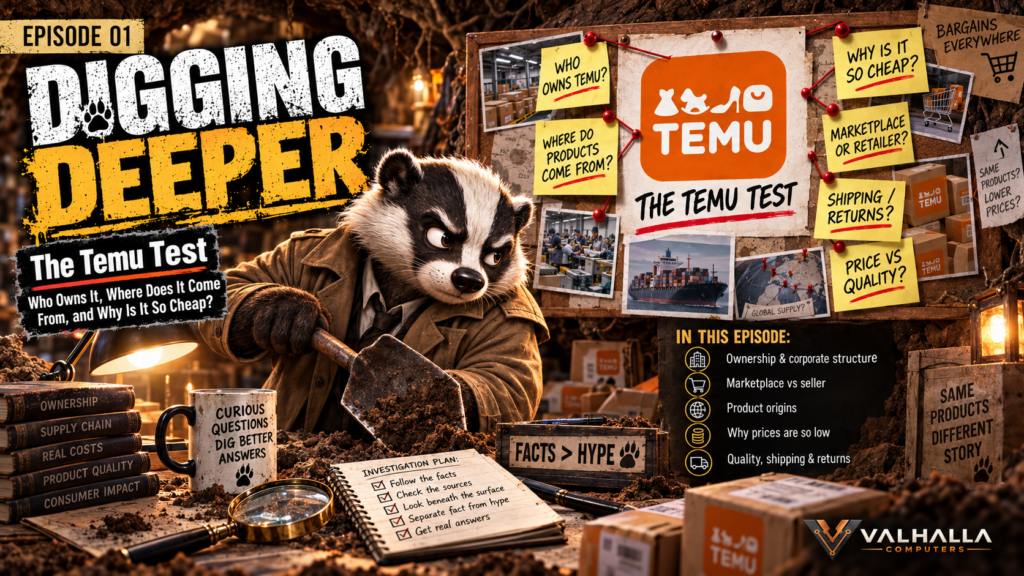
If you have spent more than ten minutes on Facebook in the last few years, there is a fair chance Temu has tried to sell you something. Maybe it was a cordless tool for a price that seemed physically impossible. Maybe it was kitchen gadgets, fishing gear, clothes, electronics, automotive accessories, craft supplies, or some completely unnecessary little object you suddenly realized you desperately needed because it cost $2.47. Temu arrived in the United States in 2022 with aggressive advertising, enormous product selection, prices that frequently undercut traditional retailers, and the wonderfully restrained slogan “Shop Like a Billionaire.” Since then, it has become one of the most recognizable online marketplaces in the world, while also generating an equally impressive collection of questions about what the company actually is, who owns it, where its products come from, how the prices stay so low, and whether buying from the platform is really as simple as the ads make it look.
Those questions are exactly why Temu makes a good first case for Digging Deeper. Unlike Something Stinks, where the skunks are usually sniffing out exaggerated claims, or Something’s Squirrelly, where the squirrel gets suspicious when prices, contracts, or fine print start looking crooked, the badger’s job is to keep digging until the ownership, history, supply chain, and business structure become clearer. Temu is almost perfect for that because the surface answer is easy — it is a huge online marketplace — while the real story underneath involves multiple corporate entities, thousands of third-party merchants, changing import rules, international logistics, product safety concerns, and a business model that has evolved considerably since its American launch.
Temu Is Real, but Its Corporate Family Tree Is More Complicated Than the Logo Suggests
The easiest question to answer is whether Temu itself is a legitimate company. Yes. Temu is a real international e-commerce platform operating as part of PDD Holdings Inc., a publicly traded multinational commerce company that also operates Pinduoduo. PDD Holdings’ latest annual report filed with the U.S. Securities and Exchange Commission explicitly identifies Temu and Pinduoduo as its major platforms and states that Temu launched in September 2022 before expanding rapidly into additional markets.
Where the answer becomes less tidy is when someone asks whether Temu is an American company or a Chinese company. Depending on which part of the business you mean, several different locations become relevant at the same time. PDD Holdings Inc., the parent company, is incorporated in the Cayman Islands. Its SEC filing lists a business address in Dublin, Ireland. Temu says it was founded in Boston, Massachusetts, while U.S. customers currently enter into Temu’s Terms of Use with Whaleco Inc., a Delaware corporation with a Boston address. At the same time, PDD Holdings tells investors that both Temu and Pinduoduo continue to primarily serve merchants located in China and that substantially all of its 2025 revenue came from third-party merchants in China.
That means the simple question, “Is Temu American or Chinese?” does not have a useful one-word answer. The customer-facing U.S. entity is American-incorporated, the parent holding company is incorporated elsewhere, executive operations are listed in Ireland, and the merchant ecosystem remains heavily tied to China. It is less satisfying than putting one little flag beside the logo, but it is also considerably more accurate.
Temu Does Not Manufacture Most of the Things You Buy
One of the most useful things to understand about Temu is that it operates primarily as a marketplace connecting buyers with third-party merchants, manufacturers, and brands. Temu is not sitting somewhere with one enormous factory making fishing reels on Monday, dresses on Tuesday, socket sets on Wednesday, and inflatable Halloween dinosaurs on Thursday. PDD Holdings describes Temu as a platform where merchants provide listings and customers purchase merchandise supplied by third-party sellers, while Temu’s own U.S. terms distinguish between local merchandise partners, cross-border sellers, and products sourced through other merchant relationships.
That marketplace structure explains why experiences can vary so dramatically from one Temu purchase to another. Buying an excellent $8 tool from one seller does not mean the $8 tool beside it is equally good. The products may come from different manufacturers, different factories, different materials, different quality-control standards, and completely different sellers even though both appear under the same orange Temu banner.
That distinction matters whenever someone says “Temu products are good” or “Temu products are garbage.” Temu is not one product line. It is an enormous marketplace containing products from an enormous number of sellers, which means broad statements about overall quality are usually too simplistic to be useful.
So Where Does All the Stuff Actually Come From?
Temu says shipping origin varies depending on the product, and that has become increasingly true as the company expands its local-seller and domestic-warehouse programs. Temu launched a U.S. local-seller program in 2024 specifically to broaden domestically fulfilled inventory and shorten delivery times, which means some products can now be stocked and shipped from inside the United States instead of arriving directly from overseas.
Even with that change, China remains a major part of Temu’s supply chain. PDD Holdings’ own annual report says both Temu and Pinduoduo primarily serve merchants in China and that substantially all of the company’s revenue during 2025 came from third-party merchants located there. That is a much stronger piece of evidence than trying to guess product origin from packaging, shipping labels, or delivery time.
This also helps explain why shoppers sometimes find products on Temu that look nearly identical to items sold on Amazon, eBay, Walmart Marketplace, AliExpress, or smaller specialty websites. Third-party merchants across different platforms can buy from the same manufacturing ecosystem, sometimes even from the same factories or wholesalers. That does not prove every apparently identical product is literally identical, because internal components, materials, tolerances, quality-control procedures, and certification can differ while the outside appearance stays the same. Still, the overlap is not mysterious. Sometimes several retailers are simply buying from the same upstream manufacturing network.
Why Is Temu So Cheap?
There is no single trick behind Temu’s pricing. Several factors work together. One of the biggest is that the marketplace can connect customers much closer to manufacturers and wholesale merchants than the traditional retail chain where a manufacturer sells to an importer, the importer sells to a distributor, the distributor sells to a retailer, and the retailer finally sells to the consumer. Cutting out some of those layers can reduce markup.
Another major factor is brutal merchant competition. When dozens of sellers offer functionally similar USB cables, storage bins, LED lights, kitchen gadgets, clothing accessories, or tools, each one has an incentive to shave the price lower to win the sale. That can be wonderful for shoppers, but intense price competition can also encourage cost-cutting in materials, packaging, testing, support, and durability.
Temu historically benefited heavily from the United States’ de minimis import rule as well. For years, low-value packages under $800 could generally enter the United States without normal customs duties, making direct-to-consumer shipping from overseas sellers especially attractive. A bipartisan U.S. House Select Committee report in 2023 specifically highlighted Temu’s reliance on that system.
That part of the Temu story has changed dramatically, and this is where older online explanations can become misleading. The United States eliminated duty-free de minimis treatment for Chinese low-value imports beginning in May 2025 and later suspended the general de minimis exemption for low-value imports from all countries effective August 29, 2025. Low-value imports are now generally subject to applicable customs duties, taxes, and procedures. So if you come across an older article explaining that Temu stays cheap because every $12 package slides into America duty-free under the $800 rule, that article is describing the old system rather than the one Temu operates under today.
Temu Has Been Adjusting to the New Import Rules
The end of the old de minimis environment did not make Temu disappear. Instead, the marketplace has been adapting its logistics and seller structure, including expanding local sellers and domestic fulfillment. Temu’s current systems explicitly distinguish between cross-border sellers and local sellers in the United States, and its U.S. terms differentiate local-warehouse merchandise from other products.
That matters because the mental picture many Americans formed of Temu during its early years — cheap product leaves a Chinese warehouse and arrives two weeks later in a little plastic mailer — is no longer the whole story. Some products still follow that path, while others are stocked in domestic warehouses or fulfilled by locally registered sellers. Delivery time, seller identity, customs treatment, and product origin can therefore vary significantly from one listing to another.
If a listing says Local Warehouse, that is not merely decorative wording. It can tell you something meaningful about where the product is being fulfilled and how the transaction fits into Temu’s evolving marketplace model.
Is Temu Just Selling Cheap Junk?
This is where internet arguments usually become less useful than people think. There are unquestionably inexpensive and poorly made products on Temu. There are also plenty of ordinary products that buyers receive and are perfectly satisfied with. The marketplace sells too many unrelated products from too many unrelated merchants for one blanket statement about “Temu quality” to mean very much.
The consequences of low quality also vary enormously by product. If a $3 silicone spatula disappoints you, you throw it away and complain about wasting three dollars. If a bicycle helmet, charger, battery, child-safety device, or electrical protection component fails, the consequences can be much more serious.
The U.S. Consumer Product Safety Commission has issued multiple recalls involving products sold by merchants through Temu. Certain bicycle helmets sold on the platform, for example, have been recalled for failing mandatory federal safety requirements, while other products sold through Temu have faced recalls involving button-battery hazards and other safety concerns. Those recalls do not mean everything sold on Temu is unsafe, and major traditional retailers experience recalls as well. What they demonstrate is that price should not be the only factor when the consequences of product failure could involve injury.
For decorative items, household accessories, simple hand tools, novelty goods, and other low-consequence products, taking a chance on something inexpensive may be perfectly reasonable. For helmets, children’s products, high-current electrical devices, lithium batteries, safety equipment, or anything where testing and certification matter, we would pay much closer attention to the seller, manufacturer, certification, and independent safety information before buying.
Cheap is great until the thing you bought was supposed to keep somebody safe.
European Regulators Have Raised Marketplace Safety Concerns Too
Questions about Temu product safety are not limited to isolated American recalls. In July 2025, the European Commission preliminarily concluded that Temu had failed to adequately assess the risk of illegal and non-compliant products appearing on its marketplace. The Commission said its own mystery-shopping exercise found that EU consumers were likely to encounter non-compliant merchandise, particularly in areas such as children’s toys and small electronics.
That investigation became more serious in May 2026, when the European Commission fined Temu €200 million under the Digital Services Act, concluding that the company’s marketplace risk assessment had significantly underestimated how often consumers could encounter illegal products.
Those findings should be understood accurately. European regulators were addressing Temu’s responsibility as a marketplace to identify and manage systemic product risks. They were not declaring that every product sold on Temu was illegal or unsafe. Once again, the distinction between the marketplace and the individual merchant matters.
Then There Is the Forced-Labor Question
One of the most serious issues attached to Temu’s history involves supply-chain oversight. In 2023, the bipartisan U.S. House Select Committee on the Chinese Communist Party investigated Temu and Shein in connection with the Uyghur Forced Labor Prevention Act. The committee’s interim report concluded that Temu did not have a meaningful auditing or compliance system at that time to affirmatively verify that products entering the United States were free of forced labor, and the committee described what it considered an extremely high risk that Temu’s supply chain could be contaminated by forced labor.
That finding needs to be described carefully. It was a congressional interim finding from 2023, not a court ruling proving that any specific product purchased from Temu was made with forced labor. The committee’s concern focused heavily on Temu relying on supplier promises rather than conducting the level of auditing the committee believed necessary.
Temu today points merchants toward a Code of Conduct and Human Rights Policy and requires business partners to comply with anti-slavery and human-trafficking laws. What we did not find was enough independent, current evidence to responsibly claim that every concern raised in 2023 has either been fully resolved or remains exactly the same today. The most accurate conclusion is that there was a serious documented congressional concern about Temu’s supply-chain verification, and consumers who care about ethical sourcing should know that history exists.
What Happens When the Product Is Garbage?
This is one area where Temu deserves some credit. The company currently advertises a Purchase Protection program covering qualifying purchases when items do not arrive, arrive damaged, or are materially different from the description. Temu also says most products are eligible for returns within roughly 90 days, although exceptions exist and some categories can have different return periods.
That does not guarantee every customer-service interaction will be painless, but it does mean there is a defined refund and return system. For inexpensive products, that can significantly change the risk calculation. Someone may be willing to gamble seven dollars on an unknown gadget if they know there is at least a reasonable process for getting money back when it arrives broken.
It is also worth remembering that there are different kinds of risk. There is financial risk, product-quality risk, safety risk, privacy risk, and supply-chain risk. A good refund policy helps with the first two. It does not automatically solve the rest.
So Is Temu a Scam?
No. Calling Temu itself a scam would be inaccurate based on what we found. Temu is a genuine global marketplace operating within the PDD Holdings corporate family, with U.S. operations governed through Whaleco Inc. It has an enormous seller ecosystem, formal return policies, global logistics operations, public regulatory filings, and a parent company reporting tens of billions of dollars in annual revenue.
That does not mean every listing deserves automatic trust. A more useful way to think about Temu is as a gigantic international flea market connected directly to a global manufacturing network. The marketplace itself is real, the payment system is real, and the package will generally be real, but the person effectively operating booth number 487 may not have the same quality standards as the person in booth number 486.
Once you look at Temu that way, a lot of the confusion disappears. Temu being legitimate does not automatically make every merchant or product equally reliable.
Is the $5 Temu Version the Same Thing Amazon Is Selling for $20?
Sometimes it may be. Sometimes it absolutely may not be. Modern online marketplaces contain enormous quantities of generic merchandise manufactured by factories that sell through multiple wholesalers, resellers, importers, private-label companies, and retail platforms. It is entirely plausible to encounter products on Temu and Amazon that originated from the same manufacturing source.
It is equally plausible for two products to use the same photograph, same external shape, or nearly identical packaging while being materially different inside. A product image does not tell you whether wiring uses the same gauge of copper, whether plastic uses the same formulation, whether a tool uses the same steel hardness, whether a battery contains the same cells, or whether a helmet passed the same safety testing.
That is why we would not automatically pay four times as much simply because an item appears on Amazon, but we would not automatically assume the $5 Temu listing and the $20 Amazon listing are interchangeable simply because the pictures match. The badger requires more evidence than matching JPEGs.
What Would We Personally Buy From Temu?
For low-risk merchandise, we would have very little hesitation experimenting. Craft supplies, decorative items, storage products, simple household accessories, basic hand tools, fishing tackle where failure is merely annoying, phone stands, stickers, inexpensive clothing, and novelty items can all be reasonable places to take advantage of Temu’s pricing.
As the consequences of failure rise, our standards would rise with them. We would want considerably more verification before trusting unknown marketplace sellers with protective helmets, child-safety products, high-current electrical equipment, lithium batteries, critical automotive components, climbing equipment, medical devices, fire-protection equipment, or anything else where failure could cause serious property damage or personal injury.
That rule is not unique to Temu. It is simply sensible marketplace shopping. The cheaper a product becomes relative to the consequences of it failing, the more curious the badger becomes.
The Biggest Temu Myth May Be That There Is One Temu
After digging through all of this, that may be the biggest takeaway. People often talk about Temu as though it were one giant retailer where a central purchasing department selects products and Temu manufactures or stocks everything itself. That is not really what the platform is.
Temu is the marketplace sitting between an enormous collection of merchants and an enormous collection of buyers. Some sellers are cross-border. Some are increasingly local. Some products ship internationally. Others sit in domestic warehouses. Some merchandise comes from manufacturers that may also supply other online marketplaces. Some sellers are undoubtedly better than others.
Once you understand that structure, many of the apparent contradictions make more sense. One buyer can have an excellent experience while another receives garbage because they bought from different sellers. One package can arrive in three days and another much later because the fulfillment path is different. A product can look identical on two websites while carrying different prices because the sellers, margins, specifications, or supply chains may not be identical.
So What Did the Badger Find?
Temu becomes considerably less mysterious once you get underneath the orange website. It is not an anonymous app randomly mailing products out of nowhere. It belongs to the PDD Holdings corporate ecosystem, while its U.S. customer-facing operation runs through Whaleco Inc. Its merchant base remains heavily connected to China even as Temu expands domestic sellers and local fulfillment, and most products are supplied by third-party merchants rather than manufactured directly by Temu.
Its low prices come from a combination of direct marketplace economics, huge merchant competition, manufacturing relationships, streamlined distribution, and historically favorable low-value import treatment. The de minimis advantage that once helped make direct-to-consumer Chinese shipping so powerful has now changed substantially in the United States, forcing Temu’s model to evolve.
There are legitimate reasons to shop there, and there are legitimate reasons to exercise caution. There are documented recalls and meaningful regulatory concerns about marketplace safety, but there is also a real return-and-refund system and a huge number of merchants conducting ordinary commerce. There are historical forced-labor concerns that should not be ignored, but those concerns also should not be exaggerated into an unsupported claim that every Temu purchase is produced through forced labor.
What we found was not some secret underground warehouse full of cartoon villains rubbing their hands together over your $3 flashlight. What we found was something more ordinary and more useful: Temu is an enormous global marketplace, and enormous marketplaces require consumers to pay attention to who is actually selling the thing they are buying. The orange logo tells you where you clicked. It does not necessarily tell you who manufactured what arrives at your door, how it was made, or whether two apparently identical listings actually contain the same product.
That is exactly why the badger keeps digging.
Digging Deeper.
Sources Worth Reading
PDD Holdings’ 2025 Annual Report filed with the U.S. Securities and Exchange Commission provides the clearest current description of Temu’s parent company, merchant model, corporate structure, launch history, and continuing dependence on merchants in China.
Temu’s current U.S. Terms of Use identify Whaleco Inc. as the U.S. contracting entity and explain the roles of third-party sellers, local-warehouse merchandise, international sourcing, customs brokers, and importers of record.
U.S. Customs and Border Protection provides current information confirming that duty-free de minimis treatment for low-value imports changed substantially in 2025.
The U.S. House Select Committee’s 2023 bipartisan interim report documents its findings concerning Temu, de minimis shipments, and forced-labor compliance at that time.
The U.S. Consumer Product Safety Commission maintains public recalls involving individual sellers and products offered through Temu, while the European Commission’s enforcement actions provide additional information concerning Temu’s marketplace product-risk obligations.