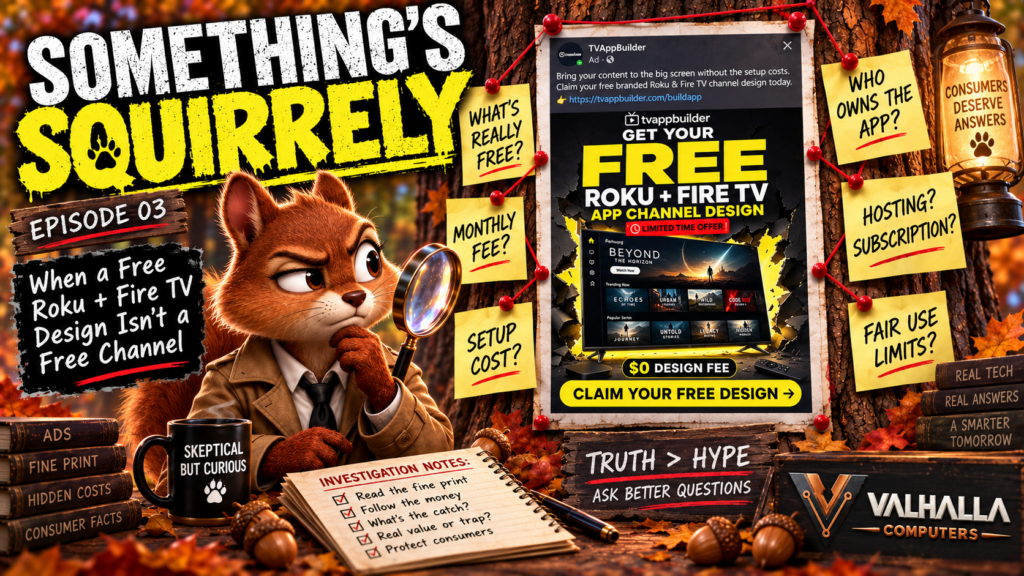
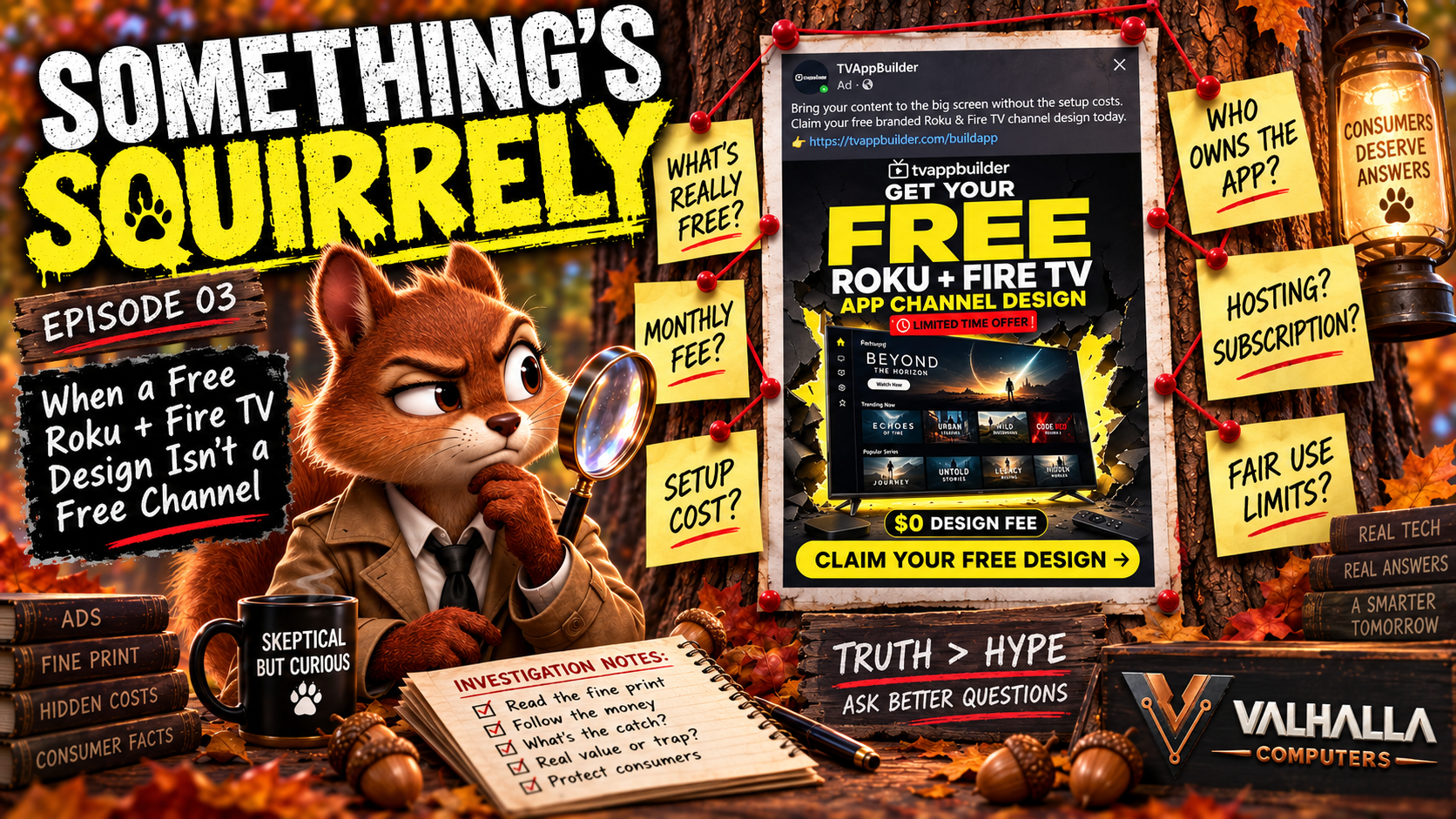
There are certain advertisements specifically engineered to make a small-business owner stop scrolling. The one that crossed our desk from TVAppBuilder certainly qualifies. In enormous yellow letters it promises “GET YOUR FREE ROKU + FIRE TV APP CHANNEL DESIGN.” Underneath that comes “$0 DESIGN FEE” and an invitation to “CLAIM YOUR FREE DESIGN.” The Facebook copy reinforces the point by telling businesses they can bring their content to the big screen without the setup costs and claim a free branded Roku and Fire TV channel design.
That is an interesting offer. It is also a carefully worded one.
The advertisement does not actually say that your completed Roku and Fire TV channels will be free forever. It says the design is free. That distinction is enough to make our squirrel put down his acorn, find the magnifying glass, and start looking for the rest of the numbers.
And, as it turns out, there are quite a few numbers.
First Things First: TVAppBuilder Appears to Be a Real Service
Nothing we found suggests that TVAppBuilder is simply a fake website collecting credit-card numbers and disappearing into the woods. Its Terms of Service identify the operator as AdSource, LLC, a Missouri limited liability company doing business as TV App Builder, and describe an actual streaming-platform service that includes video hosting, encoding, content delivery, TV application publishing and management, analytics, and integration with platforms including Roku and Amazon. The company also publishes pricing, refund terms, cancellation provisions, usage rules, and support contact information.
That is important because this series is not called Something’s Squirrelly because every company we examine must ultimately be a scam. Sometimes the squirrel’s job is simply to crack open an offer and determine exactly what the customer would be purchasing.
TVAppBuilder appears to offer something potentially useful: an organization uploads its own videos or other media, applies its branding, and uses the platform to create and maintain a television-oriented presence accessible through Roku and Fire TV. The service advertises branded layouts, video and audio series, analytics, YouTube synchronization, website embedding, live-stream support, staff accounts, and assistance building the actual channel interface.
For a church, small media company, local organization, creator, or business already producing regular video content, that could be genuinely interesting.
But interesting is not the same thing as free.
What Exactly Is Free?
The Facebook advertisement we received is specific: the channel design is free. It never promises free ongoing hosting, free lifetime publishing, or free operation of a Roku and Fire TV service.
TVAppBuilder’s own website makes the paid-service component much clearer.
One current business landing page advertises a limited promotional offer of $99 for setup, normally $499, followed by $49 per month for hosting covering Roku and Fire TV. It says the rate will remain locked while the subscription remains active and that customers may cancel at any time. The same page says the $49 monthly hosting begins when the channel is published or seven days after content is added.
So if you saw the Facebook advertisement and mentally translated “FREE ROKU + FIRE TV APP CHANNEL DESIGN” into “I can get my company onto Roku and Fire TV for zero dollars,” stop right there.
That isn’t what the advertisement actually promises.
The free component appears to be an entry point into a paid hosted service.
That alone isn’t improper. Plenty of companies give away design work, consultations, estimates, prototypes, trials, or setup assistance because they make their money from the continuing service. The important thing is understanding which number describes which part of the transaction.
A free design can still lead to a paid channel.
Then the Pricing Gets More Interesting
During our review, we found something worth paying very close attention to before purchasing.
The TVAppBuilder business landing page associated with its promotional offer shows the $99 setup and $49-per-month hosting structure. Yet TVAppBuilder’s main site was simultaneously displaying its Pro plan at $499 setup and $199 per month. That main page describes the subscription as starting when the customer publishes.
That does not automatically mean anything deceptive is happening. Businesses routinely use promotional landing pages, temporary discounts, targeted advertising offers, coupon campaigns, introductory pricing, and different plans for different customers. The Facebook ad itself says this is a limited-time offer.
But it does mean a prospective buyer should not rely on a general impression of the price.
If you enter through an advertisement offering free design, a $99 setup, or $49 monthly hosting, save the advertisement, save the landing page, and confirm in writing exactly which pricing structure applies to your account before entering payment information.
The difference is not trivial.
At $49 per month, one year of hosting would total $588, before any applicable setup charge or optional services. At $199 per month, one year would total $2,388, again before setup or extras.
Those are two very different business decisions.
The squirrel therefore has a very simple question:
Which offer are you actually buying?
“Unlimited” Also Deserves a Closer Look
Marketing pages describe unlimited video uploads and say there are no caps on the customer’s content library. One business FAQ says hosting, storage, and video delivery are included in the plan.
The Terms of Service add an important qualification.
TVAppBuilder’s Fair Use Policy states that subscription plans include resource allocations for storage, bandwidth, encoding minutes and other resources based on what it considers normal usage for an organization of that size and content volume. If usage significantly exceeds those patterns, the company reserves the right to require an upgrade, impose published overage charges, throttle or limit resources, or ultimately suspend or terminate an account after notification.
Again, this is not unusual for a hosted video service. Video consumes enormous amounts of storage and bandwidth, and virtually every provider has to protect itself against someone interpreting “unlimited” as permission to become Netflix overnight for forty-nine dollars.
But consumers should understand what unlimited means in practice.
The website’s marketing language gives the reassuring version: upload your content without worrying about a visible cap.
The Terms give the operational version: unlimited still exists within a fair-use framework.
Both matter.
Here Comes the Really Interesting Question: Who Owns the Roku App?
This is the part that moved our squirrel considerably closer to the evidence board.
TVAppBuilder’s business FAQ specifically asks whether customers need to obtain their own Roku developer account or submit their own app. Its answer is no — TVAppBuilder says it handles that process.
Convenient? Absolutely.
But Roku’s own developer documentation includes a warning that prospective customers should understand.
Roku tells publishers that when an application is submitted, the root developer account should belong to the organization that owns the app content. Roku specifically warns organizations hiring third-party app developers not to allow the developer to publish the application under the developer’s own account, because ownership of the application would then belong to that developer according to Roku’s Distribution Agreement. Roku recommends instead granting the third party administrative or app-management access to the organization’s account.
Now we have a question worth asking TVAppBuilder directly:
Under whose Roku developer account is the customer’s app actually published?
We are not claiming here that TVAppBuilder publishes every customer’s app under an account that deprives the customer of ownership. Their publicly visible material we reviewed does not give us enough information to make that statement.
But Roku itself says the root-account distinction matters.
Therefore, before paying, a customer should ask:
Who is the root owner of my Roku app listing? If I cancel TVAppBuilder later, can I transfer or retain that Roku application under my own developer account, or does the application disappear?
That is not a minor technical question.
It determines whether you are purchasing something resembling a permanent digital asset or subscribing to access to an app infrastructure controlled by the service provider.
Cancellation Gives Us Part of the Answer
TVAppBuilder’s Terms make the hosted nature of the relationship fairly clear.
Customers may cancel their subscription, with cancellation taking effect at the end of the current billing period. Upon termination, access to the service is revoked, content may be deleted within 30 days, and the Terms explicitly say the customer’s television applications may be removed from distribution platforms.
That means prospective buyers should not think of this in quite the same way as hiring a programmer, receiving finished source code, placing an application permanently under their own accounts, and walking away.
TVAppBuilder is selling an ongoing managed platform.
Your uploaded content remains yours; the Terms specifically say customers retain ownership of the content they upload. However, TVAppBuilder retains ownership of its service, software, designs, graphics and related platform materials apart from customer content.
That is a perfectly normal SaaS arrangement.
It simply means “your own Roku and Fire TV channel” should not automatically be interpreted as “an independent application that will continue operating after I stop paying TVAppBuilder.”
Ask first.
“No App Store Approval Needed” — Except There Is an Approval Process?
We also found wording on TVAppBuilder’s own pages that deserves clarification.
The main site describes Roku and Fire TV channels as providing “Instant access — no app store approval needed,” and another portion says channels can “go live instantly.”
Yet the promotional business page describes the process differently: customers upload content, TVAppBuilder builds the apps, the customer reviews them, and then TVAppBuilder handles the app-store approval processes.
Those statements may be reconcilable.
What the company may mean is that the customer personally does not need to manage the approval process, because TVAppBuilder handles it in the background or because its particular deployment architecture has already been approved.
But Roku’s own documentation is clear that a normal public Roku application must pass Roku certification and review before publication in the Streaming Store.
That makes this another excellent pre-sale question:
When TVAppBuilder says “no app store approval needed,” does that mean no approval is required at all, or simply that the customer does not personally handle the approval?
Those are not the same thing.
The 360-Million-Household Claim Needs a Little Math
TVAppBuilder’s main page currently says a customer’s app can be “discoverable by 360+ million households.” Elsewhere, its business page describes being discoverable on more than 300 million devices and specifically references more than 90 million Roku households plus more than 250 million Fire TV devices.
This is where marketing arithmetic becomes tricky.
Roku announced in April 2026 that it had surpassed 100 million streaming households worldwide. Amazon says Fire TV has more than 250 million devices worldwide.
But households and devices are not interchangeable units.
One household may own multiple Fire TV devices. A Roku household may also own a Fire TV. A person with three televisions may have three streaming devices without representing three separate households. And being technically discoverable across a platform’s installed base certainly does not mean hundreds of millions of people will actually discover a particular small-business channel.
So a claim like “360+ million households” should not be read as a literal potential audience of 360 million unique households unless the company can provide methodology supporting that number.
The underlying point remains legitimate: Roku and Fire TV are enormous platforms.
Amazon says Fire TV reaches more than 250 million devices, while Roku now reports more than 100 million streaming households. That is a very substantial addressable ecosystem.
But platform reach is not audience reach.
Publishing an app does not automatically create viewers any more than putting up a website automatically creates website traffic.
Could a Small Business Actually Do This?
Yes.
That may be the most interesting result of this investigation.
Creating a branded television presence on Roku and Fire TV is not fantasy. Amazon offers free registration for its developer program and openly supports third-party Fire TV applications. Roku provides a developer platform, SDK, public-app publishing process, monetization options, analytics and certification system.
The difficult part is the development, hosting, encoding, content management, platform compliance, maintenance and publication work necessary to keep everything functioning.
That is exactly the problem services such as TVAppBuilder are trying to solve.
Instead of a small business learning Roku development, Fire TV development, video encoding, content delivery networks, app maintenance and two different publishing ecosystems, it pays a provider to package those problems into a managed service.
When viewed that way, $49 or even a higher monthly price may be perfectly reasonable for the right organization.
The question is not whether paying a recurring fee automatically makes the service bad.
The question is whether your business has enough video content and enough audience demand to make that recurring expense worthwhile.
A local plumber with three thirty-second commercials probably does not need his own streaming network.
A church with hundreds of sermons, a regional sports organization, independent media network, training company, creator with a large video library, conference organizer, local-history project or specialty publisher might have a much stronger use case.
And Yes, We Immediately Thought About Valhalla Computers
This particular advertisement arrived at an amusing time.
Valhalla Computers has already been discussing launching a YouTube channel. We are developing AI-video experiments, Ava Morgan video tests, our AI Tool Bench work, Something Stinks investigations, Something’s Squirrelly, Digging Deeper, and whatever other strange departments the woodland investigative agency hires next.
So naturally, within approximately fifteen seconds of seeing an advertisement promising a branded Roku and Fire TV presence, somebody asked the dangerous question:
Could Valhalla Computers actually have its own television channel?
Technically, yes.
Whether it would make financial or strategic sense is an entirely different question.
And that distinction is precisely why these investigations exist.
The shiny advertisement creates the idea.
The squirrel checks the numbers.
What We Would Ask Before Paying
If we were seriously considering TVAppBuilder, we would want several questions answered in writing before entering a card number.
We would confirm exactly which promotional price applies to the account and how long that price remains locked. We would ask whether the free design offer creates any obligation to purchase setup or hosting. We would confirm when recurring billing begins. We would ask what qualifies as excessive bandwidth, storage, streaming or encoding under the Fair Use Policy and where any overage pricing is published.
Most importantly, we would ask whose Roku and Amazon developer accounts ultimately own the published applications and what happens to those applications if the service is cancelled.
We would also ask for clarification of the “no app-store approval needed” language, since other TVAppBuilder material refers to the company handling approval and Roku itself requires certification for normal public Streaming Store applications.
None of those questions implies that the service is bad.
They’re simply the questions somebody should answer before, rather than after, building an audience around a platform.
Something’s Squirrelly Verdict
So does something smell wrong here?
Not particularly.
Is something squirrelly?
Absolutely.
The Facebook advertisement is effective because FREE is the biggest word on the screen. But the thing being offered for free is specifically the design. The actual product behind that design is a paid hosted streaming service.
Once we followed the trail, we found a real service with a surprisingly broad feature set, published Terms, cancellation rights, a 60-day refund policy, and what could be a genuinely useful proposition for organizations already producing substantial video content. TVAppBuilder’s Terms say customers may request a full refund of subscription and setup fees within 60 days of their initial payment, while promotional pages also advertise a build or submission guarantee.
We also found enough questions that we would not click BUY NOW without clarification.
The promotional landing page and main website were displaying materially different pricing when we checked them. “Unlimited” usage is still governed by a Fair Use Policy. Cancellation may result in the television applications being removed. Roku’s own guidance raises an important ownership issue when third-party developers publish apps. And TVAppBuilder’s language about app-store approval could use a clearer explanation.
None of that makes TVAppBuilder a scam.
In fact, after digging into it, the underlying service may be considerably more interesting than the advertisement.
But once again, the squirrel’s lesson is simple:
Free does not necessarily mean free product. Sometimes it means free doorway into a paid service.
And this particular doorway may lead somewhere useful.
Just make sure you know the monthly rent before walking through it.