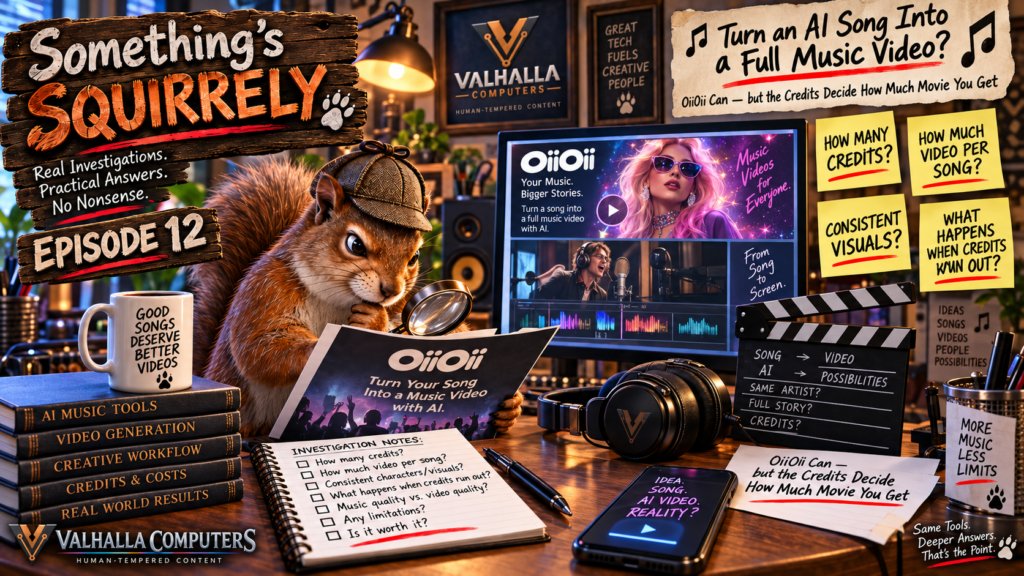
AI music generation solved one problem so efficiently that it immediately created another one. People can now make songs faster than they can figure out what the hell to put on the screen while those songs play.
OiiOii’s advertisement has an answer: give the platform your track and let its AI animation team turn it into a complete cinematic music video with synced visuals, consistent style, performers, and polished shots. For anybody who has generated a song in Suno or another music tool and then stared helplessly at a blank video timeline, that is an appealing proposition.
This time the basic capability is not merely advertising copy. OiiOii’s official music-video page says users can upload their own song, have the system analyze its mood, lyrics, structure, and rhythm, then generate the concept, script, shots, visual assets, video, and final edit inside one workflow.
This Is More Than a Single Video Generator
OiiOii describes itself as a multi-agent animation platform. Its FAQ says seven specialized agents divide the work among roles such as art direction, scriptwriting, character design, scene creation, animation, editing, and sound. Underneath that orchestration layer, the service can use a collection of different image and video models rather than asking one model to do every part of the production.
That is a sensible architecture for longer-form AI video. The hardest part of making a music video is not necessarily generating one attractive five-second shot. It is keeping the same person, clothing, environment, visual language, pacing, and story recognizable across twenty or thirty shots. OiiOii’s workflow is designed around that continuity problem rather than pretending every generation exists in isolation.
The Ad’s “Consistent Visual Style” Claim Is the One We Would Test Hardest
Consistency is one of the most valuable promises in AI video and one of the easiest promises to demonstrate selectively. A short advertisement can show the best sequence. A real project has to survive an entire song. Faces need to remain recognizable from different angles. Wardrobe should not quietly redesign itself. Locations should feel connected. The “artist” should not return from the chorus with a different jawline and three extra earrings.
OiiOii says its asset and identity systems are specifically intended to maintain character continuity, and the platform lets users regenerate individual shots rather than restarting an entire project. Those are the right features. The real question is how often a creator needs those regenerations before the finished result looks coherent.
And That Brings Us to Credits
OiiOii offers a free tier with daily credits, but paid production runs on a credit system. The company does not publish one universal “music video costs X dollars” number because the amount depends on video length, generation settings, the models selected, resolution, shot count, and other resources used. The music-video FAQ explicitly tells users to check the pricing page for current credit costs and plan options.
That variable cost makes sense technically and becomes important creatively. A three-minute song may need dozens of shots. Some shots may work on the first generation. Others may take four attempts. Character and scene assets may need their own generation work. The expensive number is not the credits required for the timeline you planned. It is the credits consumed by the timeline you finally accept.
Start With a Short Song, Not Your Rock Opera
This is one of those tools where a practical test should deliberately be small. Take a 60- to 90-second track with a clear structure. Use one or two main characters. Pick a visual style that does not demand impossible realism. Let the system build the storyboard and then track how many credits disappear between the first concept and the final exported video.
Independent users who have documented their experiences make the same basic point: generation costs grow quickly with song length and repeated shots, so shorter first projects make it much easier to learn how the platform behaves. That is far more useful information than discovering the credit economy halfway through a four-minute masterpiece.
Where OiiOii Could Actually Save a Lot of Time
The value proposition is strongest when compared with manually juggling separate tools. Without an orchestration platform, a creator might write a treatment, make reference images, generate each clip in one or more video services, name and organize the files, edit them together, create transitions, add music, and repeatedly repair continuity problems. Even if OiiOii costs more per individual generation than the cheapest standalone tool, consolidating that workflow could still be valuable.
That is especially true for creators who care more about finishing a coherent project than becoming experts in six different AI interfaces.
The Bottom Line
OiiOii appears to be offering something meaningfully different from a basic text-to-video button. The music-video workflow exists, users can upload their own songs, the system coordinates multiple production stages, and the platform is explicitly designed around multi-shot storytelling and character continuity.
The squirrel lives in the meter. “Turn your song into a complete music video” sounds like one transaction. In practice it is a chain of generations, decisions, revisions, assets, and credits. The platform may save enormous amounts of production time — but the sensible question is not merely whether it can make the video.
It is how many times you have to tell the bass player to stop changing faces before the chorus.