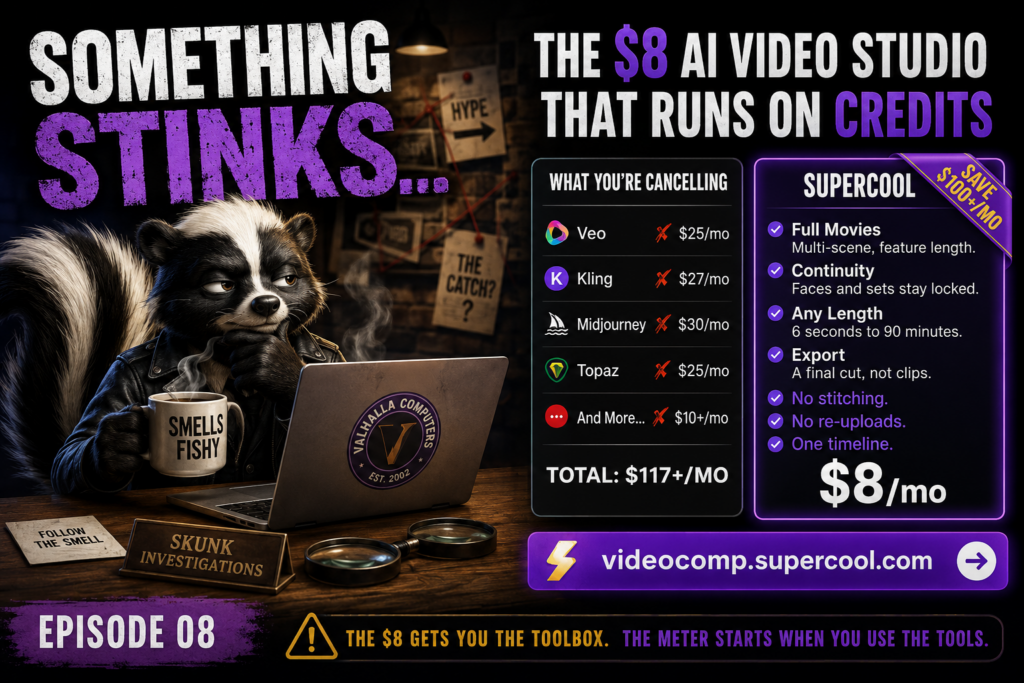
There is something irresistible about an advertisement that tells you it has solved an expensive problem for eight dollars.
Cancel Veo. Cancel Kling. Cancel Midjourney. Cancel Topaz. Forget the editor, stock footage, motion designer, render fees, and apparently half the subscriptions currently draining your bank account every month. According to a series of Facebook advertisements currently promoting SuperCool, all of that can supposedly be replaced by one AI-powered workflow costing just $8 per month.
That is quite a claim.
To be fair from the beginning, SuperCool appears to be a real and fairly ambitious platform. This is not one of those cases where the product evaporates the moment you start digging into it. SuperCool offers a collection of AI-powered tools intended to handle writing, images, video generation, animation, voice, editing, longer-form projects, and other creative tasks within one environment. For somebody tired of bouncing between half a dozen different AI services, the basic concept actually makes a lot of sense.
The interesting part begins when you stop looking at the advertisement and start looking at how the eight-dollar plan actually works.
Because the $8 price is real. It just doesn’t tell you anywhere near the whole story.
SuperCool’s inexpensive Mini plan currently includes 2,000 credits per month. Those credits are what power the actual AI generation taking place inside the platform. Images consume credits. Video consumes credits. Different models can consume different amounts of credits. Higher-quality or more advanced generation options can consume more than cheaper ones.
In other words, eight dollars does not buy unlimited use of every AI video tool under the sun. It buys admission to the platform and gives you a starter tank of fuel. That distinction becomes considerably more important when you start looking at video generation.
SuperCool’s own documentation provides examples showing video generation costing around 80 credits per second in one Creator Studio workflow. At that rate, a 15-second generation consumes approximately 1,200 credits.
Remember, the eight-dollar Mini plan starts with 2,000. If every generation worked perfectly the first time and you spent every credit exclusively on video, that would represent roughly 25 seconds of generated footage.
Twenty-five seconds.
Not twenty-five minutes.
Not a feature film.
Seconds.
Other SuperCool documentation gives even higher general examples for video-generation costs, which demonstrates another important part of the system: there is no single universal price for every second of AI video. SuperCool operates as an orchestration platform capable of using different models and different quality levels. The underlying model being used, the type of generation being performed, and the quality selected can all affect how quickly those credits disappear.
That architecture may actually be one of SuperCool’s strengths. Instead of requiring the customer to personally maintain accounts with multiple AI providers, the platform can coordinate different technologies behind one interface.
But it also means the number $8 per month tells you remarkably little about what your finished project is ultimately going to cost.
Then there is the advertisement’s claim about creating full movies, maintaining continuity, producing projects of any length, and supporting everything from six-second clips to productions lasting as long as 90 minutes.
That sounds spectacular until you consider how AI video production actually works.
SuperCool does offer tools intended to help users build longer projects, but a 90-minute AI movie is not generated as one continuous 90-minute video by pressing a giant purple button and going out for lunch.
The movie is still assembled from scenes and individual shots.
A story is developed. Characters and environments are established. Shots are generated. Clips are reviewed. Scenes are assembled. Narration, dialogue, music, subtitles, transitions, and other elements are added. SuperCool provides an environment intended to coordinate those pieces and produce the finished project without requiring the user to manually bounce between numerous separate applications.
That is useful.
It is also considerably different from what the phrase “Full Movies — Any Length” may cause someone scrolling quickly through Facebook to imagine.
And every generated shot still consumes credits.
Consider a theoretical 90-minute movie. Ninety minutes contains 5,400 seconds of finished footage. At the 80-credit-per-second example rate, generating exactly 5,400 seconds once would represent approximately 432,000 credits.
That calculation also assumes something anyone who has spent more than fifteen minutes using AI video will immediately recognize as completely ridiculous:
Every generation works perfectly the first time. No strange fingers. No character suddenly changing clothes. No object disappearing halfway through the shot. No face wandering off-model. No camera movement that bears absolutely no resemblance to the prompt. No horse deciding that gravity is optional. No truck transforming into a sedan. No character turning around and becoming an entirely different person. No regenerations at all. Good luck with that.
AI video remains an iterative process. You generate a scene, examine it, find something wrong, adjust the prompt, and generate it again. Sometimes version two fixes the original problem and introduces three new ones. Sometimes version six is somehow worse than version one. Sometimes the AI produces something so bizarre that you temporarily forget what you were originally trying to accomplish.
Every one of those attempts consumes computing resources. And in a credit-based system, computing resources consume credits.
SuperCool itself recommends testing shorter generations before committing more credits to longer versions. That is sensible advice and something experienced AI-video users already tend to do.
It also illustrates why the subscription price and the actual cost of producing finished video are two very different numbers. So what does eight dollars really buy? A much more useful description would be:
Eight dollars buys access to the SuperCool platform plus a limited monthly allowance of generation credits.
That isn’t nearly as exciting as:
YOUR VIDEO BUDGET. GONE.
But it is much closer to how the economics actually work.
SuperCool offers larger plans containing substantially larger pools of credits, and the company’s own documentation positions the Mini plan more toward lighter or occasional use while recommending higher tiers for people seriously producing video on a regular basis.
That makes the comparison used in the Facebook advertisement particularly interesting.
One ad compares subscriptions such as Veo, Kling, Midjourney, Topaz, and other services, adds their monthly prices together, and then places that total next to:
SuperCool — $8/mo Visually, the message is obvious. Why spend over a hundred dollars every month when you can have all of it for eight? The problem is that those numbers aren’t necessarily comparing equivalent things. Those other subscriptions have their own generation allowances, limits, features, and pricing structures. SuperCool’s eight-dollar price comes with its own generation allowance in the form of credits.
The more useful comparison would therefore be:
How much finished usable content can I actually produce for the money?
That is considerably harder to fit into a Facebook advertisement.
None of this means SuperCool is necessarily a bad product.
Quite the opposite. The idea behind it is potentially very useful.
One of the biggest annoyances in AI-assisted production right now is fragmentation. You write something in one service, generate the image somewhere else, animate it somewhere else, make a voice in another application, edit everything in yet another application, and eventually realize you have six browser tabs open and five different companies charging your credit card every month.
An orchestration platform attempting to bring those tools together can have genuine value.
SuperCool’s workflows appear designed around exactly that problem. Different AI models can potentially be used for different jobs while the customer works within one broader environment. Short-form content, images, scripts, voice, longer productions, and editing can be coordinated without the user personally maintaining every underlying workflow.
That convenience may absolutely be worth paying for. But convenience is not the same thing as unlimited generation. Access to multiple AI technologies is not the same thing as receiving unlimited use of every one of them for eight dollars. The credit meter is the part potential customers need to understand. And that becomes even more important when we start looking at customer experiences.
Recent public reviews include complaints from some SuperCool users who say they signed up for an inexpensive plan and later encountered additional credit purchases or top-ups. Some reviewers claim credits disappeared much faster than expected. Others say they were surprised by additional charges while working on projects.
Those are individual customer reports, not proof that every SuperCool customer will experience the same thing, and they should be treated accordingly.
SuperCool also responds publicly to a number of complaints, and there are cases where the company says it investigated billing issues or issued refunds.
So this is not evidence that SuperCool is secretly stealing everybody’s money, nor would it be responsible to present it that way.
What those reviews do provide is another very good reason to understand exactly how the account is configured before starting a large generation project.
Before you begin, check how many credits are included with your plan. Find out what the models you intend to use cost. Understand what happens when your included credits run out. Determine whether any automatic credit purchasing or top-up feature exists on your account, whether it is enabled, and how additional purchases are authorized.
Then keep an eye on the meter while you’re working.
That five-minute investigation could be considerably more valuable than staring at the eight-dollar subscription price.
SuperCool also extends beyond simple video generation into other areas such as website and application creation. Some of those services can involve additional usage-based charges for things such as storage, hosting, or API usage depending on what features someone uses.
That does not mean the person generating a fifteen-second video is automatically being charged for website hosting. It does reinforce the larger point: SuperCool is fundamentally a metered platform. The subscription is one part of the cost. Usage can be another. And that brings us back to the advertisement. Is it lying? Not necessarily. The ad does not explicitly say: Unlimited AI video generation for $8 per month. It says: Every AI Video Tool. One Workflow. $8/Mo. Eight dollars does apparently provide access to the platform. The platform does provide numerous AI capabilities. Those capabilities can be coordinated inside one workflow. In the narrowest technical sense, the advertisement has plenty of room to defend itself. The problem is the conclusion an ordinary person scrolling through Facebook is encouraged to draw.
When you cross out:
Veo — $25 per month.
Kling — $27 per month.
Midjourney — $30 per month.
Topaz — $25 per month.
And then prominently display:
SuperCool — $8 per month
the obvious takeaway is:
Why am I paying all these companies when eight dollars can replace everything?
The more accurate takeaway is:
Eight dollars gets me into a platform capable of replacing several different workflows, and then my actual usage is controlled by a credit system.
That may still be a fantastic deal for the right person.
But those are two very different statements.
So does something stink?
A little.
Not because SuperCool appears fake.
Not because charging for AI generation is unreasonable.
And not because combining numerous creative tools into one platform is somehow deceptive.
Somebody has to pay for the massive amount of computing power behind modern AI video, and a credit system is one perfectly legitimate way to do that.
The smell comes from using an incredibly attractive $8/month headline to sell something whose practical production capability depends heavily on a credit meter sitting behind that price.
SuperCool’s own documentation makes the basic arrangement reasonably clear once you go looking for it.
The entry-level plan costs eight dollars.
It comes with a limited number of credits.
Video generation consumes those credits.
Different models and workflows can consume them at different rates.
Serious video production can require considerably more.
Long-form movies are assembled from numerous generated shots and scenes rather than emerging as one magical uninterrupted generation.
And failed attempts still count.
That doesn’t make the product bad.
It means the credit system may be more important than the subscription price when deciding whether SuperCool actually saves you money.
There is a recurring lesson in almost every Something Stinks investigation.
Whenever an advertisement tells you that something traditionally expensive has suddenly become incredibly cheap, don’t begin with:
“Is this possible?”
Start with:
“How are they making the numbers work?”
Sometimes the answer is advertising.
Sometimes it’s a subscription funnel.
Sometimes it’s a limited introductory offer.
Sometimes it’s an upsell.
And increasingly in artificial intelligence, the answer is:
Credits.
SuperCool may legitimately allow a creator to replace several separate subscriptions with one consolidated workflow. For somebody currently paying for half a dozen AI services, that could actually save money and make production considerably easier.
The eight-dollar plan might even be an inexpensive way to experiment with the platform and decide whether the workflow fits.
Just don’t confuse the price of opening the toolbox with the price of using everything inside it.
The $8 gets you the toolbox.
The meter starts when you use the tools.
And that, ladies and gentlemen, is where Something Stinks