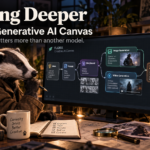
AI video has spent the last few years getting very good at producing impressive moments and considerably less good at producing an entire coherent story. A beautiful ten-second shot is one problem. Keeping the same character, costume, location, visual language, story logic, pacing, and audio identity across minutes of footage is another. Vivago R1 is interesting because it is explicitly aimed at that second problem rather than simply advertising a prettier single generation.
R1 Is Built Around Orchestration
HiDream describes Vivago R1 as a multi-agent creative system that can break a project into script, storyboard, character, scene, visual, and audio work before assembling the result. Recent launch material describes R1 as a conversational creation agent rather than a single video model. That distinction matters. The platform is trying to behave more like a small production workflow that coordinates specialized steps than a text box connected directly to one generator.
Longer Video Is Mostly a Consistency Problem
The difficult part of long-form generative video is not merely adding more seconds. Every new shot creates another opportunity for a face to change, a prop to disappear, a room to rearrange itself, a costume to mutate, or a story beat to contradict what happened thirty seconds earlier. R1’s pitch is that planning and orchestration can preserve context across those transitions. The company has demonstrated and publicly discussed multi-minute output, with recent launch material describing coherent work in roughly the five-minute range under suitable conditions.
That Does Not Eliminate Directing
The ad itself hints at the right lesson: if separate generations look good individually but feel like unrelated movies when combined, simply forcing them together does not fix the story. A creator still needs to make decisions about coverage, shot duration, continuity, rhythm, performance, music, and what information the audience should receive in each scene. AI can make more raw material and can increasingly coordinate it, but the quality bar for a finished story remains much higher than the quality bar for a striking clip.
This Matters to Small Businesses Too
Most small businesses do not need five-minute cinematic productions every week, but the underlying workflow is useful for product explainers, training videos, branded stories, social campaigns, event recaps, onboarding, and customer education. The advantage of longer-form AI is not that every company should start making movies. It is that one system may eventually maintain the same spokesperson, product, brand style, and visual world across enough scenes to tell a complete message without rebuilding every shot manually.
Watch the Economics, Not Just the Demo
Longer AI video means more generations, more retries, more assets, and more opportunities for something to fail. Credits, model choices, generation time, upscaling, licensing, and human editing all affect the true cost of a finished minute. A platform that creates a coherent first assembly can still be valuable even when the final piece needs editing, but businesses should compare cost per usable finished video rather than cost per generated clip.
Bottom Line
Vivago R1 represents a meaningful direction for generative video: the industry is moving from “make me a clip” toward “help me plan and produce a story.” The technology is getting better at carrying context across scenes, but orchestration does not make taste automatic. If R1 can reliably reduce the continuity and assembly work, that is a bigger practical improvement than another benchmark showing prettier ten-second footage. The director’s chair is not empty yet—it is just getting a much more capable assistant.