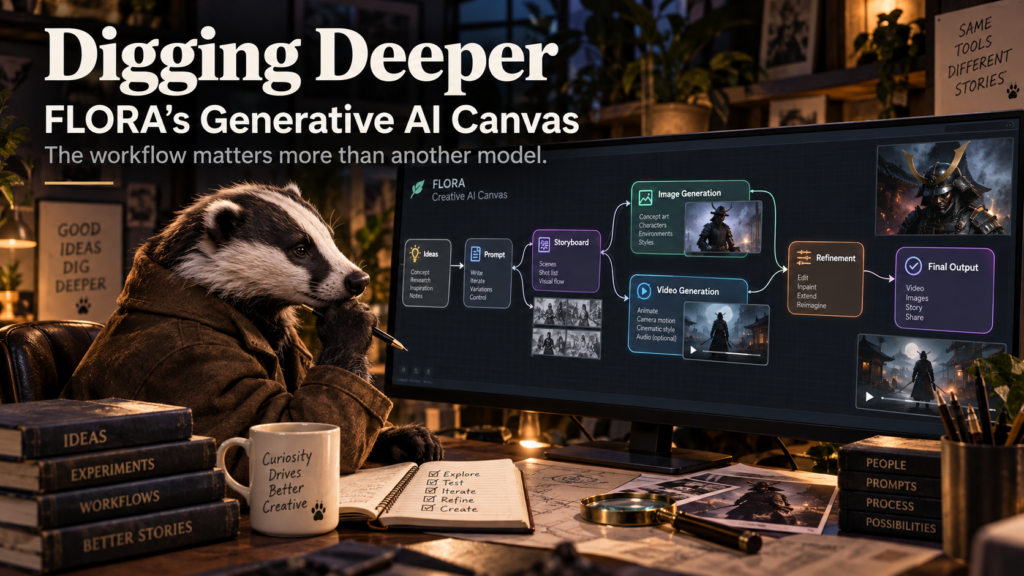
The ad for FLORA does not lead with a magical promise that one prompt will make you rich. It shows a creator talking about a workflow, then zooms out to a canvas full of connected steps. That makes it more interesting than the average “look what AI made” promotion because it is aimed at a real problem: creative work rarely happens in one prompt.
A usable campaign might begin with research, move into copy, generate several image directions, refine one of them, create variants, turn a still into video, and then export assets for different platforms. The pain is often not the generation itself. The pain is remembering which model, prompt, reference image, edit and decision produced the version everybody liked.
FLORA Is Trying to Make the Process Visible
FLORA describes itself as a generative AI canvas for creative teams. Its node-based workspace can connect text, image, video and audio tasks into reusable workflows instead of treating every generation as an isolated chat. The company also emphasizes collaboration, shared assets and repeatable techniques, which is a much more professional framing than simply promising prettier pictures.
The distinction matters for agencies and small teams. If a designer has to rebuild the same chain of prompts every week, the AI tool may save generation time while creating new organizational work. A visible workflow can preserve the logic: this text becomes that prompt, this reference feeds that image step, this selected image moves into that video model, and the final output follows a known path.
It Is Also an Aggregator
FLORA is not asking users to bet everything on one proprietary image or video model. Its current product material lists access to a large group of third-party models, including tools from several major AI vendors. That gives creators the ability to choose a model for the job while keeping the surrounding workflow in one place.
That approach has an obvious advantage: the “best” model changes constantly. A team that builds its entire production process around one generator may have to rebuild the process when another model becomes better, cheaper or more controllable. A model-agnostic canvas can make the generator interchangeable while preserving the rest of the production logic.
The Free Plan Is Enough to Understand the Idea
FLORA’s current pricing page includes a free tier with a limited number of generations and a small number of active projects, while paid tiers add broader model access, team usage, collaboration and larger usage pools. That is useful because this is the kind of product that makes more sense after you actually build a workflow than after watching a polished demo.
The cost question is also different from a flat-price graphics app. Generations draw from usage tied to the models being called. A workflow with three image steps and two video steps can therefore have a very different cost from one that only produces text and a final still image. Reusability helps, but complicated workflows still consume real resources.
A Canvas Does Not Automatically Make a Good Process
Visual workflow tools can become their own form of spaghetti. A clean five-node process is easy to understand. A giant canvas with dozens of branches, duplicate experiments, half-finished ideas and mystery connections can become a diagram of exactly how nobody remembers what is happening.
The benefit comes when the team decides which steps deserve to be repeatable. Brand references, approved prompt structures, standard export sizes, review checkpoints and known-good model settings are excellent candidates. Every random experiment does not need to become permanent infrastructure.
This Is Where AI Starts Looking Less Like a Toy
The most interesting AI products for business are increasingly the ones that make repeated work more reliable. A generator is fun. A repeatable process is useful. When a new employee, contractor or collaborator can open a workflow and understand how the team turns an idea into an approved asset, the software begins to capture institutional knowledge rather than just produce files.
That does not eliminate creative judgment. It gives judgment somewhere to live. The human still chooses the direction, rejects bad outputs, protects the brand and decides when a result is good enough. The canvas simply makes those decisions easier to reproduce.
The Bottom Line
FLORA’s biggest selling point is not that it contains AI models. Everybody contains AI models now. The more interesting idea is that the creative process itself can be designed, reused and improved instead of disappearing into a pile of chat histories and downloaded PNG files.
For a solo creator, that may be convenient. For a team, it can become operational memory. The question is not whether the canvas can make an image. It is whether it can help you make the next fifty images without reinventing the job every time.