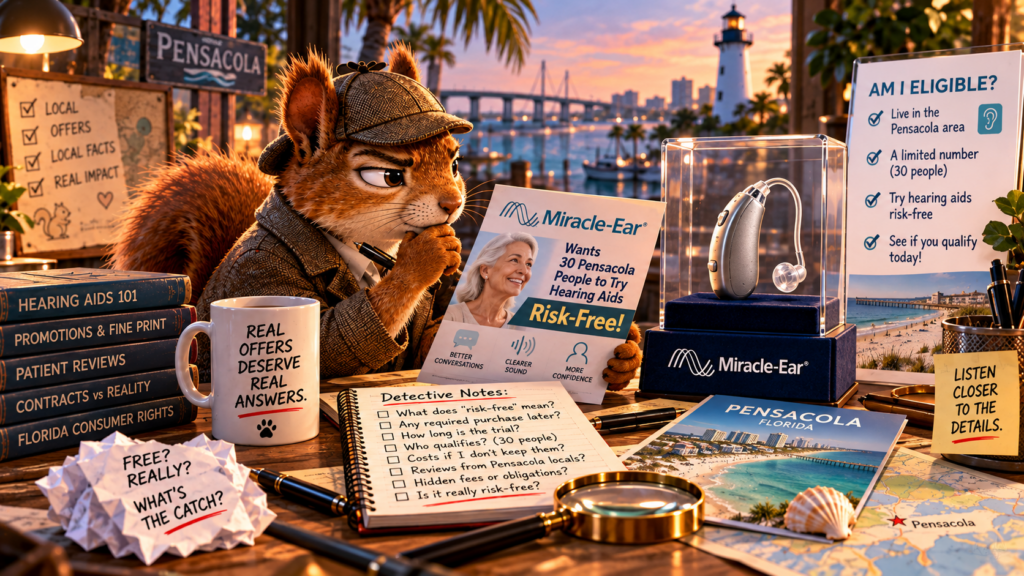
The Miracle-Ear ad is aimed directly at Pensacola and uses a familiar local-response formula: “We are looking for 30 people” to try almost invisible hearing aids “RISK-FREE.” It then asks viewers to select an age range and find out whether they qualify. The business itself is real, the Pensacola targeting is plausible, and Miracle-Ear genuinely offers trial programs. The part that deserves context is what “risk-free” means and whether the “30 people” language should be interpreted as a literal once-only opportunity.
Miracle-Ear Really Does Offer a Risk-Free Trial
Miracle-Ear’s official trial information explains that customers can wear hearing aids in real-life environments and return them during the applicable trial period if they are not satisfied. That is useful because hearing aids are difficult to evaluate in a ten-minute office demonstration. Restaurants, television, driving, family conversations, and background noise reveal far more about whether a fitting actually works for the wearer.
But the Trial Is Not Simply “Take Free Hearing Aids Home”
The company’s own explanation also says the normal process includes a hearing assessment, recommendations, fitting, purchase of the hearing aids, and then the risk-free trial period. Miracle-Ear notes that terms vary by participating location and that fitting or restocking fees may apply in some circumstances. Those details do not make the trial fake, but they matter when an advertisement’s largest words are “RISK-FREE.” Consumers should ask exactly what must be paid, what is refundable, how many days the trial lasts, and what condition the devices must be in when returned.
The “30 People” Message Is a Marketing Device Worth Questioning
Scarcity works because nobody wants to be person number 31. “We need 30 people” hearing-aid promotions have been used in the industry for many years in different markets, often as a way to encourage people to book an evaluation quickly. That does not prove this specific offer lacks a real local limit. It does mean the number should not pressure anyone into making a medical or financial decision before understanding the price, return terms, technology level, warranty, and alternatives.
The Age Selector Is Also Doing Marketing Work
Hearing loss becomes more common with age, so asking whether a visitor is in a 50–59, 60–69, 70–79, or 80+ bracket helps the advertiser qualify leads. It may also make an older viewer feel that the offer was designed specifically for people like them. A hearing evaluation should still be based on the individual’s hearing, communication needs, health history, and lifestyle rather than an age bracket in a Facebook form.
Questions to Ask Before Agreeing
Ask for the exact model, technology tier, total purchase price, financing terms if any, trial length, refund policy, fitting fees, restocking fees, warranty, loss-and-damage coverage, and included follow-up service. If insurance is involved, find out what the insurer actually pays and whether using benefits changes the included aftercare. A reputable hearing-care provider should be able to answer those questions without relying on urgency.
Bottom Line
The Miracle-Ear offer is not a phantom product: the company does advertise risk-free hearing-aid trials. The squirrely part is how a localized “30 people” ad can make a standard sales and evaluation process feel like a rare opportunity that must be claimed immediately. Treat the ad as an invitation to ask questions, not as a deadline. Better hearing is important enough to compare the devices, the professional care, the return terms, and the complete cost before letting a scarcity counter make the decision.