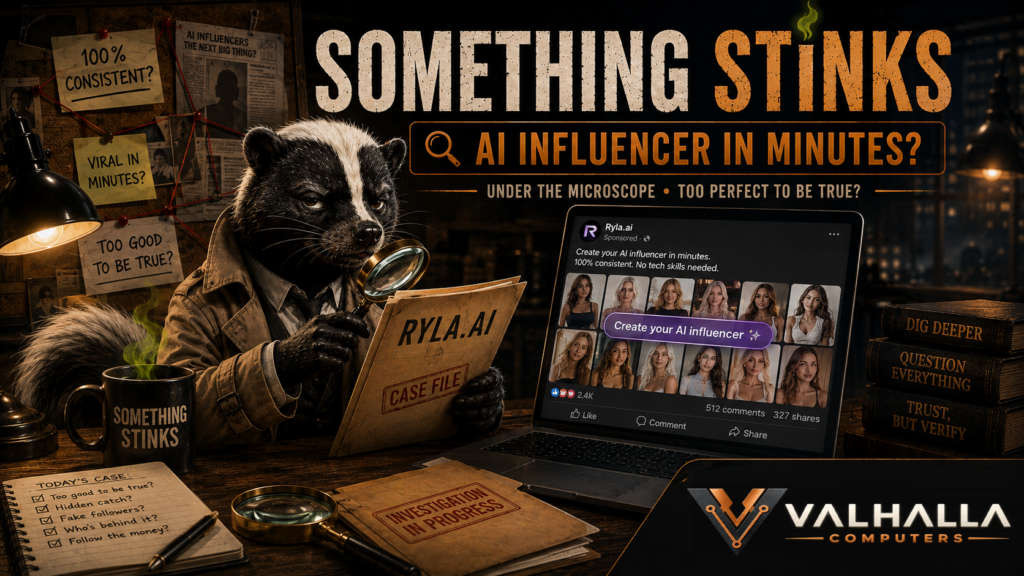
There is a particular kind of advertisement becoming increasingly common on social media. It usually begins with a beautiful artificial person staring back at you from a carefully designed screen. The software promises that you can create your own AI influencer almost instantly. No expensive camera. No model. No photography experience. No technical knowledge. No complicated prompts. Click a few buttons, create your virtual celebrity, start producing content and — somewhere in the marketing fog — begin imagining followers, views and money pouring in.
This particular advertisement from RYLA caught our attention with the promise, “Want a hyper-realistic AI Influencer in minutes? No tech expertise needed!” Then comes an even stronger statement: “100% Consistent AI Characters.” The advertisement also pushes the idea that creators can quickly begin producing the kind of content capable of attracting an audience. That is about the point where our little skunk started sniffing around.
To be fair from the beginning, RYLA appears to be a legitimate AI content-generation platform. This is not an article claiming that the company is fraudulent, nor are we saying the software does not work. In fact, RYLA offers many of the tools someone building an AI character would genuinely want, including character creation, AI photography, video generation, lip synchronization, voice options, templates and technology intended to preserve a character’s identity across generations. Bringing those capabilities together inside one platform could potentially make the process considerably easier than trying to cobble together several different AI services.
The part that begins to smell funny is the enormous leap between creating an AI character and creating a successful AI influencer. Creating an attractive artificial person can indeed happen surprisingly quickly. Modern AI tools have become remarkably good at producing impressive portraits from relatively simple instructions. Choose an approximate age, hairstyle, eye color, clothing and environment and the result may look good enough to make someone believe the difficult part is already finished.
The problem is that at that point you have created a picture. You have not necessarily created a character. A believable recurring character needs recognizable facial features from multiple angles. She needs consistent proportions. She needs to smile, frown, laugh, think, sit down, stand up, turn sideways, walk through a room and appear under dramatically different lighting while still obviously looking like the same person. She needs to change clothing without suddenly changing her body shape. Her hair has to remain recognizable. Her eyes need to stay the same color. Even little things such as freckles, facial structure and expressions matter when followers are supposed to recognize the same person over hundreds of posts.
Then the character needs to move. Then she needs to speak. Then she needs a voice that fits her personality instead of sounding like the navigation system in a 2011 Buick. Then the lips need to move at roughly the same time as the words. Then her facial expressions need to match what she is saying. Then someone needs to give her something interesting enough to say that people will actually stop scrolling long enough to listen.
After solving all of that, congratulations. You still do not necessarily have an influencer. What you have is an actor.
This is where claims about “100% consistent AI characters” deserve a little extra scrutiny. Character consistency is one of the most difficult problems in generative AI. Every time an image is generated, the system is creating a new image rather than simply taking another photograph of an existing human being. Modern systems can use reference images, identity models and other techniques to greatly improve consistency, but the generator still has opportunities to wander. Hair changes slightly. Facial structure shifts. Body proportions move. Clothing behaves differently. Fingers occasionally begin making independent career decisions.
Video makes the problem even more complicated because the character does not only need to remain recognizable in one image. Her identity needs to stay stable through dozens or hundreds of consecutive frames while she moves. A face that looks perfect at the beginning of a clip can gradually change during movement. Hands can deform. Hair can behave strangely. Objects can move in physically impossible ways. Better technology can dramatically reduce these problems, and specialized character platforms may handle them much better than general-purpose generators, but there is still an enormous difference between saying a system is designed for strong character consistency and implying that every generation will be mathematically perfect every single time.
Consider something as simple as an AI character reading a joke from her phone. She reads the setup, thinks about it for a moment, initially does not understand it, realizes what the punch line means and then laughs. A human performer can do this naturally without consciously thinking about the thousands of tiny movements involved. Her eyes move before her head. Her eyebrows change. Her attention remains focused on the phone. There is a short delay while her brain processes the joke. Her mouth begins changing before the laugh. Her shoulders may move. She breathes differently. Her head tilts. Her eyes narrow. The laugh has timing and personality.
Generative video has to invent all of those details while simultaneously preserving the face, hairstyle, hands, clothing, phone, background, lighting and body of the character. That is why a ten-second AI video can occasionally require far more experimentation than a cheerful “Create” button might lead someone to expect.
Then we arrive at the word that makes many AI advertisements especially aromatic: viral.
Software can generate content. Software cannot guarantee that strangers will care about it. That distinction matters enormously. People do not automatically follow a virtual influencer simply because she is attractive. There are already virtually unlimited numbers of attractive AI-generated people appearing online. Another beautiful artificial face is not particularly rare anymore. Attention is rare.
An AI influencer still needs a concept, personality, humor, writing, timing, recurring themes, audience interaction, posting schedules, captions, editing, sound, hooks, thumbnails and community management. Someone needs to study what works, determine what fails and continually experiment. There may be dozens of posts that receive almost no attention before one suddenly connects with viewers. Artificial intelligence can help create every part of that process, but it cannot magically make an audience interested.
That is the same inconvenient truth hiding behind countless “passive income” advertisements. A computer can automate production. It cannot automate demand.
There is also the small matter of money. Many AI platforms provide free trials or limited free generations, which can be excellent ways to find out whether the workflow actually suits you before paying anything. Serious production, however, generally involves credits, subscriptions or generation limits. Images consume credits. Videos consume credits. Lip synchronization consumes processing resources. Higher-resolution output may cost more. Custom character models may require higher subscription tiers.
Rejected generations consume credits too. Experiments consume credits. The image where your character suddenly resembles her second cousin consumes credits. The video where gravity briefly stops working consumes credits. The gorgeous generation that would have been absolutely perfect except the character somehow acquired seven fingers still consumes credits.
Anyone serious about building an AI personality should therefore budget for experimentation rather than calculating expenses exclusively around successful generations. If a service says a certain subscription can generate a particular number of images or videos, that does not necessarily mean all of those generations will become usable posts. Some will be tests. Some will be discarded. Some will be almost perfect, which is occasionally even more frustrating than completely wrong.
Another phrase frequently used in this type of advertising is “no technical skills required.” In many cases that statement may genuinely be true. You might not need to understand programming. You might never have to know what a diffusion model is. You may never need to learn about training models, reference weights or any of the other terminology floating around the AI-generation world. A well-designed platform can hide much of that complexity behind buttons, sliders and templates.
Removing technical complexity, however, does not remove creative complexity.
Someone still has to decide who this character is. What does she care about? How old is she? How does she speak? What does she find funny? What does she wear? Where does she live? What does she refuse to do? What does her audience expect from her? What makes one photograph obviously her rather than merely another AI-generated woman? How does she respond when people leave comments? What kind of content should she make tomorrow that is different enough to remain interesting but similar enough to remain recognizable?
Those are not computer science questions. They are branding, writing, directing, storytelling and marketing questions. Those skills matter just as much as knowing which button to push.
So, does RYLA itself stink? Not necessarily. In fact, the platform appears to be addressing a legitimate problem. Consolidating character generation, identity control, images, video, voice and lip synchronization into one interface could potentially save creators a tremendous amount of time compared with managing several unrelated tools. We have not independently tested every feature, so we are not going to tell readers whether RYLA is fantastic, terrible or worth their subscription money.
What smells is the increasingly common style of AI advertising that compresses an entire creative business into a screenshot and three sentences. Create beautiful AI person. Make content. Gain followers. Profit.
The technology may reduce the amount of labor between those steps. It does not remove the steps.
If you are curious about an AI influencer platform, test it properly before committing serious money. Create the same person from dramatically different angles. Change the lighting. Change clothing. Generate full-body images. Make the character sit, stand and walk. Test profiles. Test hands. Test emotional expressions. Generate video. Make the character talk. Try complicated scenes instead of only portraits. Then come back the next day and try again.
Do not judge an AI tool by the five best examples on its sales page. Judge it by your fifty generations.
AI influencers absolutely can be created faster and more easily than ever before. The technology is genuinely impressive and getting better at an incredible pace. But creating an artificial person in a few minutes and building a character that people recognize, enjoy and voluntarily follow are still two very different accomplishments.
An AI influencer really can be created in minutes.