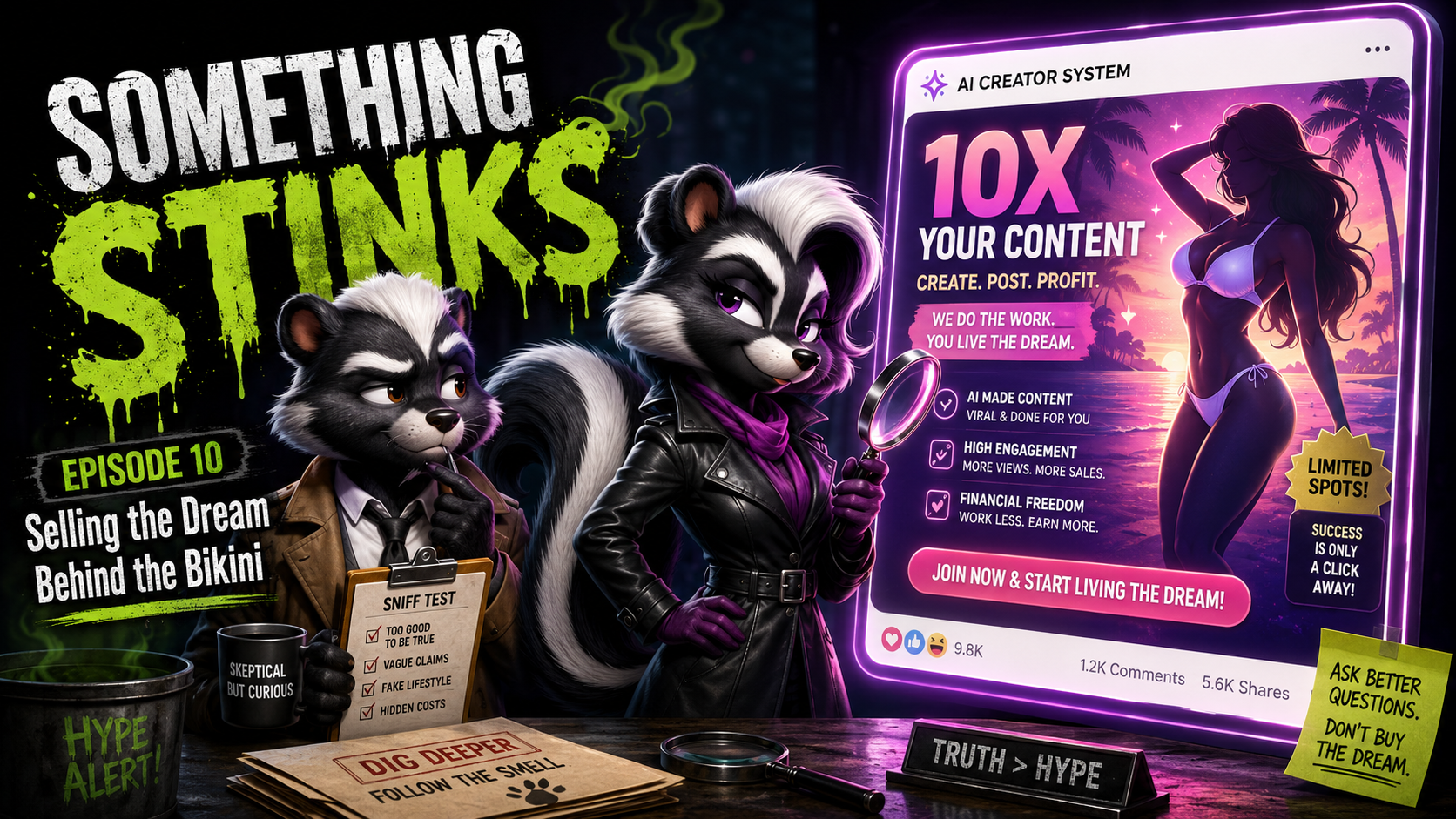
There is one particular advertisement that has apparently decided it and I are now in a committed relationship because it keeps appearing in my Facebook feed.
The message changes slightly, but the story remains pretty much the same: artificial-intelligence creators are making people serious money, you can get your first AI creator for free, you do not need a camera or studio, and somewhere in the background there is usually a very expensive car helping demonstrate what your future could supposedly look like.
One version that recently appeared on my screen was particularly subtle about it. The video literally included the caption “Exposing how fake AI girl paid for my McLaren.”
Nothing says sober business analysis quite like a supercar parked behind the person explaining the opportunity.
The company behind the ad is AI Creator Marketplace, and after looking through what they actually offer, there is an important distinction worth making immediately. This does not appear to be some completely fabricated “AI girls will make you rich tomorrow” operation.
There is a real platform, there really are AI creators available without an upfront charge, and people really can apply to manage them and earn a percentage of the resulting revenue. The squirrel is hiding in what the word free means, what exactly you are receiving, how the money is divided, and how much actual work sits between clicking “Apply” and parking a McLaren in the driveway.
Yes, the AI Creator Really Can Be Free
Let us give the advertisement credit where it deserves it.
AI Creator Marketplace currently says users can browse a large library of pre-created AI personalities, apply for one, verify their identity and begin managing the creator without paying an upfront fee. The company advertises free education, free tools and access to pretrained models that can be used to generate content.
Their marketplace is not exactly small either. At the time I checked, it contained well over a thousand available brunette creators alone, along with categories for blondes, black hair, Asian creators and various body types. Individual listings advertise access to AI generation technology and the ability to produce both general-audience and adult-oriented images and videos.
So when the Facebook advertisement says “Your first AI creator is free,” that part is not particularly controversial.
What matters is understanding what “free” actually gets you. You are not necessarily being handed a digital character in the same sense that somebody creating an original virtual personality from scratch might say they own the brand. You are applying to manage a creator from somebody else’s marketplace, and that is a very different business relationship.
You Are the Manager, Not Necessarily the Owner
AI Creator Marketplace describes the process in fairly straightforward terms. You browse the available creators, apply for one, verify your identity, receive access to the creator’s content tools and then run the profile. The responsibilities include creating and posting material, responding to fans and building revenue around the character.
Their own FAQ even includes information about handing a model back if you no longer want to manage it, which tells us something important about the arrangement.
If I build a digital personality from scratch, determine her appearance, personality, branding, website, social accounts and business purpose, I am thinking about that character as an asset I created.
If a marketplace assigns me a prebuilt creator and provides the pretrained model and starting content, I am functioning more like a manager operating inside an existing ecosystem.
There is nothing inherently wrong with that. Franchises, affiliates, talent managers and marketplace sellers operate under similar arrangements every day.
But somebody considering this as a long-term business should understand the difference before spending six months building an audience around a character they assumed belonged entirely to them. I would want very clear answers about who owns the creator’s identity, who controls associated social accounts, what happens if the relationship ends, whether similar models can be assigned elsewhere and whether the manager can take the character outside the marketplace.
Those questions matter considerably more than whether the first batch of AI pictures costs zero dollars.
“Free” Works Because They Make Money When You Make Money
AI Creator Marketplace explains its business model fairly plainly. It gives managers access to creators without requiring the traditional upfront payment that might go to a human creator, then takes a percentage of the revenue once the creator starts earning.
That makes the free model considerably easier to understand.
They are not giving away AI creators because they suddenly became a charitable organization dedicated to populating Instagram with computer-generated brunettes. They are making an investment in the manager.
You supply the labor required to build traffic, post content, engage fans and monetize the profile. If nothing happens, the marketplace did not spend much acquiring you. If you succeed, they participate in the revenue.
That is actually a sensible business model. It just means the real offer is closer to “Here is an AI creator without an upfront acquisition cost. Build a business around her and we will share in the resulting revenue.”
That description is less exciting than “Free AI creator,” but it is also more useful.
Then Fanplace Takes Its Share Too
The monetization shown throughout AI Creator Marketplace is closely connected with Fanplace, where creator profiles can earn money through subscriptions, tips, pay-per-view content and paid messages.
Fanplace currently says creators keep 80% of earnings, while the platform retains 20% to cover payment processing, hosting, support, fraud prevention and chargebacks.
That means there can already be a platform deduction before considering whatever percentage arrangement exists between the manager and AI Creator Marketplace.
Again, none of that is inherently unfair. Platforms cost money to operate, payment processors charge fees, and fraud and chargebacks are real expenses.
But if an advertisement shows somebody waving around a revenue figure, the number that matters to a prospective manager is not simply “The AI girl made $10,000.” The useful question is how much of that $10,000 actually reached the manager after platform splits, refunds, chargebacks, processing costs and marketplace percentages.
Gross revenue buys impressive screenshots.
Net income pays the electric bill.
The Website Is Very Fond of Large Numbers
AI Creator Marketplace currently promotes large headline figures about total creator earnings and user signups, and it showcases success stories with monthly revenue numbers ranging from a few thousand dollars to figures well into five digits.
Those numbers certainly get your attention.
They are also testimonials and highlighted success cases.
That does not mean they are false, but they tell us very little about the experience of the typical person who signs up.
Every business-opportunity advertisement prefers to show the person who made $100,000 rather than the thousands of people who created an account, posted a few times, discovered marketing is hard and wandered away.
To evaluate the opportunity properly, I would rather see median earnings, the percentage of approved managers who ever generate revenue, average time to first sale, retention after six months and the percentage of creators earning enough to exceed their operating costs.
Those numbers would tell us something useful.
A photograph of a sports car tells us somebody has access to a sports car.
About That McLaren
The particular advertisement that keeps appearing in my feed leans directly into the lifestyle angle by claiming to explain how a fake AI girl paid for a McLaren.
Could that be true? Absolutely.
If somebody built a sufficiently profitable collection of AI creator profiles, earned management revenue from them, sold education around the process, operated the marketplace or built related businesses around the ecosystem, there is no mathematical reason they could not buy an expensive car.
What the advertisement does not establish is whether the AI creator alone generated the money that paid for the car, how much revenue was required, how long the process took or whether other businesses contributed significantly to the owner’s finances.
There is an enormous psychological difference between “I own a McLaren and I run an AI creator business” and “I clicked the free AI girl button and she bought me a McLaren.”
The first is entirely plausible.
The second is the dream being sold.
And dreams tend to convert very well in Facebook advertising.
The AI Girl Does Not Actually Do the Work
This may be the most important part of the entire offer.
The AI creator is fictional, but the work required to make the business succeed is very real.
AI Creator Marketplace tells managers they are responsible for running the profile, posting content, communicating with fans and growing revenue. Its training and tools are designed to teach managers how to drive traffic, improve content and monetize an audience.
Think about what that actually involves. Someone needs to generate usable images and videos, choose which ones get published, build social-media accounts, write captions, understand platform rules, attract followers, answer messages, convert followers into paying customers and keep subscribers interested enough to renew.
The AI woman may not require sleep, but her manager certainly does.
This is not passive income in the sense that you select a brunette on Monday and she automatically begins depositing money into your wallet while you spend Tuesday fishing. You are operating a marketing business with an AI-generated personality as the product.
The tool has changed.
The work has not disappeared.
The Adult-Content Angle Is Not Exactly Hidden
The Facebook advertisement itself is relatively tame, but the marketplace makes clear that many of these creators can be used in adult-oriented monetization.
Listings advertise the ability to generate both SFW and NSFW images and videos, and the marketplace categories are aimed very obviously at creator-subscription audiences.
That may be exactly what some prospective managers are looking for, but it is worth understanding what kind of business ecosystem you are entering.
This is not primarily a virtual spokesperson platform designed around friendly AI insurance agents and fictional hardware-store employees. A substantial portion of the opportunity revolves around monetized parasocial creator relationships.
That brings its own business, ethical and platform-policy questions. How clearly is the AI nature of the creator disclosed to paying customers? What rules do social networks impose on synthetic personalities? How do monetization platforms handle explicit AI content? Could those policies change after you have spent months building an audience?
Those are real business risks because your revenue depends heavily on platforms you do not control.
The Free Creator May Still Be a Good Opportunity
After all of that, here is the funny part: I do not think the basic idea is stupid.
AI creators have already demonstrated that fictional digital personalities can build audiences. Generative image and video tools are becoming good enough to maintain increasingly convincing characters, and there is clearly a market for creator-style entertainment that does not require a traditional human influencer behind the camera.
AI Creator Marketplace lowers one of the biggest barriers to experimenting with that business by giving newcomers a pretrained character and tools instead of forcing them to figure out character consistency, model training and content generation from scratch.
For someone who understands social-media marketing, enjoys audience building and wants to experiment without spending heavily upfront, that could be genuinely useful.
The mistake would be thinking the free AI girl is the business.
She is only one part of it. The actual business is everything you build around the character.
A Free Fishing Pole Does Not Guarantee Fish
Suppose I gave somebody a fishing rod for free.
That would certainly reduce the cost of going fishing, but it would not guarantee that they knew where the fish were, which bait to use, how to cast, what time to go or whether there were any fish in the lake to begin with.
The same principle applies here.
The marketplace can give you the character, generated images, courses and monetization infrastructure. It can even show you examples of people who apparently did extremely well.
None of that guarantees that you can attract an audience.
Audience attention is the scarce resource in this business. There are already thousands of attractive artificial personalities online, so the Internet is not suffering from a shortage of AI-generated women.
Your job is figuring out why anybody should care about yours.
So, Is “My First AI Creator” Squirrely?
Yes, but not because the product appears fake.
The free AI creator appears real, the generation tools appear real, the monetization platform appears real and the revenue-sharing model appears real.
The squirrel is hiding in the enormous gap between receiving a free digital character and building a profitable creator business.
The advertisement compresses that entire process into a wonderfully appealing sequence: obtain AI girl, post content, make money, purchase McLaren.
Reality contains quite a few additional steps. You need traffic, marketing, content people actually want, fan engagement, conversions, retention, an understanding of the revenue splits and the discipline to keep producing content after the novelty wears off.
The creator may be artificial.
The business is not.
I Am Still Not Buying the McLaren
If somebody wants to experiment with AI Creator Marketplace, the lack of an upfront creator fee makes the barrier to entry relatively low, and I can understand why the concept attracts people.
What I would not do is look at the person standing beside the expensive car and assume the automobile represents the normal outcome of clicking “Get your first AI creator today.”
Maybe his AI creators genuinely contributed to buying the McLaren. Good for him.
Before I start shopping for one myself, though, I would like considerably more information about average manager earnings, every revenue split involved, creator ownership, portability and how many of those signups ever made enough money to cover a tank of gas.
There is an advertising trick much older than artificial intelligence: you do not sell the shovel by talking about the shovel. You show people the gold.
In this case, apparently, you show them the McLaren.
And after seeing this guy in my Facebook feed night after night, I have at least learned one thing: if the AI girls really did buy that car, I sincerely hope they remembered to budget for the insurance.