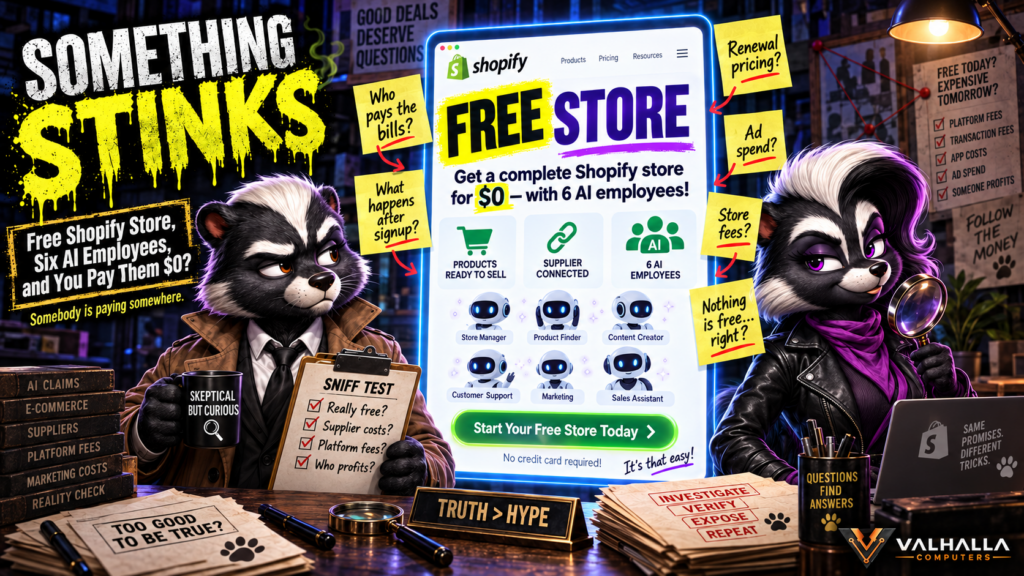
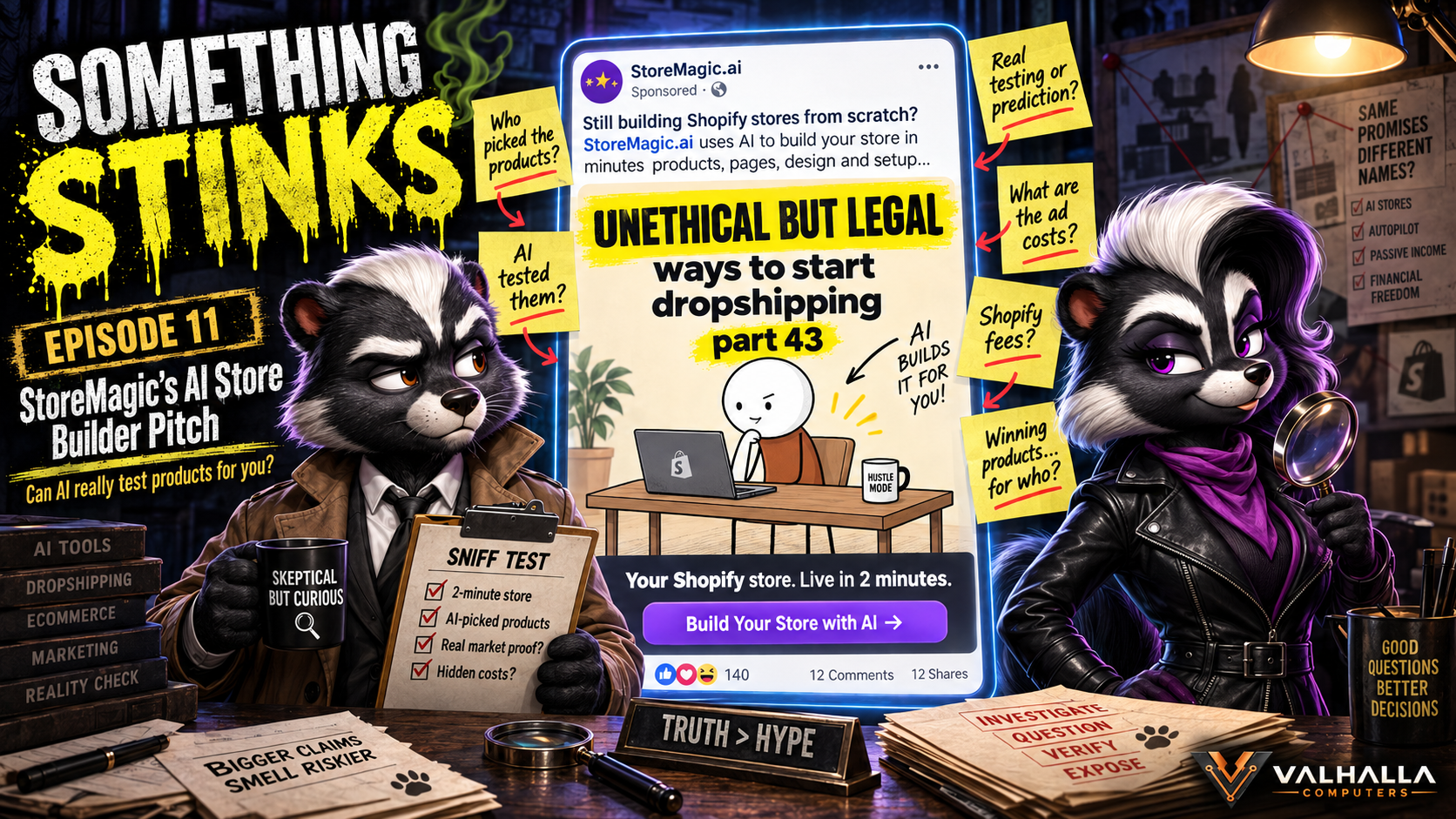
Sometimes an advertisement does not merely promise to remove one obstacle. It sees every obstacle in the room, kicks the door open, and announces that apparently none of them exist anymore.
Krafted’s Facebook ad is magnificent in that respect. Forget just giving you a free online store. It says you get a complete Shopify store, products connected to suppliers, six AI employees, and your first 100 days mapped out. The giant red stamp says ALL FREE. The copy above it goes even harder: “F*CK JUST GIVING YOU A FREE STORE. I’LL GIVE YOU THE BUSINESS AND THE TEAM TO HELP RUN IT.”
Then, down beneath the graphic, the Facebook card quietly says: “Start your own online store for just $20.”
Well. That escalated from free rather quickly.
The Offer Is Real Enough to Have a Landing Page
Krafted’s current landing page says it builds Shopify stores in roughly 24 hours and repeatedly states that customers pay Krafted $0. It showcases six named AI helpers covering management, marketing, copy, customer service, short-form video scripts, and analytics. The promise is not merely “here is a template.” Krafted is selling the idea that a beginner receives both the storefront and an AI-assisted operating system for what to do next.
That is a much more interesting product than a random drop-shipping theme. It is also exactly why the financial model deserves attention. Companies can give away useful things. They simply do not stay companies unless money enters the system somewhere.
Free Store Does Not Mean Free Ecommerce Business
Even if Krafted never charges another dollar for building the store, Shopify itself has ongoing costs. Shopify’s current U.S. pricing page lists Basic at $29 per month when billed yearly or $39 when paid monthly after its introductory promotion. Payment processing also carries transaction fees. Paid apps, domains, advertising, returns, samples, and other operating costs can add more.
Then there is the merchandise. “Products + supplier connected” does not mean the products are free. In a drop-shipping-style model, the customer pays your storefront, the supplier still has to be paid for the item and fulfillment, the payment processor takes its fee, and whatever remains has to cover advertising and leave a margin for you.
About Those Six AI Employees
Calling software agents “employees” is fantastic marketing because it makes a bundle of automation tools sound like you just inherited a staff meeting. Krafted describes agents that suggest next steps, write marketing material, draft customer responses, create product copy, prepare TikTok scripts, and analyze store numbers.
Those functions can absolutely be useful. They are still software. An AI that drafts a customer response has not taken legal responsibility for what it says. An AI that proposes an ad campaign has not guaranteed that the ads will convert. An AI that reads the numbers does not deposit profit into your bank account. Somebody still needs to review the work, make decisions, understand the customers, and notice when the automated employee has confidently wandered into traffic.
The $0 Versus $20 Question Needs a Straight Answer
This is the part we would want clarified before entering payment information. The ad graphic and landing-page language lean heavily on “free” and “you pay us $0,” while the Facebook link card shown with the same promotion says the online store costs $20. There may be a perfectly ordinary explanation — a setup offer, separate service, refundable amount, changed promotion, or another term on the checkout path — but the customer should not have to invent that explanation.
Before clicking the final button, find the actual checkout amount, what renews, what Krafted earns from suppliers or partners, whether any app subscriptions are installed, what Shopify plan is required, who owns the store and domain, how cancellation works, and whether you can remove the Krafted tools without breaking the business. “We charge you nothing” is useful information only when we also understand who does pay.
The Hardest Part of Ecommerce Was Never Building the Homepage
This is where the dream collides with the same wall every automatic-store offer eventually reaches. Shopify can make a store easy to build. Suppliers can make inventory easy to list. AI can make copy and graphics easy to produce. None of those things automatically create demand.
The store still needs people who want the products at a price that leaves enough margin after fulfillment, payment fees, returns, and customer acquisition. If thousands of beginners receive similar stores connected to similar suppliers, differentiation becomes harder rather than easier. The technology solves setup friction. It does not repeal competition.
The Bottom Line
Krafted may genuinely provide a lot of useful setup work at little or no direct charge, and the AI-assistant layer is more interesting than the usual “here is your generic store, good luck” pitch. But “ALL FREE” is too large a phrase for a business ecosystem with Shopify subscriptions, payment fees, supplier costs, marketing expenses, and an ad card that itself mentions $20.
The store may be free. The business is not. And if somebody hands you six employees who never need a paycheck, at least ask which one of them has been assigned to explain the revenue model.