AI is very good at some things. It is also remarkably good at being marketed as if it can do everything.
That distinction matters for small businesses.
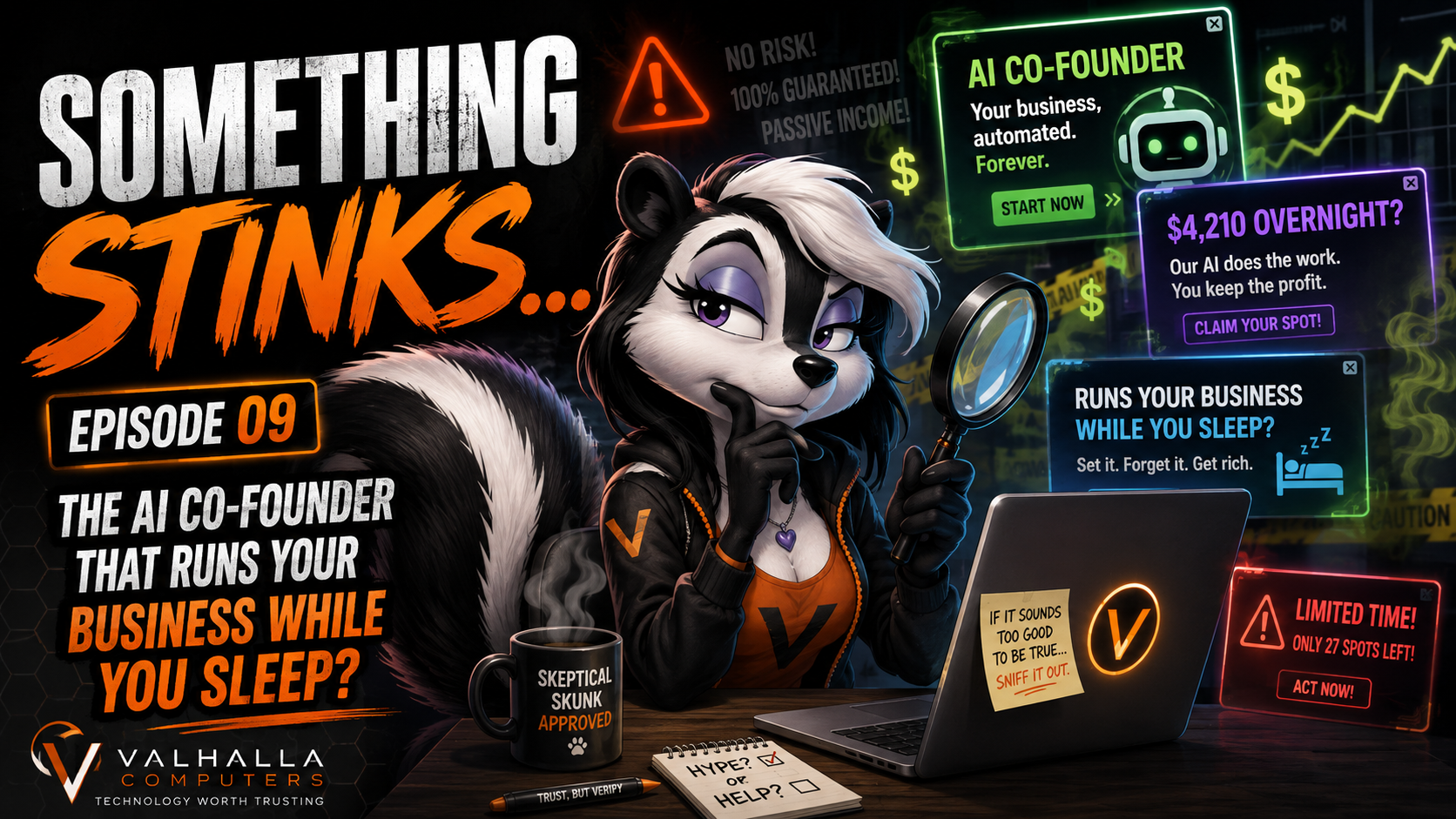
Open almost any social feed and you will eventually see an ad promising an “AI employee,” an “AI sales team,” an “AI business in a box,” or a system that supposedly handles marketing, customer service, content, leads, follow-up, research, scheduling, and probably lunch while the owner sleeps. The pitch usually sounds less like software and more like a replacement for having to run a business at all.
Reality is less dramatic, but far more useful.
AI works best in a small business when it is treated as a tool that reduces friction, speeds up repetitive work, helps organize information, and gives a human operator a better starting point. It can save hours. It can help one person do work that used to require several disconnected tools. It can improve consistency. It can uncover patterns that are easy to miss. What it usually cannot do is replace judgment, accountability, customer relationships, or the basic need to understand what your business is actually trying to accomplish.
AI Is Excellent at Getting You Past the Blank Page
One of the most practical uses for AI is also one of the least glamorous: helping a person get started.
Writing a blog post, email, product description, FAQ, proposal, social caption, or customer response is often slowest at the beginning. The business owner knows what needs to be said but still has to decide how to organize it, what order the information should appear in, and how much explanation is enough.
AI can turn rough notes into an outline, suggest headings, organize scattered ideas, rewrite awkward sentences, or produce a first draft that a human can then review and improve. That does not mean the machine should be allowed to invent facts and publish unsupervised. It means the owner does not have to spend twenty minutes staring at a blinking cursor before the real work begins.
That difference alone can make content creation much more sustainable for a small operation.
It Is Very Good at Repetitive Administrative Work
Small businesses lose an enormous amount of time to tasks that are necessary but not especially valuable on their own. Sorting information, summarizing notes, converting one format into another, drafting routine replies, cleaning up a spreadsheet, categorizing feedback, or turning a meeting transcript into action items can eat up hours without creating anything the customer ever sees.
AI is often useful in exactly these places.
A business can use it to summarize a long email thread, extract tasks from notes, compare two documents, turn a rough list into a polished checklist, standardize descriptions, draft follow-up messages, or organize customer questions into common themes. Those are not revolutionary uses. They are simply efficient ones.
And efficiency is often more valuable than revolution.
Research Gets Faster, but Verification Still Matters
AI can be an excellent research assistant when the person using it understands the difference between finding information and proving that information is correct.
It can help identify questions worth asking, summarize a group of sources, compare product features, explain unfamiliar terminology, find patterns in reviews, or turn a messy subject into a clearer research plan. It is especially useful when a small business owner needs to understand a topic quickly enough to make a better decision.
But AI can also be confidently wrong. It can misunderstand a source, repeat outdated information, blend two different products together, or fill a gap with something that sounds plausible.
The practical rule is simple: use AI to accelerate the research process, not to eliminate verification. If the answer affects money, customers, contracts, legal obligations, safety, pricing, or anything else that matters, check the source.
Customer Service Can Be Assisted Without Becoming Robotic
There is a useful middle ground between answering every routine question manually and turning the entire customer relationship over to a chatbot.
AI can help draft responses to common questions, suggest clearer wording, summarize a customer’s issue before a human responds, or create internal reference material so the same question is answered consistently. A chatbot can also handle simple requests such as business hours, basic product information, or navigation when the information comes from a controlled knowledge base.
The trouble starts when businesses confuse “can respond” with “can take responsibility.”
A customer with an unusual billing problem, a complicated complaint, a refund dispute, or a situation that requires judgment should not have to fight through an automated maze designed to prevent a human from ever seeing the problem. AI should make service faster and clearer, not become a digital wall between the business and the customer.
AI Is Useful for Content, but It Still Needs a Point of View
This is one of the areas where AI is both extremely helpful and extremely easy to misuse.
It can help with outlines, topic ideas, headline variations, summaries, social posts, image concepts, email drafts, repurposing, and research. A small business with limited time can use those capabilities to build a much larger and more consistent body of content than it could manually produce from scratch.
But there is a reason so much AI-generated marketing sounds interchangeable: the machine is very good at producing something that resembles competent content. Resembling competent content is not the same thing as having something worth saying.
The business still needs a voice, standards, experience, local knowledge, opinions about its own work, and a reason for readers to care who wrote the article. Human review is what turns generated text into business communication instead of generic filler.
AI can help build the clay. Somebody still has to shape it.
It Can Make Existing Content Work Harder
One of the best uses of AI is not creating more from nothing. It is extracting more value from work the business has already done.
A detailed article can become a shorter social post. A video transcript can become an FAQ. A long customer explanation can become a help document. A webinar can produce several short clips and a written summary. Ten customer questions can reveal the subject of the next article.
This kind of repurposing is valuable because the original thinking has already happened. AI is helping adapt that work to different formats instead of pretending every platform requires an entirely new idea.
For a small business, that is a much saner approach than living on a permanent content treadmill.
AI Can Help You See Patterns in Your Own Business
Another practical use is analysis.
Small businesses often collect more information than they realize: customer emails, support questions, sales notes, website analytics, reviews, social comments, product feedback, and internal records. The problem is that the information is scattered.
AI can help summarize recurring complaints, identify frequently mentioned products, group customer questions, compare periods of activity, or highlight topics that deserve more attention. Used carefully, it can help a business owner notice something that was always present but difficult to see across dozens or hundreds of individual interactions.
Again, the machine is not making the business decision. It is helping the owner see the decision more clearly.
Images and Video Are Becoming Practical Small-Business Tools
Generative image and video tools are improving quickly enough that small businesses can now create useful visual material without a full production department. Product concepts, article illustrations, social graphics, simple promotional clips, storyboards, mockups, and background elements can often be produced much faster than they could a few years ago.
That does not mean every business should replace photography, designers, actors, or original creative work with AI. It means there are situations where the cost of creating a visual used to be high enough that the business simply went without one.
AI has lowered that barrier.
The best results still come from having a clear visual standard and reviewing what gets produced. Hands still become mysterious. Logos still mutate. Text inside images still occasionally looks like it was written during an earthquake. Consistency requires direction.
Where the “AI Runs Everything” Story Falls Apart
The biggest problem with overhyped AI business claims is not that automation is useless. Automation is extremely useful. The problem is pretending that connecting several automated steps together eliminates the need for supervision.
A system can draft an email, but somebody must decide whether the email should be sent. It can generate a product description, but somebody must know whether the claims are accurate. It can create a social post, but somebody should notice when the tone is wildly wrong. It can summarize a customer complaint, but somebody still has to decide what the business is going to do about it.
The more important the task, the more dangerous “set it and forget it” becomes.
Businesses are accountable for what their systems send, publish, promise, charge, recommend, and store. An AI tool does not become the responsible party just because the software generated the mistake.
The Best Use of AI Is Usually Boring
That may be the most useful thing for a small business owner to understand.
The most valuable AI implementation may not be a digital employee with a name and an animated face. It may be cutting forty-five minutes out of a weekly reporting task. It may be turning a pile of rough notes into a usable proposal. It may be creating five headline options in thirty seconds. It may be summarizing a long support thread before you call the customer. It may be finding ten old articles that should link to the new one.
Those improvements are not spectacular enough for a Facebook ad promising passive income while you sleep.
They are spectacular enough to save a small business several hours every week.
Start With the Problem, Not the AI
Before adding another AI tool, ask what problem it is supposed to solve.
If the answer is specific — “we spend too long drafting routine follow-ups,” “our content process is inconsistent,” “we need to organize customer questions,” or “research takes too long” — then it becomes possible to evaluate whether AI actually improves the process.
If the answer is simply “we need AI because everybody is using AI,” then the business is shopping for a technology before it has identified a need.
That is how monthly subscriptions multiply while productivity stays exactly where it was.
AI Should Make the Human Better at the Job
The best small-business AI systems do not remove the owner from the business. They give the owner leverage.
They reduce repetitive work, make research faster, provide better starting points, improve organization, and help useful ideas travel farther. They allow a small team to operate with capabilities that once required more time, more software, or more people.
That is already plenty.
AI does not need to run the company while everyone sleeps to be valuable. It just needs to make the hours when people are awake more productive.
And unlike the ads promising six digital employees working twenty-four hours a day for free, that is a standard AI can actually meet.
Want to use AI without turning your business into an experiment? Valhalla Computers helps small businesses build practical websites, content systems, and digital workflows where automation supports the human running the business instead of pretending to replace them. Explore our services or see the products currently available.