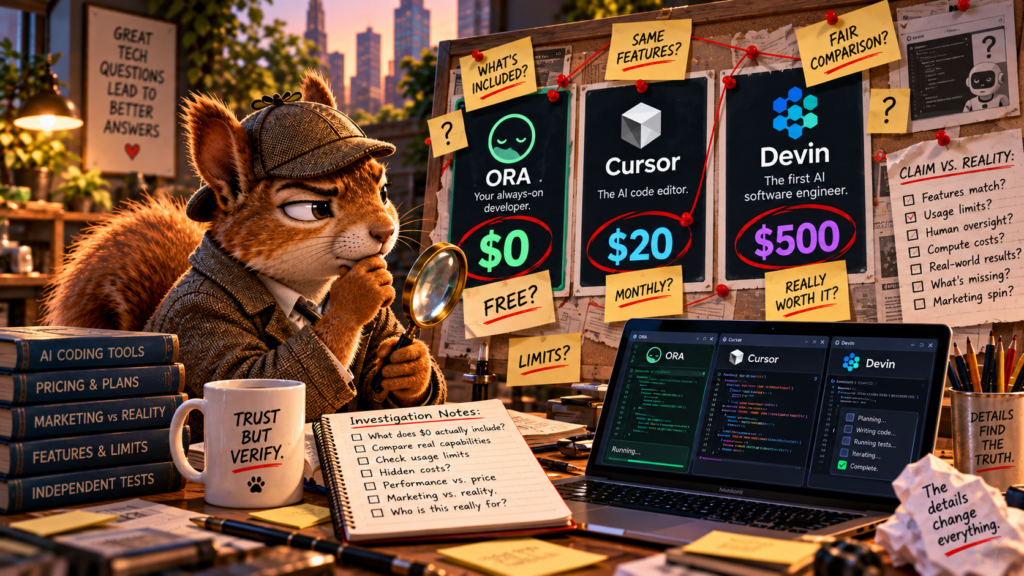
The Facebook ad is wonderfully simple: Cursor: $20. Devin: $500. ORA: $0. Underneath, ORA by Aurem promises “real coding power” on a zero-dollar budget and a limited free-access offer. That is exactly the kind of comparison that deserves a closer look, because all three products have different workflows, limits, and pricing structures. ORA is not imaginary, and its free access is not fabricated, but “$0” does not mean unlimited autonomous software engineering forever.
What ORA Actually Is
According to Aurem’s current product site, ORA connects to a GitHub repository, reads the codebase, plans a change, writes code, runs checks, and can commit the result to a branch after the user approves the ship step. That is a different workflow from a conventional autocomplete assistant. The company emphasizes a Plan → Execute → Verify → Scan → Ship loop, direct GitHub commits, rollback, and a security scanner called Vanguard. In other words, the useful comparison is not simply “three coding chatbots with three prices”; it is three products trying to solve overlapping development problems in different ways.
Where the $0 Claim Comes From
Aurem currently lists a permanent free tier with a limited number of tasks per month, while paid tiers add higher task allowances, additional modes, parallel agents, and support. The company is also running limited promotional offers for early users. Its pricing page currently shows Free, Starter, Pro, and Team tiers rather than one universal $0 plan. That means the ad is anchored in something real, but the headline comparison compresses “free tier or limited promotion” into “ORA: $0,” which is a much more dramatic message than the pricing page itself.
Flat Price Does Not Mean Unlimited Work
One detail worth watching with any AI coding subscription is the unit that gets rationed. Some services meter tokens, some meter requests, some meter agent hours, and ORA meters tasks according to the plan. A flat monthly price can be easier to budget than an open-ended token bill, but it still has an allowance. A small bug fix and a complicated multi-file feature are not necessarily equivalent in the real effort required, even when the subscription interface calls both a task. Small businesses and solo developers should compare the actual work they expect to perform rather than comparing only the number printed in an advertisement.
The Security Claim Needs the Most Caution
Aurem promotes mandatory pre-commit security scanning and says Vanguard checks code before a commit lands. That is a useful design choice, but the company also uses language suggesting ORA “cannot ship insecure code.” No static scanner, AI reviewer, or pre-commit pattern library can guarantee that every security flaw will be detected. Business logic vulnerabilities, broken authorization, unsafe infrastructure configuration, dependency risks, and flaws that emerge only in production can slip past automated checks. Treat security scanning as an additional layer, not as permission to stop reviewing code.
Who Might Actually Benefit
ORA could make sense for a developer, student, or small technical team that already lives in GitHub and wants a task-oriented agent rather than an IDE-first assistant. A nontechnical business owner should be more cautious, because a tool that can modify a repository is powerful precisely because it can make real changes. Use branches, backups, pull requests, tests, least-privilege credentials, and human review. The more autonomous the coding tool becomes, the more important those boring safeguards become.
Bottom Line
The ad is not exposing a fake product, and ORA really does offer a way to start without paying. The squirrely part is the framing: $0 versus $20 versus $500 makes unlike plans look like a clean apples-to-apples contest. The better question is whether ORA’s task limits, GitHub-centered workflow, model quality, security controls, and current paid tiers match the way you actually build software. Free is a great price for testing a tool. It is not a substitute for understanding what happens after the trial.