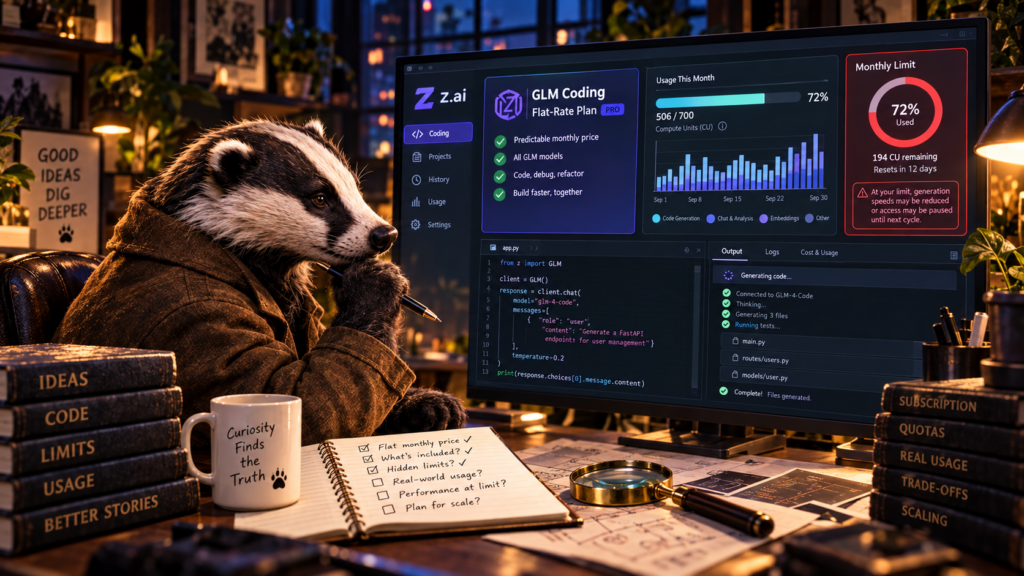
“No more token anxiety” is a message that will resonate with anyone who has watched an AI coding session chew through a context window while quietly wondering what the API bill will look like tomorrow. Z.ai is advertising GLM-5.3 coding access as a flat-rate alternative to unpredictable token billing. The idea is real, but flat-rate subscription should not be confused with unlimited usage. The company has moved its coding plans toward quotas and credits that cap how much work fits inside each tier.
GLM-5.3 Is a Current Coding Model, Not an Old Model in a New Ad
Z.ai released GLM-5.3 in August 2026 with a strong emphasis on long-horizon coding and agentic workflows. Its ZCode environment has continued receiving updates through September, including multi-agent workflows, remote control, and tooling improvements. The company also supports using GLM through multiple coding-agent environments, so the service is broader than one proprietary editor.
The Subscription Still Has Usage Accounting
Z.ai’s current ZCode plan page lists Lite, Pro, and Max coding tiers with weekly credit allowances. The Lite tier currently shows 10,000 credits per week, with higher plans multiplying that capacity. Z.ai has also described a points-based quota system where input, cached input, and output consume capacity differently. That structure is easier to budget than an uncapped pay-as-you-go bill, but it is still metering. A developer can hit a limit even though the monthly subscription price itself is fixed.
Promotional Pricing Needs a Date Attached
The current ZCode page displays discounted prices alongside higher list prices, including a Lite price below its normal monthly figure. Promotions change, and advertisements often outlive the exact offer that inspired them. Before comparing the service against Cursor, Claude Code, Copilot, API usage, or another coding plan, check the live subscription page. A price comparison without the included capacity is incomplete anyway; the cheapest monthly number can become expensive if it repeatedly runs out before the week does.
Long-Horizon Coding Is Where Cost Predictability Gets Interesting
Modern coding agents do much more than autocomplete a line. They read repositories, inspect documentation, execute tools, run tests, compare results, and loop until a larger objective is complete. That can consume a huge amount of context. A quota-based subscription can be attractive when the same codebase context is reused efficiently, especially when cached tokens are billed at a lower rate. The meaningful metric is how many real development tasks your plan completes, not how many raw tokens appear on a usage dashboard.
Open Weights Do Not Eliminate Operating Cost
GLM-5.3 is also part of the open-weight model conversation, but running a capable model yourself shifts the cost rather than making it disappear. Hardware, memory, electricity, deployment, updates, monitoring, and engineering time become your responsibility. For many small teams, a subscription with predictable limits is cheaper than self-hosting even when the model weights are available. For other teams with substantial infrastructure, self-hosting can provide control that a hosted plan cannot.
Bottom Line
Z.ai’s “flat-rate” pitch addresses a real frustration: nobody enjoys budgeting software development around an unpredictable stream of token charges. The current coding plans do provide a fixed subscription price, but they also have credit allowances and usage rules. That is not deceptive by itself; it is simply how the economics work. Compare the monthly price, weekly capacity, model quality, supported tools, privacy requirements, and completed-task throughput. Token anxiety only disappears if the replacement quota fits the way you actually work.