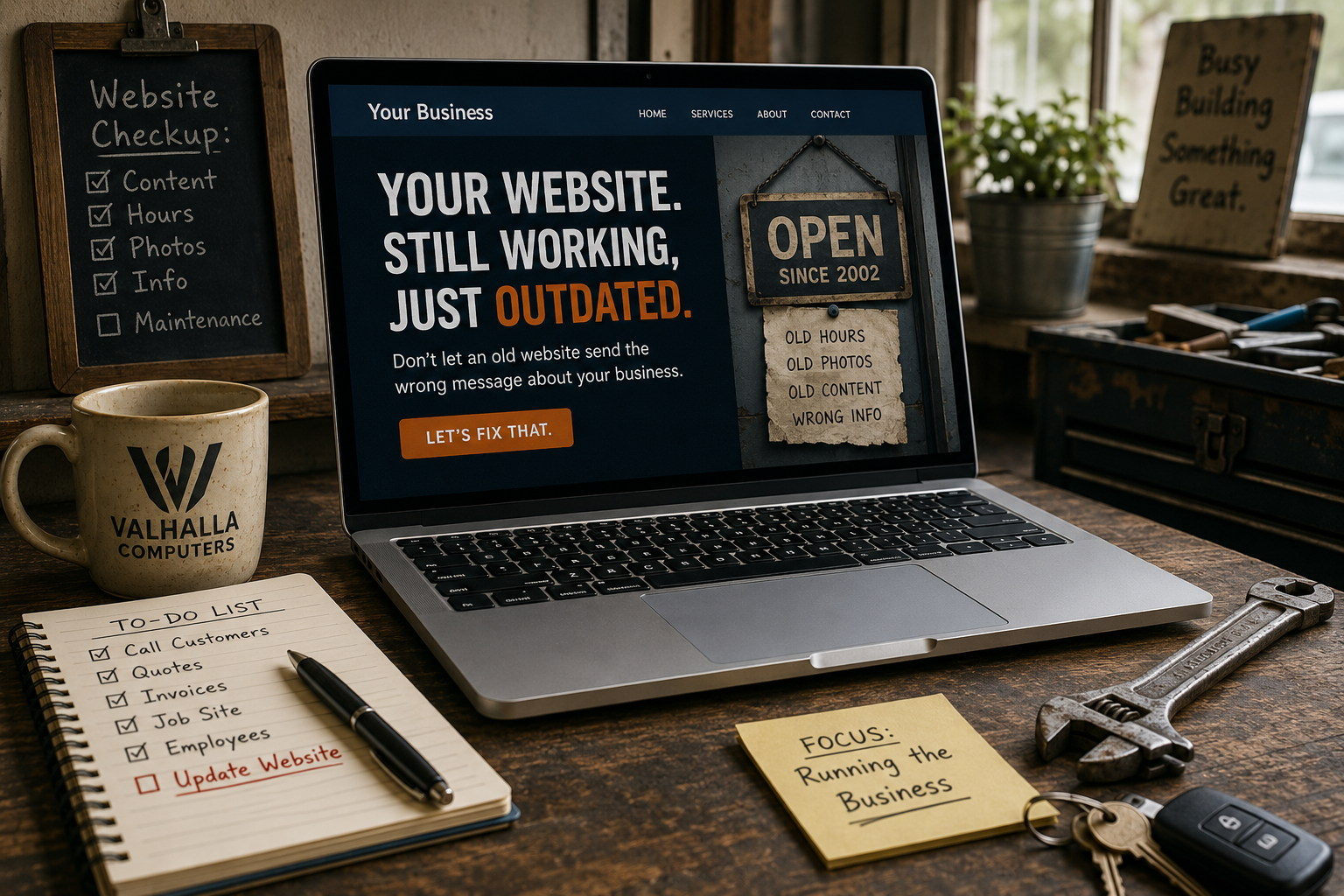
Running a small business already requires an unreasonable number of skills. Depending on the day, the owner may be the salesperson, bookkeeper, customer-service department, purchasing manager, scheduler, marketing department, janitor, delivery driver, and occasionally the person standing in the parking lot trying to figure out why something that worked yesterday suddenly does not work today. Somewhere along the way, the internet added another expectation to that list: apparently every business owner is also supposed to become a web developer.
The problem usually begins innocently enough. A business needs a website, so someone builds one. Maybe it was professionally designed years ago. Maybe a friend helped put it together. Maybe the owner created it with WordPress because the advertisements promised that building a website would be simple. At first everything works. The phone number is correct, the contact form sends messages, the pictures look good, and customers can find what they need.
Then the website begins requiring attention.
WordPress asks for updates. Plugins start displaying warnings. A form stops delivering messages. A page that once looked fine suddenly looks strange on a phone. Google wants something verified. The hosting company sends an email filled with terminology nobody recognizes. An image takes forever to load. A security plugin announces that something needs immediate attention. A theme update changes the appearance of a page. Eventually the business owner finds themselves sitting in front of an administrative dashboard at eleven o’clock at night wondering why running a landscaping company, plumbing business, repair shop, or local retail store somehow now requires understanding PHP versions and DNS records.
It should not.
A business owner should understand what their website needs to accomplish. They should know what information customers need, what services should be featured, how the company should sound, and what makes their business different from competitors. They should not necessarily have to understand every technical mechanism behind making those things work.
A Website Is a Business Tool, Not a Second Career
A useful small-business website has a fairly straightforward job. It should help potential customers understand what the company does, where it operates, why someone should trust it, and how to make contact. Depending on the business, it might also display products, collect appointment requests, answer common questions, provide directions, show previous work, accept payments, or publish useful information.
None of those goals require the business owner to become an expert in web development.
There is an important distinction between understanding a tool and knowing how to manufacture one. Most business owners know how to drive a vehicle without knowing how to rebuild its transmission. A contractor can use accounting software without understanding how the database behind it was engineered. A restaurant owner can operate a commercial refrigerator without knowing how to manufacture the compressor.
Websites should be viewed similarly.
The owner should know whether the website is accomplishing its purpose. They should be able to recognize when information is outdated, when customers are struggling to find something, or when the website no longer accurately represents the business. But there is no particular business advantage in forcing an HVAC contractor to spend Saturday afternoon learning how WordPress caching works unless that contractor genuinely enjoys doing it.
Sometimes the smarter business decision is simply to have someone else handle the technical work.
WordPress Made Websites Easier, Not Effortless
WordPress deserves much of its popularity. It allows businesses to maintain websites that would once have required considerably more custom development. Themes, plugins, visual editors, and hosting tools have made it possible for ordinary users to accomplish things that once required writing code from scratch.
But “easier” should not be confused with “automatic.”
A modern WordPress website is a collection of interconnected components. WordPress itself needs maintenance. Themes receive updates. Plugins interact with one another. Hosting environments change. PHP versions become obsolete. Security vulnerabilities are discovered. Browsers change the way they display certain content. Search engines alter how they evaluate pages. Form-delivery systems can encounter problems. Backups need to exist somewhere other than the server they are supposed to protect.
Most of the time everything works quietly.
Until it doesn’t.
Then the person running the business suddenly has to determine whether the problem comes from WordPress, the theme, a plugin, hosting, email configuration, DNS, caching, SSL certificates, security software, or something completely unrelated.
That is not a reasonable expectation for someone whose actual profession has nothing to do with websites.
The Dangerous Part Is Not Knowing What You Don’t Know
Some website problems are obvious. If the homepage displays an error message, everyone knows something is wrong. If the contact page disappears, someone will eventually notice.
The more expensive problems are often the quiet ones.
A contact form may appear to work perfectly while messages are never actually reaching the business. A website may look normal on the owner’s computer but be almost unusable on a phone. An expired plugin might still function while containing a known security vulnerability. A backup system might report that backups are being created even though nobody has ever tested whether those backups can actually be restored.
A business owner may continue paying for services they no longer need because nobody remembers why they were originally purchased. Old employee accounts may still have administrative access. Pages created years ago may contain incorrect prices, discontinued services, or obsolete phone numbers. Google may continue indexing old material that contradicts what the company currently offers.
None of these problems necessarily announce themselves with flashing red lights.
That is why occasional technical review matters.
It is also why “the website still loads” is not the same thing as “the website is healthy.”
Website Maintenance Does Not Have to Mean Constant Redesign
Another misconception is that maintaining a business website means rebuilding it every few years.
Sometimes a complete redesign is appropriate. Businesses change. Technology changes. A website built fifteen years ago may genuinely be easier to replace than repair.
But many small-business websites do not need to be demolished and rebuilt. They need maintenance.
The difference matters.
A website cleanup might involve updating WordPress and plugins, removing abandoned software, correcting outdated pages, improving mobile display, checking forms, reviewing backups, fixing broken links, cleaning navigation, improving page speed, updating photographs, and making sure important business information is consistent.
None of that necessarily requires replacing the entire site.
This is similar to maintaining almost anything else a business owns. You do not replace a work truck because it needs tires and an oil change. You do not remodel an entire office because one light fixture failed. You determine what is actually wrong and address the problem at the appropriate level.
Small-business websites deserve the same practical approach.
The Owner Still Needs to Be Involved
Hiring someone to handle website work does not mean surrendering control of the business.
In fact, the best arrangement is usually collaborative.
The owner knows the customers. The owner knows which services are profitable. The owner knows which questions people repeatedly ask. The owner knows what competitors misunderstand about the industry. The owner knows which photographs genuinely represent the business and which ones make employees laugh because nobody on the job site has ever looked remotely that clean.
That knowledge is invaluable.
The technical person brings a different set of skills. They know how to organize information on a website, troubleshoot problems, maintain WordPress, improve performance, correct configuration issues, and translate what the business owner wants into something that works online.
Neither replaces the other.
A web developer cannot magically know twenty years of industry experience possessed by the business owner. The owner should not be expected to magically know twenty years of website technology.
The best results happen when each person contributes what they actually know.
Small Problems Become Big Problems When Nobody Owns Them
One of the most common patterns with small-business websites is that responsibility becomes vague.
The employee who originally handled the website leaves the company. The person who built it stops doing freelance work. A relative who “knows computers” helped years ago but no longer remembers the login. The hosting account belongs to an email address nobody uses anymore. Nobody is quite sure whether backups exist or where the domain is registered.
Nothing immediately collapses, so the situation continues.
Then something important happens.
The domain expires. The website is compromised. The hosting company requires verification. The contact form fails. Google sends a security warning. A plugin update breaks something important.
Suddenly everyone realizes nobody actually knows who is responsible for the website.
This is why even a very small business should know several basic things: where the domain is registered, who controls the hosting account, who has administrator access, whether reliable backups exist, and who should be contacted when something stops working.
That does not require becoming a web developer.
It simply means treating the website like an actual business asset.
DIY Is Fine When DIY Makes Sense
There is nothing wrong with a business owner managing their own website if they enjoy doing it.
Some people genuinely like technology. They enjoy learning WordPress, experimenting with layouts, troubleshooting plugins, and understanding how everything fits together. For them, maintaining the website may actually be enjoyable.
The important question is whether the work makes sense for that particular owner.
If spending three hours solving a website problem saves money and the owner enjoys the challenge, wonderful.
If spending those same three hours means losing three service calls, delaying estimates, missing customer emails, or staying up until two in the morning while searching forums for an error message, the economics begin looking very different.
Time has a cost.
Small-business owners are particularly vulnerable to forgetting that because they rarely receive an invoice for their own time.
A task that appears “free” because the owner handles it personally can become extremely expensive when it consumes hours that could have been spent doing the work that generates revenue.
Technical Jargon Should Not Be a Sales Technique
The technology industry has another habit that does small businesses no favors: making ordinary problems sound unnecessarily complicated.
There are certainly complicated website problems. But there is no reason to bury a business owner under terminology simply to make the person providing technical support sound impressive.
If a contact form stopped working because the website was attempting to send mail through an unreliable configuration, explain that.
If a plugin is abandoned and needs replacement, explain that.
If the hosting environment needs an updated PHP version, explain what that means and whether anything could break during the change.
Technical expertise should make technology easier for the customer to understand, not harder.
A small-business owner should be able to ask, “What went wrong?” and receive an answer in ordinary language.
They should also be able to ask, “What are my options?” without every answer conveniently resulting in the most expensive solution.
Trust is especially important with website work because much of the work happens behind the scenes. A customer cannot always visually inspect a database repair or security configuration in the same way they can inspect a new fence or freshly painted room.
Clear explanations matter.
Your Website Should Work While You Are Working
Ultimately, the website exists to support the business.
While the owner is repairing a vehicle, installing an air conditioner, meeting a customer, landscaping a property, preparing an order, or completing any of the thousand other tasks required to keep a small company operating, the website should quietly be doing its own job.
It should be introducing the company to people who have never heard of it.
It should be answering basic questions.
It should be explaining services.
It should be providing contact information.
It should be establishing credibility.
It should be giving customers useful reasons to come back.
And when something technical requires attention, the owner should have somewhere to turn without first earning an unofficial degree in web development.
Knowing When to Ask for Help Is Part of Running a Business
Successful business owners outsource things constantly.
They hire accountants because tax law is complicated. They use attorneys when legal questions matter. They call electricians when electrical work exceeds their experience. They bring vehicles to mechanics when a repair requires equipment or knowledge they do not possess.
Website work is no different.
There is no prize for spending an entire weekend repairing something another person could have corrected in an hour.
The goal is not to prove that you can personally perform every task associated with running a business.
The goal is to run the business well.
At Valhalla Computers, that is how we approach small-business website support. Sometimes a website needs substantial work. Sometimes it needs a careful cleanup. Sometimes one annoying problem simply needs somebody willing to track down what went wrong and fix it.
The business owner does not need another profession.
They already have one.
Your website should support that profession—not require you to learn an entirely new one just to keep it running.