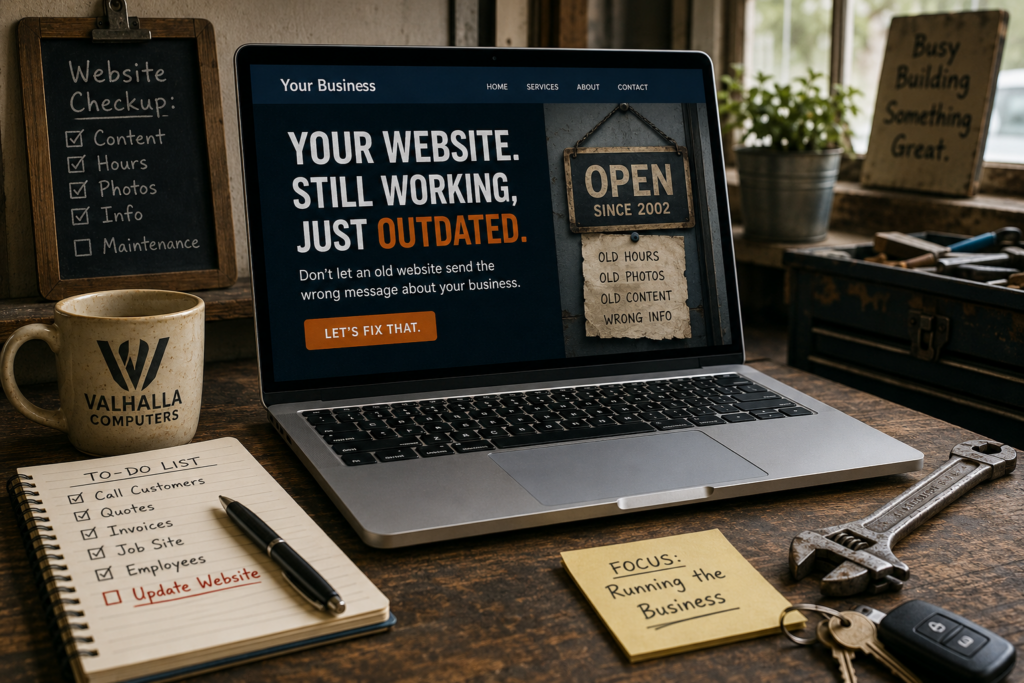
Most small business websites do not become outdated because the owner stopped caring about the business. They become outdated because the owner is busy running the business. The phone rings, a customer needs an estimate, an employee calls out, a delivery is late, equipment breaks, invoices need to be sent, and a job that should have taken three hours somehow consumes the entire afternoon. Somewhere near the bottom of that list is the website that was going to get updated “when things slow down.” Of course, things rarely slow down.
Months pass, sometimes years, and the website remains online and technically functional. Nothing necessarily flashes an error message or announces that something is wrong. Instead, little pieces of the site slowly drift away from the business they are supposed to represent. Services change, hours change, staff members come and go, new capabilities are added, old promotions remain behind, and information that was perfectly accurate when the site was created gradually becomes outdated. The website is not exactly broken. It has simply been forgotten for a while.
Your Website Can Work Perfectly and Still Be Wrong
A website can load quickly, display correctly, and allow customers to navigate from page to page while still doing a poor job for the business behind it. Maybe the phone number is correct but the business hours changed two years ago. Perhaps an employee who left long ago is still listed on the About page, or the company expanded into several new services that the website never mentions. An old promotion may still be visible, the latest blog article may be five years old, or a service page may contain a few lines of placeholder text nobody noticed when the website was originally built.
None of those things necessarily stop the website from functioning, but they absolutely affect how a potential customer sees the company. Someone visiting your website for the first time does not know that you have been too busy taking care of customers to update a paragraph or remove an old photograph. They only know what appears on the screen in front of them, and online first impressions happen quickly. A site that looks forgotten can unintentionally make a perfectly active and professional business look less active and professional than it really is.
Small Details Create Bigger Questions
Some of the most important information on a small business website is also the easiest to overlook. Phone numbers change. Email addresses change. Business hours change. Companies move. Service areas expand. Employees come and go. Certifications are earned. New equipment is purchased. Services are added or discontinued. A customer who finds two different phone numbers on the same website should not have to guess which one works, and someone looking for weekend hours should not have to wonder whether the schedule on the Contact page or the schedule in the footer is correct.
From inside the business these may seem like tiny details, but from the customer’s side they introduce uncertainty. If the website cannot confidently answer a simple question such as when the business is open or which number to call, a visitor may begin wondering what else is out of date. They probably will not stop and carefully analyze the problem. More often, they simply click back, look at another company, and move on.
Outdated information can also undersell a business rather than merely make it look sloppy. Imagine a company website written in 2015 that proudly says the owner has “more than 10 years of experience.” If nobody ever updates that sentence, the website can still be saying the same thing in 2026 even though the owner now has more than two decades of experience. The business earned those additional years; the website simply forgot to tell anybody. The same thing happens with customer counts, years in business, certifications, awards, expanded facilities, additional locations, major projects, and new capabilities. Your website should never exaggerate your history, but it should not undersell what you have genuinely accomplished either.
The Ghosts of Website Builds Past
Anyone who has worked with websites for long enough has encountered content that was obviously never supposed to survive the original build. A page may still say “Insert description here.” A portfolio may contain the fictional example projects that came with the theme. A testimonial may still be attributed to John Doe. A blog landing page may contain the original WordPress sample text, or an About page may suddenly mention a completely different company because somebody reused a template and missed one paragraph during editing.
During development, everyone knows that material is temporary. Six months later, nobody remembers it exists. These leftovers are especially common on pages the business owner rarely visits. The homepage may receive regular attention while an About page, obscure service page, archive, footer, or blog landing page quietly preserves whatever was there when the site launched. Individually these mistakes are usually harmless and easy to correct, but they can make visitors question how carefully the business maintains its online presence.
This is one reason periodically looking through your own website as though you were a customer is so useful. Instead of asking whether the website technically works, ask whether the information makes sense to someone who knows absolutely nothing about the company. Follow the navigation, read the service descriptions, check the contact information, click the buttons, and look at pages you normally ignore. A fresh set of eyes often discovers things that have become completely invisible to the person who sees the website every day.
Old Content Can Make an Active Business Look Inactive
A blog or news section can be an extremely useful part of a small business website, but an abandoned one can send an unintended message. Imagine arriving at a company website in 2026 and finding a prominent section labeled “Latest News” where the newest article is from 2019. A visitor may wonder whether the company is still operating, whether anyone maintains the website, and whether the services listed elsewhere are still current. They may never consciously form those questions, but the impression remains.
That does not mean every small business suddenly needs to publish something three times a week. Most do not, and filling a website with generic material simply to satisfy a publishing calendar rarely helps anybody. A smaller number of substantial, useful articles published consistently can be far more valuable than dozens of short posts that say very little. The goal should not be to prove that someone remembered the blog password. The goal should be to answer questions customers genuinely have.
Fortunately, most business owners already possess an endless source of topics because customers supply them every day. A plumber hears, “Why does this drain keep clogging?” An HVAC technician hears, “Why is my air conditioner running all day?” A mechanic hears, “Why does my car shake when I brake?” A landscaper hears, “Why does my yard stay wet for days after it rains?” A handyman hears, “Can this be repaired, or does it need to be replaced?” Every one of those questions can become useful website content because each begins with an actual customer problem rather than a marketing department trying to invent something to say.
Your Website Should Represent the Business You Run Today
Keeping a website current does not mean constantly redesigning it. In fact, a website that is structurally sound, easy to navigate, and accomplishing its job may not need a major redesign for years. What it does need is occasional attention. The services should still be accurate, the phone number and email address should work, the business hours and service area should be correct, and the About page should describe the company that exists today. Photographs should reasonably represent the current business, links should lead somewhere useful, old promotions should disappear when they expire, and customers should be able to find information that helps them decide whether you are the company they need.
The mobile version matters too. A site that looked perfectly respectable on a desktop computer when it was created years ago may be unpleasant to use on the phone where many customers now encounter it. Buttons become difficult to tap, text may be awkwardly sized, images may overwhelm the screen, forms can become frustrating, and information that seemed conveniently placed on a large monitor can require endless scrolling on a smaller device. None of that necessarily requires rebuilding the website from scratch, but it deserves attention.
The Website Usually Gets Neglected for a Very Good Reason
There is an important point here that gets lost in a lot of marketing advice: a plumber should spend most of the day doing plumbing. A mechanic should spend most of the day repairing vehicles. A contractor should be running jobs, and a restaurant owner already has enough to worry about between food, staff, inventory, vendors, schedules, and customers. Expecting every small business owner to simultaneously become a web developer, copywriter, search specialist, graphic designer, social media manager, photographer, and WordPress technician is unrealistic.
In many cases the website falls behind precisely because the owner is putting time where the business needs it most. That is not laziness or incompetence; it is prioritization. The problem is simply that eventually someone still needs to take care of the digital side. One outdated sentence probably will not cost a company a customer, and neither will one old photograph, forgotten article, or awkward paragraph. But websites are judged as a whole. An outdated phone number combined with an ancient copyright date, a dormant blog, inconsistent service information, a broken link, and leftover template content can begin presenting a very different picture from the successful business operating behind it.
You Probably Don’t Need to Throw Everything Away
There is an entire industry built around convincing business owners that every website problem requires throwing away the existing site and starting over. Sometimes that really is necessary. Technology gets too old, designs become unusable, security becomes difficult to maintain, and businesses occasionally outgrow the structure they began with. But often a complete rebuild is unnecessary.
If the structure still works, the site loads properly, customers can navigate it, and the underlying system is healthy, a thoughtful cleanup may accomplish far more for considerably less money and disruption. Update the information, correct the obvious mistakes, remove things that no longer belong, strengthen weak pages, add useful content, check the mobile experience, and make sure customers can easily find what they need. Sometimes the website was never truly broken. It was simply forgotten for a while.
That’s Where Valhalla Computers Comes In
Valhalla Computers has been working with computers and websites under the Valhalla name since 2002. Today, much of that experience is focused on helping small businesses keep their digital presence useful, accurate, and professional without forcing the owner to become another kind of technician after the workday is already over. That may mean cleaning up an existing website, helping with WordPress, creating substantial customer-focused articles, producing supporting images and social content, or simply finding the little problems that have been sitting unnoticed for years.
The goal is practical. Your website should represent the business you are running today, not the business you were running the last time somebody remembered to update it. If you suspect your website may have been forgotten for a while, Valhalla Computers can take a look. Sometimes a fresh set of eyes and a little maintenance are all that stand between an aging website and one that starts working for the business again.