Something’s Squirrelly – Episode 2: The Printer You Pay For But Never Own
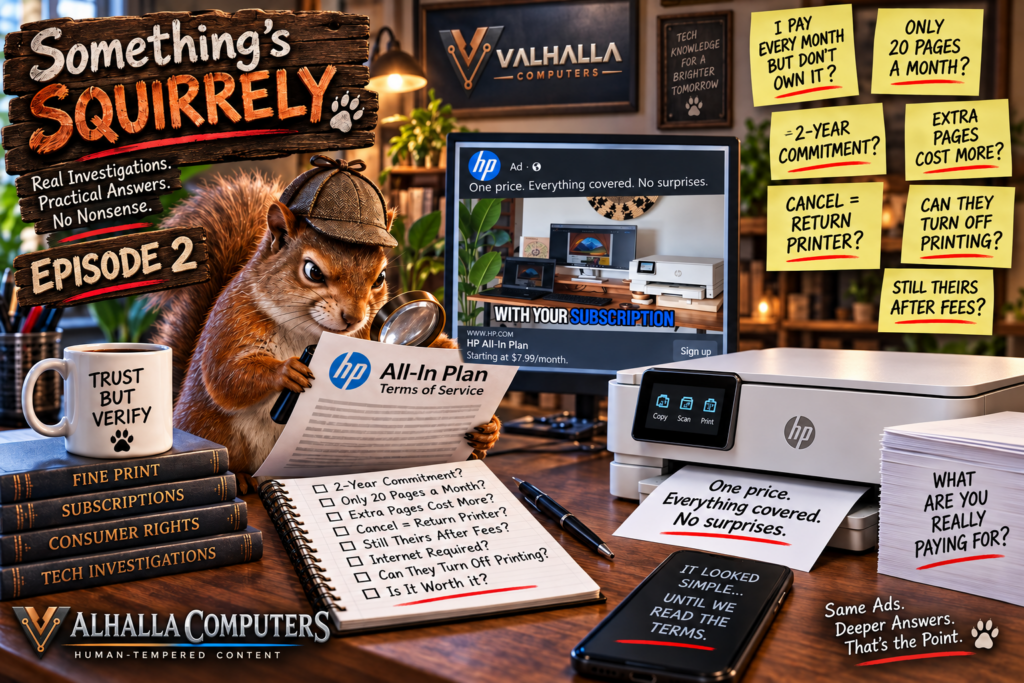
There are subscription services for music, television, software, cloud storage, meal delivery, automobiles, phones, and just about everything else somebody can figure out how to bill monthly. So perhaps it was only a matter of time before the humble home printer joined the subscription economy. That is the basic idea behind HP’s All-In Plan, a printer subscription advertised with wonderfully reassuring language such as “One price. Everything covered. No surprises.” The Facebook advertisement that caught our attention promotes plans starting at $7.99 per month and presents the service as a convenient way to get a printer, ink delivery, support, and ongoing hardware coverage without paying the full cost of a new machine upfront.
On the surface, that sounds pretty reasonable. A relatively small monthly payment gets a printer delivered to your home, HP keeps ink coming, technical support is included, and replacement hardware may be provided when something fails. For somebody who hates dealing with cartridges, warranties, and unreliable printers, there is a legitimate convenience argument to be made. The squirrel only became interested when we started reading exactly what that monthly payment buys, because one of the most important facts about the All-In Plan is also one of the easiest to overlook when you see the advertisement: you are not purchasing the printer. You are subscribing to the right to use it. HP retains ownership of the printer throughout the subscription, and completing the commitment period does not automatically transfer that ownership to the customer.
$7.99 Per Month Sounds Cheap Until You Define the Product
HP’s current entry-level All-In Plan starts at $7.99 per month and includes an HP Envy-class printer with an allowance of approximately 20 printed pages per month. Unused pages can roll over up to the plan’s specified limit, and customers who exceed the monthly allowance are charged for additional page blocks. For someone who occasionally prints shipping labels, insurance documents, school forms, recipes, or a few business pages, twenty pages may be entirely sufficient. Someone printing tax packets, craft patterns, photographs, business proposals, school projects, or large documents could reach that allowance much faster.
The important distinction is that the monthly fee is not simply a payment toward eventually owning the hardware. It buys access to a package containing the printer, page allowance, ink delivery, support, hardware coverage, and the other services attached to the subscription. If a customer remained on a $7.99 plan for two full years, the base subscription alone would total approximately $191.76 before taxes, extra pages, or other applicable charges. At the end of that period, the customer still would not own the printer. That does not automatically make the plan expensive or unreasonable. It simply means the consumer should compare HP All-In as a service arrangement, not as a discounted installment plan for purchasing hardware.
That distinction matters because the monthly price can feel psychologically similar to financing. Most of us are accustomed to paying monthly for cars, phones, appliances, and other equipment with the assumption that ownership may eventually transfer. HP’s model is closer to renting or leasing equipment together with a printing service. As long as the customer understands that difference before signing up, there is nothing inherently wrong with it. The squirrel becomes interested when the advertisement feels simpler than the relationship actually is.
The Printer Remains HP Property
HP’s terms make ownership unusually clear. The company retains title to the printer and the subscription cartridges throughout the relationship. If the customer leaves the plan, upgrades, or otherwise ends the service, the printer is expected to be returned. Completing the contractual commitment does not make the printer yours, paying an early cancellation fee does not make it yours, and even paying an unreturned-printer fee does not automatically transfer ownership.
That makes the All-In Plan substantially different from purchasing a printer with financing. It is closer to leasing a modem from an internet provider or leasing a vehicle. You may use the equipment for years and benefit from everything it provides, but the machine sitting on your desk still belongs to the company providing the subscription.
For many customers, that may be perfectly acceptable. Plenty of people do not care who legally owns the box sitting beside the computer as long as it works when needed. Others may find the concept uncomfortable because printers have traditionally been inexpensive consumer equipment purchased outright, kept until they fail, and eventually replaced. HP is changing that relationship from hardware ownership to service access, and consumers should understand that shift before comparing a monthly subscription price with the retail cost of buying a printer.
The Low Monthly Price Also Comes With a Commitment
The All-In Plan is not simply a casual month-to-month rental that can always be abandoned immediately without consequence. HP currently places many cartridge-based printers under a two-year commitment, while certain Smart Tank offerings can involve longer commitments. Customers generally receive an introductory period during which cancellation is easier, but after that period, early cancellation fees can apply depending upon the printer model and how early the customer leaves the plan.
For lower-cost models, those fees may be relatively modest, while more expensive printers can carry substantially higher charges. HP’s current terms show that the amount generally decreases as the customer gets closer to completing the commitment. From HP’s perspective, the structure makes sense because the company is shipping customers hardware without requiring them to pay the retail purchase price upfront. The company naturally wants protection against someone ordering a printer, using it briefly, canceling immediately, and effectively treating the subscription as a cheap hardware giveaway.
The issue is not that a commitment exists. The issue is that “Starting at $7.99 per month” sounds considerably more flexible than “Starting at $7.99 per month with a multi-year commitment and possible early cancellation fees.” Both statements can be true, but the second gives a consumer a much more complete picture of what is being purchased.
Canceling the Service Means Returning the Printer
When a customer cancels the All-In Plan, HP expects the printer and subscription supplies to be returned. HP provides the return process and prepaid shipping materials, but the customer still has to send the equipment back within the timeframe established by the agreement. Failure to return the printer can result in an additional unreturned-equipment fee based on the model.
What makes this particularly interesting is that paying the unreturned-printer fee still does not necessarily convert the printer into something the customer now owns. HP’s terms specifically protect the company’s ownership interest even when fees become due because equipment was not returned. In other words, the fee is not presented as a buyout price.
That detail may surprise people because many rental arrangements train consumers to think of a replacement fee as the point where ownership essentially becomes irrelevant. Lose a rental item, pay the replacement cost, and the matter feels finished. HP’s language is much more explicit: the printer is their equipment, and the fee does not automatically convert the relationship into a sale.
That is exactly the kind of fine-print distinction our squirrel likes to drag into the daylight.
The Printer Also Needs to Stay Connected
Another important part of the All-In Plan is internet connectivity. HP requires the subscription printer to remain connected so the service can monitor usage, manage the subscription, handle ink delivery, and confirm account status. If the printer becomes disconnected for an extended period, some subscription functions may stop working, including printing itself, while monthly charges can continue until the customer actually cancels the plan.
For most users, this may never become an issue because modern printers are already connected to Wi-Fi. But it changes the nature of the device. A traditional printer usually operates as local hardware. You install it, connect a cable or Wi-Fi network, and expect it to keep functioning regardless of whether an outside subscription server knows what you are doing. Under the All-In model, the printer becomes part of a managed service where connectivity and account status are directly related to the ability to use the hardware.
That may sound perfectly normal to people accustomed to streaming subscriptions, cloud software, and connected devices. It may sound much less appealing to someone who believes that pressing Print should result in paper coming out whether or not a remote account server happens to be happy that day.
A Missed Payment Can Affect the Ability to Print
One of the most interesting details in the agreement is what happens when the subscription account becomes delinquent. HP reserves the right to suspend or restrict service if payment cannot be collected. Certain functions such as scanning may remain available, but the company can revoke or suspend the customer’s ability to print until the account is brought current.
That creates a situation that would have sounded bizarre during most of the history of home computing. A mechanically functional printer can be sitting on the desk with paper loaded, ink installed, electricity connected, and no hardware failure whatsoever, yet the customer may still be unable to print because the subscription account is not active.
From HP’s perspective, the logic is straightforward. The customer does not own the printer and is paying for printing access as part of a service. From the consumer’s perspective, however, it represents a significant philosophical change in what a printer actually is. The machine stops being purely hardware and becomes what could reasonably be described as a service endpoint. The subscription is no longer merely providing convenience around the printer; it becomes part of the printer’s ability to perform its primary purpose.
That does not automatically make the model unacceptable. It simply means anyone considering it should understand that the physical presence of the printer does not guarantee continued printing access if the subscription relationship stops.
Disconnecting the Printer Does Not Cancel the Subscription
Another detail worth understanding is that disconnecting the printer, removing the ink, or simply choosing not to use the equipment does not end the billing relationship. The customer has to follow HP’s actual cancellation process. This is normal for subscription services, but it can feel counterintuitive when the subscription is attached to a physical household device.
Turning off Netflix does not cancel Netflix, and unplugging a cable modem does not cancel internet service. The same logic applies here. The fact that the printer is sitting unused does not mean the service has ended. Monthly charges can continue until the customer formally cancels.
The difference is psychological. People have decades of experience thinking of printers as appliances rather than recurring services. HP is asking customers to treat the printer more like telecommunications equipment or subscription software, where the physical device and the billing relationship remain tightly connected.
HP Does Provide Real Benefits in Return
It would be unfair to describe the All-In Plan as nothing more than an elaborate scheme to keep ownership of a printer forever. The service includes benefits that could genuinely matter to certain customers. Automatic ink delivery removes one of the most annoying parts of printer ownership. Hardware coverage can reduce the risk of suddenly having to replace a failed machine. Technical support is included, and qualifying failures may result in replacement hardware being shipped quickly.
For someone running a small home business, working remotely, teaching from home, or simply depending on a printer regularly, downtime can be considerably more expensive than the subscription itself. If a machine fails the night before an important project and HP can replace it quickly, the value of the service becomes easier to understand. Someone who dislikes troubleshooting printer problems may also appreciate having the manufacturer remain responsible for hardware it still owns.
The subscription can also make budgeting easier. Instead of periodically buying expensive ink cartridges and occasionally replacing an entire printer, the customer pays a predictable monthly amount based largely on expected page usage. For someone whose printing habits are consistent, that predictability may be worth the tradeoff.
The All-In Plan is therefore not automatically a bad product. It is a product designed around convenience rather than ownership, and those are two different purchasing priorities.
The Page Allowance May Matter More Than the Printer Model
The advertisement naturally emphasizes the printer sitting in an attractive home office, but the page allowance is arguably more important than the hardware for many customers. The entry-level plan includes only a modest number of pages each month, and although unused pages can roll over, heavy printing can still trigger additional charges.
That means customers need to think about printing in much the same way mobile-phone customers once thought about minutes and text messages. How many pages are included? How many rolled over? How much is the next block? Did this month happen to include a large tax return, school project, business proposal, genealogy archive, or craft pattern that suddenly multiplied normal usage?
A light user may never care. Someone who prints thirty or forty pages most months may simply choose a higher plan. The problem comes when somebody signs up based primarily on the low monthly price without realizing that the attractive entry point represents a limited page allowance rather than unlimited printing.
Again, this information is available. The squirrel is not accusing HP of hiding the existence of page limits. The point is that the page allowance is part of the price, and the advertisement’s opening number only tells part of the story.
Upgrades Can Keep the Subscription Cycle Going
One of the attractive features HP promotes is the possibility of receiving newer hardware after the customer has been in the program long enough. That can be genuinely useful. Traditional printer ownership often means keeping a machine until it becomes unreliable, obsolete, or so hostile toward Wi-Fi that the owner begins considering violence. Under a subscription model, customers may periodically move into newer hardware without making another large purchase.
The tradeoff is that an upgrade can begin a new commitment associated with the replacement printer. That means the customer should not think of an upgrade as HP simply gifting them another machine after years of loyalty. The newer printer remains part of the ongoing subscription relationship and remains HP-owned equipment.
For customers who enjoy always having relatively current hardware, that may be a benefit. For someone who normally buys a printer and keeps it for eight or ten years, the subscription could result in paying indefinitely for equipment that never becomes theirs.
There is no universal answer as to which model is better. It depends entirely on how much the customer values ownership compared with convenience.
This Is Different From HP Instant Ink
It is also important not to confuse the All-In Plan with HP’s better-known Instant Ink subscription. Instant Ink traditionally focuses on ink and page usage while the customer owns a compatible printer separately. The All-In Plan goes much further by including the actual printer hardware as part of the subscription.
That distinction matters because the consumer relationship is fundamentally different. With Instant Ink, the customer generally owns the printer and subscribes to supplies. With All-In, HP owns the printer, provides the ink, manages the page allowance, supplies support, monitors the equipment, and charges the customer for continued access to the entire package.
In some ways, that actually makes the All-In model more internally logical. If HP owns the equipment, it makes sense that HP controls support, cartridge supply, replacement, monitoring, and usage rules. The question is whether the customer realizes that this is the arrangement being offered when the advertisement is condensed into the appealing phrase “One price. Everything covered. No surprises.”
“No Surprises” Depends on Whether You Read the Agreement
Once the terms are actually read, HP is relatively explicit about how the program works. The company states that it owns the printer, identifies the commitment period, explains cancellation fees, describes page allowances, discusses additional-page charges, requires connectivity, establishes return requirements, and explains what can happen when payments stop.
The details are not invisible. They are simply considerably more complicated than the advertisement.
That is where the squirrel ultimately lands. $7.99 per month sounds like an inexpensive printer. What the customer is actually evaluating is a multi-year hardware-and-service subscription where HP owns the printer, limits monthly page usage according to plan, manages the ink, requires internet connectivity, can charge for additional pages, may impose early cancellation fees, expects the equipment returned when service ends, and can suspend printing if the subscription account is not current.
Some customers may read all of that and still decide the service is a bargain.
Others may immediately drive to the nearest store and buy a printer they can unplug from the internet without asking anyone’s permission.
Both reactions are reasonable.
Who Could Actually Benefit From HP All-In?
The All-In Plan makes the most sense for someone who values convenience more than hardware ownership. A home-office user with predictable print volume might appreciate the fixed monthly cost and automatic ink delivery. Someone who cannot afford printer downtime may value replacement coverage. An older or less technically inclined customer may prefer having HP responsible for troubleshooting and hardware failures. A household that rarely prints but somehow always discovers empty cartridges at the worst possible moment may appreciate the supplies arriving automatically.
For those customers, the monthly payment is buying more than ink or plastic hardware. It is buying convenience, support, predictable billing, and the transfer of maintenance responsibility back to HP.
Convenience has real value.
The important thing is recognizing that convenience is what is being purchased.
Who May Be Better Off Buying a Printer?
Someone who dislikes recurring subscriptions, uses third-party ink, keeps printers for many years, wants full control over their hardware, prints unpredictably, or prefers devices that continue working without an active online account may find the All-In model much less attractive.
That person may be happier paying $100, $150, or $250 once, owning the machine outright, buying ink when needed, and accepting responsibility for whatever happens afterward.
Traditional ownership is not automatically cheaper, either. Ink can be expensive, printers fail, replacement costs add up, and cheap consumer printers have earned their reputation for finding new and creative ways to become irritating.
The point is not that ownership always wins.
The point is that ownership and subscription are different products, and the monthly number alone does not tell you which one will be cheaper or more useful for your situation.
So, Is Something Squirrelly?
Yes, although once again the squirrel has not uncovered a fake company, imaginary service, or obvious scam. HP is one of the largest computer and printer manufacturers in the world, and the All-In Plan is a genuine service with publicly documented terms.
What makes it squirrelly is how radically the concept of a familiar household printer changes once that device becomes part of a subscription ecosystem. You can pay for years without ever owning the hardware. You can complete the commitment and still be expected to return it. You can pay an early termination fee without gaining ownership. You can have a printer physically sitting beside you with ink and paper installed and still lose the ability to print if the subscription account is suspended.
For some customers, the benefits may absolutely outweigh those restrictions. They may prefer never having to buy another printer, hunt for cartridges, deal with hardware failures, or wonder whether the machine will survive another year.
For other customers, the idea that a printer sitting in their own house can stop printing because a monthly account is not active will be enough to end the discussion immediately.
Neither reaction is wrong.
Just understand what you are actually signing up for.
HP All-In is not really selling you a printer for $7.99 a month.
It is selling you printing as a service.
And apparently our squirrel has now discovered that even the humble printer has joined the subscription economy. 🐿️
Something’s Squirrelly.
Sources Worth Reading
HP’s official All-In Plan pages explain available printers, monthly pricing, page allowances, rollover pages, additional-page charges, commitment periods, support benefits, upgrades, and equipment-return requirements. HP’s current All-In Plan Terms of Service provide the more detailed rules governing printer ownership, connectivity requirements, payment defaults, printing suspension, cancellation fees, unreturned-printer fees, equipment returns, and termination. HP’s support documentation provides additional details about how monthly page allowances and rollover pages are calculated.
Anyone considering the service should read the current terms associated with the exact printer and plan being offered before deciding whether the subscription is cheaper or more convenient than simply purchasing a printer outright.