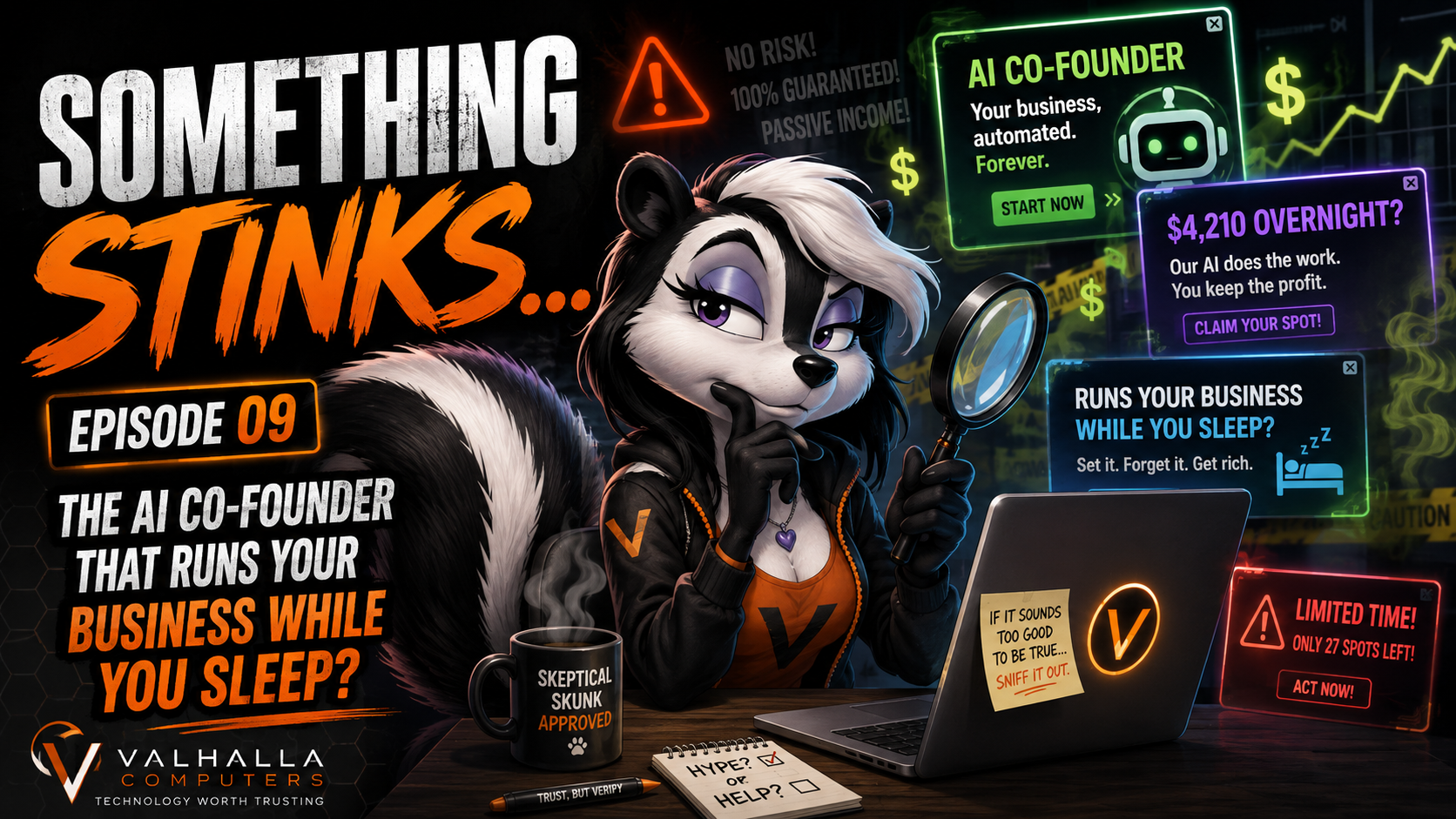
There is a particular kind of advertisement that practically writes a Something Stinks article for us. It does not necessarily advertise a fake product. It does not have to make an obviously impossible promise. It simply has to present something in such wonderfully effortless terms that one question immediately comes to mind: What part are you not telling me?
Enter Supercreator.
The Facebook advertisement that crossed my screen opens with a problem that anyone running a popular social-media account can understand: “Tired of playing catch-up with 100+ DMs a day?” Fair enough. Anyone who has ever managed a busy inbox knows that responding to every message can become a full-time job by itself. Miss a message, take too long to respond, and someone loses interest. If your income depends on maintaining conversations with subscribers, the problem becomes even more serious.
Supercreator’s solution sounds delightfully simple. According to the advertisement, “Supercreator gives OnlyFans creators a full AI team. Chatting. Selling. 24/7.”
That certainly sounds convenient.
Apparently the days of hiring people, training them, scheduling shifts, watching performance, dealing with sick days and making sure somebody is actually answering messages are over. Instead, you get a tireless artificial-intelligence sales department that never sleeps. While you are eating dinner, taking a shower or lying on a beach somewhere, your computerized workforce is chatting with fans, pitching content and making money.
There is even a big inviting “Start Free Trial” button.
What could possibly stink about that?
Well, let’s start with the part that made the skunks reach for the magnifying glass: Supercreator’s own terms tell a slightly more complicated story than the advertisement.
Supercreator does indeed offer an AI chatter called Izzy. According to the company’s documentation, the system can communicate with fans, use information supplied by the creator to emulate their personality and conversational style, recommend and sell content, and perform other tasks that would otherwise require a creator or human chatter to remain involved in those conversations. The company even describes the Super AI tier as putting Izzy “on autopilot.” So there is genuine technology behind the advertisement. This isn’t a case where someone simply pasted the letters AI onto an ordinary inbox and called it revolutionary.
Then we reach Supercreator’s Terms and Conditions.
Those terms specifically require the customer to inform end users that they are interacting with an AI system rather than a human chatter. That point alone is worth noticing because the entire purpose of training Izzy on a creator’s biography, communication style and personality is to make the conversation feel natural and personalized. Supercreator’s own setup instructions encourage creators to describe themselves thoroughly so the AI can learn how they speak and interact with fans. The system is designed to communicate in the creator’s style, but according to the company’s terms, the fan is still supposed to be told that the conversation is actually being handled by artificial intelligence.
That is not necessarily a bad thing. In fact, disclosure is arguably exactly what should happen when an AI is communicating with someone in another person’s voice.
But it does make the marketing considerably more interesting.
Then comes the even better part.
Supercreator’s terms say customers must review and evaluate all AI outputs before their use. The company explains that AI can contain inaccuracies and says human intervention and review are “crucial.” The following section goes even further, warning that AI output may not always be accurate, reliable, safe, beneficial, available or complete.
Wait a minute.
Didn’t we just hire a “full AI team” that chats and sells 24/7?
Because “full AI team working around the clock” and “a human needs to review the AI’s output before use” sound like two rather different levels of automation.
If Izzy is simply helping a human compose responses, that requirement makes perfect sense. The AI drafts something, the creator or employee reviews it, approves it and sends it. Plenty of AI tools work exactly that way.
But Supercreator also markets Izzy as an autonomous chatter that can operate on autopilot.
That leaves a fairly obvious question: How does a creator review every output before use while the AI is simultaneously chatting autonomously with fans around the clock?
Maybe there is a workflow or configuration distinction buried deeper in the product. Maybe some modes are supervised while others operate automatically. But the contrast between the advertisement and the legal language is precisely why reading beyond the Facebook ad matters. The advertisement sells freedom from constant messaging. The terms remind you that the machine can make mistakes and place responsibility for reviewing its output back on you.
In other words:
Congratulations on your new employee. Please supervise it.
And our AI sales department hasn’t even received its first paycheck yet.
The Facebook advertisement prominently invites potential customers to “Start Free Trial,” which again sounds wonderfully inexpensive. Supercreator does have a free CRM Lite plan, so the word “free” is not imaginary. There is just one little problem if what attracted you was the 24/7 AI salesperson shown in the advertisement.
The free CRM Lite plan includes no Izzy AI messages at all.
According to Supercreator’s current pricing documentation, CRM Lite is free for as many as ten accounts, but Izzy is not included. The next level, CRM Premium, starts at $15 per account per month and includes a limited number of AI messages. The actual Super AI tier—the one offering the autonomous Izzy experience—starts at $99 per OnlyFans account per month plus 5% of the net sales generated by the AI. Pricing then scales according to the account’s earnings.
Again, there is nothing inherently wrong with charging for software.
Developing an AI system costs money. Running one costs money. If a tool genuinely increases a creator’s sales enough to justify its price, $99 per month could be an excellent investment.
But “Start Free Trial” beside an advertisement for a 24/7 AI sales team creates a very different first impression from “the autonomous AI tier begins at $99 per account per month plus a percentage of the sales it generates.”
The difference becomes even more interesting when we look at how those AI conversations are actually metered.
Supercreator does not simply charge the monthly fee and unleash Izzy into an infinite ocean of messages. The system uses AI message credits. Every response Izzy sends consumes an AI message. The included allowance depends on the plan and the creator’s earnings tier. Supercreator gives the example of 2,000 AI messages at the $99 Super AI tier. Once those included messages are exhausted, additional messages can be purchased through packages beginning at approximately three cents per message, with larger packages reducing the per-message cost.
And what happens when your tireless 24/7 AI employee runs out of messages?
It stops.
Supercreator’s own documentation says Izzy pauses when the account’s AI-message quota is exhausted. The AI begins working again when the monthly quota refreshes, when the customer purchases additional messages, or when the optional automatic package upgrade adds more capacity. Supercreator specifically recommends enabling Auto-Upgrade to prevent Izzy from going offline.
So perhaps “never sleeps” would be more accurately written as:
Never sleeps, provided the meter is still running.
That doesn’t make the pricing unfair. Usage-based AI pricing is common because generating AI responses consumes computing resources. The more you use the service, the more it costs the provider to operate.
But it is another example of how dramatically different the product sounds once we replace advertising language with ordinary language.
The advertisement says you receive a full AI team chatting and selling 24/7.
The actual arrangement is closer to this: you subscribe to software that can automate conversations and sales activities, the autonomous tier starts at a monthly fee per account, the company receives a percentage of qualifying AI-generated sales, AI conversations consume a limited message allowance, additional usage can cost extra, the AI can stop when that allowance is exhausted, fans are supposed to be informed that they’re communicating with AI, and the terms tell the customer that human review of AI output is crucial.
That’s still potentially a useful product.
It just sounds considerably less like hiring an army of immortal salespeople.
There is another reason this deserves attention beyond simply making fun of an overly enthusiastic Facebook advertisement. Artificial intelligence is rapidly blurring the line between assisting a person and pretending to be a person, and platforms built around personal relationships sit directly in the middle of that issue.
OnlyFans is an especially interesting example because subscribers are not necessarily paying only for photographs or videos. Part of what many creators sell is access and personal interaction. A subscriber may place value on receiving a response because they believe the creator personally read their message and personally responded to them.
An AI that can convincingly imitate the creator fundamentally changes that transaction.
Supercreator seems to recognize this problem, which presumably helps explain why its terms require disclosure that the person on the other side is interacting with AI. That requirement is significant. It acknowledges that there is a meaningful difference between talking to the creator and talking to software designed to communicate like the creator.
This isn’t unique to adult-content platforms either.
The same question is going to appear everywhere.
Imagine hiring a financial adviser and later discovering every conversation was actually handled by an AI trained to sound like your adviser. Imagine believing you were receiving personal responses from a fitness coach, consultant, musician, influencer or customer-service representative when software was actually conducting the conversation. Sometimes that distinction may not matter at all. Sometimes it may matter enormously.
The important part is knowing which one you’re getting.
That makes Supercreator’s disclosure requirement one of the more responsible elements of the system, even if it slightly deflates the fantasy presented in the advertisement.
There is also something slightly wonderful about the circular nature of modern AI marketing.
First, AI is advertised as the technology that eliminates the need for people.
Then the legal terms tell you that people are crucial because AI makes mistakes.
Then the AI is advertised as working around the clock.
Then the billing documentation explains that it stops when the message allowance runs out.
Then you’re offered automatic billing upgrades to make sure the tireless employee remains tireless.
We have apparently recreated payroll, supervision and overtime using tokens.
To be completely fair, none of this demonstrates that Supercreator is a scam. It appears to be a real company offering a real product with genuine AI functionality. The company provides substantial documentation explaining how Izzy works, how it is configured, how AI messages are counted and how its pricing operates. A creator managing hundreds of daily messages may genuinely find the system enormously valuable. If the AI generates enough additional sales, the subscription and commission could easily pay for themselves.
That’s not the smell.
The smell comes from the enormous gap between the effortless fantasy presented in the advertisement and the considerably more complicated reality found in the documentation.
“Full AI team. Chatting. Selling. 24/7.”
That’s fantastic copy.
It sounds considerably better than:
“Automated AI messaging software that requires disclosure, carries usage limits, may need human review, starts at $99 per account for autonomous operation, receives a percentage of AI-generated sales and may stop chatting unless you buy more message capacity.”
Probably wouldn’t fit on the Facebook graphic either.
This is exactly why we keep saying the same thing throughout the Something Stinks series: the big print tells you what to want. The small print tells you what you’re actually buying.
Artificial intelligence does not change that rule.
If anything, AI makes the rule more important because terms such as autonomous, AI team, agent, copilot, 24/7, and fully automated can create an impression of independence that the actual product may not completely deliver.
So if you’re considering something like Supercreator, don’t simply ask whether the AI works.
Ask how much human supervision it requires. Ask whether customers are told they are interacting with AI. Ask what happens when the AI says something wrong. Ask who is responsible when that happens. Ask how usage is measured. Ask what happens when you exceed the included allowance. Ask what percentage of sales the platform receives. And most importantly, calculate whether the additional revenue produced by the AI actually exceeds what you are paying for the privilege of having it.
Because a computerized salesperson can still be an expense.
A chatbot can still require supervision.
An autonomous employee can apparently still run out of minutes.
And sometimes your “full AI team” turns out to be less like hiring a staff and more like adopting a very ambitious digital teenager.
It works all night.
It spends your money.
It occasionally says something questionable.
And apparently you’re still responsible for checking on it.