
Something Stinks: Your 100,000-Word “Finished Book” Apparently Still Needs a Writer
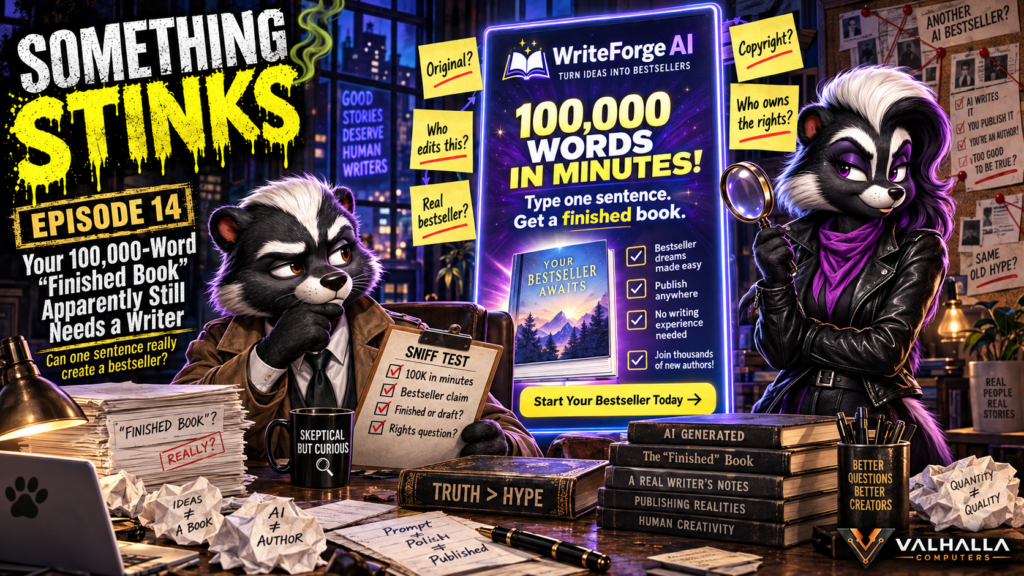
There is a particular kind of advertisement that works because it takes something difficult, frustrating and deeply human, then removes almost everything difficult, frustrating and human from it.
Writing a book is a perfect target.
People spend months or years outlining, drafting, rewriting, deleting entire chapters, changing character motivations, moving scenes around, fixing continuity mistakes and staring at a blinking cursor while wondering why the brilliant idea in their head sounds ridiculous once it reaches the page. Some people never finish at all, which is exactly the emotional pressure point behind an advertisement that recently crossed my screen for ScribistIQ.
The advertisement begins with a simple confession: “I’m 45. I spent years trying to write a book but never finished.” Then comes the solution: “Then I found this AI book writer that helped me publish my first bestseller.”
That is one hell of a transformation.
Years of unfinished writing become a published bestseller, apparently courtesy of artificial intelligence.
The text above the advertisement takes the promise even further, describing ScribistIQ as “a book generator, not an AI writing assistant,” and promising 100,000 words in minutes, not weeks while assuring customers that they own the rights.
At first glance this sounds exactly like the kind of claim that should immediately send the Something Stinks skunks scrambling for the magnifying glasses.
The interesting part is that ScribistIQ really does appear capable of producing enormous amounts of text very quickly.
According to the company’s own website, its Ultra Max system can generate a novel of up to 30 chapters and approximately 100,000 words. ScribistIQ says a 100,000-word Ultra-tier novel takes about seven minutes to generate from beginning to end. The service can also generate cover artwork, produce audiobook narration and export books as PDF, EPUB and DOCX files. This is not merely an AI chat window producing three paragraphs at a time while the user repeatedly types “continue.” It appears to be an actual automated book-production system.
So the smell is not coming from the claim that the software can produce a lot of words quickly.
The smell begins when we start asking what those words actually represent.
A Finished Book and a Finished Manuscript Are Not Necessarily the Same Thing
ScribistIQ repeatedly uses the phrase “finished book.” The homepage says it can turn a single sentence into a finished novel in minutes. Its pricing page advertises plans capable of producing finished books every month, every week or even more than one per day depending on the subscription level.
That sounds wonderfully final.
The company’s own FAQ becomes noticeably more cautious when it addresses quality.
When ScribistIQ asks, “Are the books actually good?” its answer describes the result as a strong first draft that can either be published as-is or edited further.
There is nothing wrong with selling an AI system that produces a strong first draft. In fact, that could be extremely useful.
A writer could spend weeks planning a story, use an AI system to generate an initial version, then spend months reshaping it, rewriting scenes, fixing dialogue, adding personal style and turning the machine-generated material into something much more distinctly their own.
That would be AI acting as a production tool.
But “strong first draft” and “finished novel” create very different expectations.
Anyone who has actually written a book knows how much work can exist between those two phrases.
A first draft may contain repetitive language, weak pacing, flat characters, continuity mistakes, scenes that accomplish nothing, dialogue that sounds artificial, plot points that disappear and conclusions that arrive because the manuscript has simply run out of pages.
The interesting thing is that ScribistIQ seems to understand this problem very well.
The company offers an editor, a continuity system, a story bible and, on its Pro plan, something called a Deep Manuscript Audit. That audit examines a generated manuscript across twelve editorial categories including continuity, setup and payoff, plot logic, character arcs, pacing, point of view, repetition, sentence flow, clichés, dialogue and grammar.
Those are excellent things to check.
They are also exactly the kinds of things you check because the book may not actually be finished when the machine stops generating words.
If a product needs an entire editorial system to inspect plot logic, pacing, character development, repetition and continuity after generation, perhaps “finished” is doing some heavy lifting in the marketing department.
Seven Minutes of Writing Does Not Equal Seven Minutes of Authorship
There is another distinction worth making here.
Generating 100,000 words and writing a novel are not necessarily the same accomplishment.
Typing is not the difficult part of writing.
A reasonably fast typist can produce words quickly. A transcription system can produce them even faster. AI can produce them faster still.
The hard part is deciding which words belong there.
Writing involves deciding what a character wants, why that matters, what prevents them from getting it, how they change, what information the reader receives and when they receive it. It means determining whether a scene should exist at all, whether an emotional reaction feels earned and whether the ending resolves the promises made hundreds of pages earlier.
A machine can certainly assist with those jobs. Modern AI systems are becoming increasingly capable of maintaining context, tracking characters and creating coherent long-form narratives.
But speed is not automatically quality.
If I use a machine to generate 100,000 words in seven minutes, what I possess at minute eight is 100,000 words.
Whether I possess a good novel is another question entirely.
ScribistIQ itself acknowledges that distinction by providing tools to review outlines before generation, edit manuscripts afterward and audit finished material for structural and stylistic problems.
That is a much more realistic representation of how AI can participate in writing.
Unfortunately, “Generate a Very Large First Draft Extremely Quickly and Then Spend Considerable Time Turning It Into Something Worth Publishing” probably did not perform as well in Facebook advertising tests.
And Then We Get to the Bestseller
This is where the advertisement becomes much more interesting.
The person in the ad supposedly spent years failing to finish a book, discovered an AI book writer and then published their first bestseller.
Notice how smoothly the story moves from generation to commercial success.
That jump is enormous.
Writing a book and selling a book are completely different problems.
You can write an extraordinary novel and sell twelve copies.
You can write an average novel and sell thousands.
Sales depend on genre, audience, cover design, title, reviews, distribution, pricing, advertising, mailing lists, social media, author reputation, timing and sometimes plain old luck.
An AI system could potentially help with many of those things, but generating the manuscript does not automatically create demand for it.
I could find extensive information on ScribistIQ’s website about generating books, editing them, producing covers, creating audiobooks and exporting files. I could not find a public claim establishing that using the software makes a book a bestseller or documentation substantiating the specific bestseller story presented in this Facebook advertisement.
That does not prove the person in the advertisement did not have a bestseller.
It simply means the most commercially impressive part of the advertisement is also the part that deserves the most skepticism.
“AI helped me finally finish my book” would be a reasonable testimonial.
“AI helped me organize and publish my first novel” would also be believable.
“Years of failure followed by AI followed by BESTSELLER” is where advertising starts turning a tool into a dream.
The Free Part Is Mostly a Sample
ScribistIQ does allow new users to try the system before paying, but the free experience is considerably smaller than the 100,000-word miracle advertised at the top of the funnel.
The company currently gives new accounts a free opening chapter of approximately 500 to 700 words with no credit card required. To generate complete books regularly, users move onto paid plans.
Those plans currently begin at $29 per month for Lite, followed by $49 per month for Standard and $169.99 per month for Pro. The very longest Ultra Max books—20- and 30-chapter versions reaching toward the 100,000-word range—are available on the Pro tier.
Again, there is nothing wrong with charging money for sophisticated software.
AI generation costs money to operate. Long-context models, image generation, audiobook narration and file production all consume computing resources. A company providing those services has every right to charge for them.
The important thing is simply understanding the difference between the advertisement and the actual transaction.
The ad sells the fantasy of typing an idea and suddenly becoming a published author.
The actual service is a subscription-based AI production platform using a credit system, with different generation lengths, editing functions and monthly allowances depending on how much you pay.
That may still represent good value for the right user.
It is simply less magical once the pricing page enters the conversation.
“Cancel Anytime” Has an Interesting Definition
ScribistIQ also advertises the familiar phrase “Cancel anytime.”
That is technically true.
According to the company’s pricing information, cancellation takes effect immediately. When you cancel, access ends and the unused portion of your monthly plan allowance is cleared. ScribistIQ specifically recommends waiting until the end of the period you have already paid for if you want to use the entire allowance.
That is an important detail.
Many consumers interpret “cancel anytime” as meaning they can turn off renewal while continuing to use the service until the current paid billing period ends.
That is not how this particular system works.
Cancel halfway through the month and you do not receive a prorated refund for the remaining days. The company’s pricing page also states that purchases are final and that subscription plans and credit packs are generally non-refundable, although failed generations return credits to the account.
Again, none of this necessarily makes the service unreasonable.
It simply means customers should understand what “cancel anytime” means before pressing the button.
“You Own the Rights” Is More Complicated Than It Sounds
The advertisement also emphasizes that the customer owns the rights.
ScribistIQ itself is very clear about its position: the company says it does not claim ownership of the books users generate, does not place its own byline on exported files and does not take a percentage of book sales.
That is good.
But there is another legal question hiding underneath the phrase “you own the rights.”
A company agreeing not to claim ownership of AI output is not the same thing as copyright law automatically granting the customer exclusive copyright over everything the AI generated.
The U.S. Copyright Office addressed this directly in its 2025 report on artificial intelligence and copyrightability. The Office concluded that AI-assisted works can receive copyright protection when there is sufficient human-authored expressive material, creative selection, arrangement or modification. It also reaffirmed that merely providing prompts to an AI system does not, by itself, make the resulting machine-generated expression copyrightable.
That distinction matters enormously for a system marketed around generating an entire novel from a sentence.
If someone enters a premise, presses a button and receives 100,000 words primarily generated by artificial intelligence, the fact that ScribistIQ does not claim ownership does not automatically answer every question about whether all of those words receive copyright protection in the United States.
If the user substantially rewrites the manuscript, rearranges it creatively, adds original material, modifies characters, rewrites scenes and turns the generated draft into a genuinely human-authored work, the copyright analysis can be very different.
And that brings us directly back to the same conclusion we keep reaching in this series.
The human still matters.
Quite a lot, actually.
The Irony Is That ScribistIQ’s Best Features Encourage Human Involvement
What makes this advertisement especially interesting is that the underlying software appears more sensible than the marketing fantasy surrounding it.
ScribistIQ allows writers to review and modify outlines before longer books are generated. It lets users import existing manuscripts, continue books, provide writing samples, edit generated chapters and work alongside an AI assistant in its Write Studio. Its story-bible system is designed to maintain continuity, and its manuscript-audit feature specifically looks for structural problems after generation.
Those are all examples of AI being used as a tool.
And that is exactly where artificial intelligence can become genuinely useful to writers.
A novelist struggling with an outline can ask AI for alternatives.
A writer can use it to identify continuity mistakes.
An author can generate several approaches to a scene and then write their own version.
AI can help organize research, test ideas, identify repetitive language, brainstorm titles, summarize notes and even produce rough material that the writer reshapes.
Those are incredibly powerful capabilities.
The problem begins when the tool is marketed as though the difficult part of creating something meaningful was simply producing enough words.
A book is not good because it contains 100,000 words.
A writer is not successful because an EPUB file exists.
And an author certainly does not become a bestseller because a progress bar reached 100 percent in seven minutes.
The Publishing World Does Not Need More Unedited Sludge
There is also a broader problem worth considering.
AI has dramatically reduced the cost of producing enormous amounts of text.
That means online bookstores can potentially be flooded with books created by people who invested almost no time reading, editing or improving what the machine produced.
If one person can generate six books a month, thirty books a month or—according to ScribistIQ’s Pro pricing—potentially hundreds of shorter books from a monthly credit allowance, quantity is no longer difficult.
Quality becomes the scarce resource.
Readers already have more books available than they could consume in several lifetimes. The world does not desperately need another ten thousand novels simply because computers can now produce them cheaply.
What readers still value is a reason to choose your book.
A distinctive voice.
An interesting perspective.
Characters worth caring about.
Useful expertise.
A story someone actually wanted to tell.
AI can help create those things, but it cannot guarantee them simply by generating more text.
This is the same lesson businesses are learning with websites, blogs, social-media posts and marketing material.
When everyone can generate content instantly, generating content stops being impressive.
Having something worth saying becomes more important.
So, Is ScribistIQ Bullshit?
No.
And once again, that makes the advertisement more interesting.
ScribistIQ appears to be a real product with genuinely impressive capabilities. Generating a coherent long-form draft in minutes is technically remarkable. Combining manuscript generation, cover creation, audiobook production, exporting, editing and continuity management in one system could save writers enormous amounts of time.
A writer who understands what the system is doing could probably use it extremely effectively.
The smell comes from the implication that speed has replaced authorship.
The advertisement gives us the familiar transformation: years of struggling writer → discovers AI → publishes bestseller.
The actual product documentation tells a more believable story: generate the draft quickly, review the outline, edit the manuscript, check continuity, audit the prose, create the cover, export the files and decide how much human involvement the final book still needs.
That is less dramatic.
It is also considerably more realistic.
Artificial intelligence may help someone finally finish the book they have wanted to write for twenty years.
That would be genuinely wonderful.
But if the only contribution someone makes is typing one sentence and waiting seven minutes, perhaps we should be careful about confusing owning a generated manuscript with having suddenly mastered the craft of writing.
A machine can produce 100,000 words before most of us finish breakfast.
Getting somebody to willingly read all 100,000 of them is still your problem.
And getting enough of those people to buy the book to make it a bestseller?
Apparently even artificial intelligence has not found the seven-minute button for that yet.
🦨