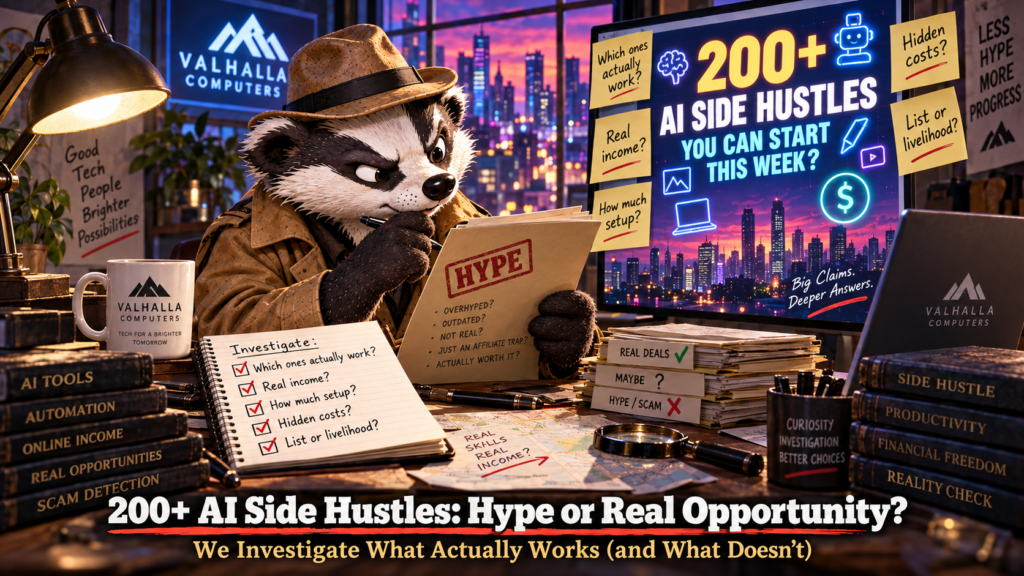
There is a specific kind of advertisement that has become almost unavoidable in the AI boom. It begins with the assumption that money is flying through the air, continues with the suggestion that everyone except you has apparently learned how to catch it, and ends with a free guide that promises to explain where the buckets are stored.
Mindstream’s Facebook ad fits the formula beautifully: “Stop missing out on AI profits.” Subscribe free and get access to more than 200 money-making strategies that “actually work.” The giant graphic simplifies that into an even cleaner promise: 200+ AI side hustles you can start this week.
The first useful fact is that the guide itself appears to be real. Mindstream has repeatedly promoted a collection of more than 200 ways to make money with AI, and The Hustle’s current resource library also lists a “200+ Ways to Make Money with AI” guide covering AI business models for different skill levels. So this is not a case where the promised download vanishes as soon as you surrender an email address.
The List Is Real. The Word “Profits” Is Doing More Work.
An idea can be legitimate without being profitable. That sounds obvious, but AI side-hustle advertising often blurs the distinction. “Use AI to create social media content,” “build simple automations,” “offer chatbot setup,” “generate product photography,” or “help businesses summarize documents” can all describe real services. None of those descriptions tell us how many buyers exist in a particular market, what competitors charge, how long the work takes, what quality clients expect, or how much of the process still requires human expertise.
Two hundred ideas also creates its own psychological trick. A giant menu feels like opportunity because surely something on the list must work for you. Maybe it will. But a person who tries ten ideas for two days each may accomplish less than someone who spends a month learning how to solve one boring problem for one specific kind of customer.
AI Removed Some Barriers. It Did Not Remove the Business Part.
AI genuinely makes certain small businesses easier to start. A person can draft copy faster, create basic graphics, analyze information, prototype software, prepare proposals, automate repetitive work, and learn unfamiliar tools much faster than even a few years ago. That can lower startup costs dramatically.
What it does not automatically provide is a customer. It does not make somebody trust you, guarantee that your output is accurate, resolve licensing questions, handle revisions, answer the phone, collect an unpaid invoice, or convince a local business owner that your service solves a problem worth paying for. Those are the parts missing from most “make money with AI” screenshots because they do not fit neatly into a glowing purple skyline.
The Better Way to Use a 200-Idea Guide
Instead of reading a list like a catalog of guaranteed income streams, use it as brainstorming material. Look for ideas that overlap with something you already understand. If you know automotive work, AI may help you build content or documentation services for repair shops. If you understand WordPress, AI can accelerate audits, content production, and site maintenance. If you know a local industry well enough to recognize its annoyances, automation may help you package a solution.
That is also why we keep returning to the idea of Human-Tempered Content at Valhalla Computers. The useful part is not simply possessing an AI tool. The useful part is combining the tool with judgment, experience, checking, and a real understanding of what the customer needs.
What the Advertisement Is Actually Selling
The ad is also a textbook lead magnet. Mindstream gives away a large collection of useful-looking information in exchange for a newsletter subscription. There is nothing inherently wrong with that. Free guides, checklists, ebooks, and reports have been used to build mailing lists since long before anybody added the letters “AI” to the headline.
But understanding that exchange helps keep the promise in perspective. The product being advertised is not merely 200 side hustles. It is your attention and an ongoing relationship with the publisher. The dramatic “stop missing out on AI profits” language gets you through the door. The newsletter is what keeps you there.
The Bottom Line
There probably are hundreds of ways to use AI in a side business. There are also hundreds of ways to use a pickup truck, a computer, a camera, or a pressure washer to make money. Owning the tool and seeing the list of possibilities are merely the beginning.
The part that smells a little funny is not the existence of the guide. It is the implication that “AI profits” are something people are missing because they have not yet downloaded the right list. A side hustle still needs customers, skill, quality control, persistence, and enough margin left over after expenses to justify the time.
Two hundred ideas can tell you where to start looking. Unfortunately, the guide cannot do the hustling part for you. Apparently they still have not automated Tuesday afternoon when nobody answers your sales emails.