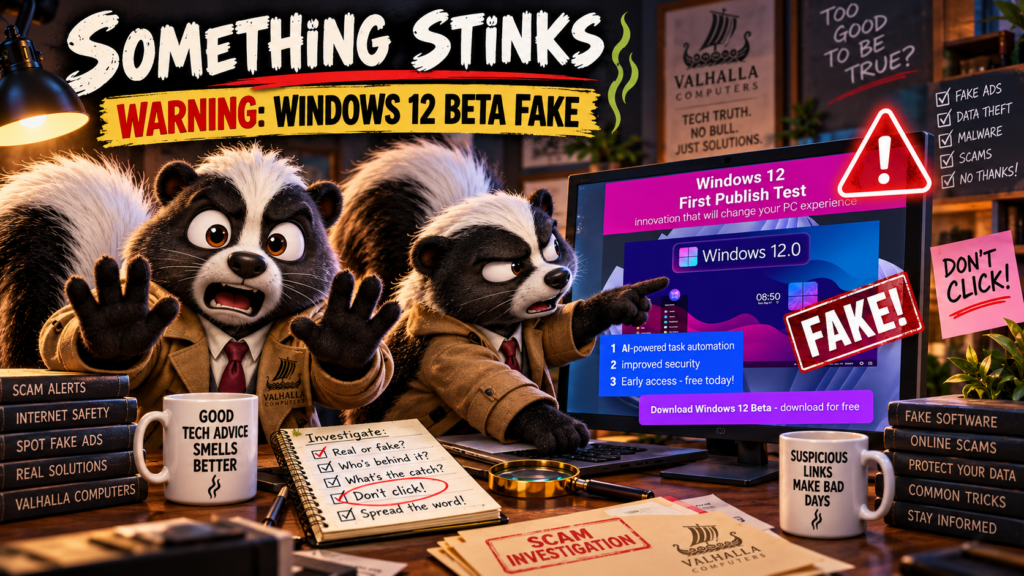
WARNING: If you see an ad offering a free “Windows 12 Beta,” do not treat it as an official Microsoft download just because it uses a Windows logo, familiar colors, or the word “beta.” The ad we were shown claims “Windows 12 First Publish Test,” promises AI-powered task automation and improved security, and urges people to “Download Windows 12 Beta — download for free.” As of September 23, 2026, Microsoft’s own Windows Insider channels are still publishing preview builds under the Windows 11 name. There is no official Windows 12 beta listed through Microsoft’s normal public testing channels.
The Ad Makes a Very Specific Claim
This is not one of those cases where an advertiser is merely being a little creative with wording. The ad is presenting something that looks like a Microsoft operating-system preview and explicitly tells the viewer that a “Windows 12 Beta” is available for free. That is a claim a normal person could reasonably interpret as an official or legitimate pre-release copy of Microsoft’s next version of Windows.
The problem is that Microsoft’s current public information does not support that claim. On September 18, Microsoft’s official Windows Insider Blog announced new Windows 11 Insider Preview builds for its Beta and Experimental channels. A September 11 Insider announcement likewise described Windows 11 Beta, Experimental, and Release Preview builds, including Windows 11 version 26H1. Microsoft’s own documentation for joining the Windows Insider Program also tells testers to begin with a licensed copy of Windows 11 and receive Windows Insider Preview builds through Windows Update. Those are the places an actual Microsoft preview should be coming from, not a random advertising landing page.
The ad becomes even more questionable when you look at where it appears to send people. The screenshot identifies the destination as NAKCHAS.COM, not microsoft.com. Even stranger, the link preview under the ad reads “Modern Facade Windows Twelve – Architectural Mastery” and begins describing architectural brilliance. That sounds like a page about windows in a building, not the Windows operating system. Yet the graphic above it is advertising “Windows 12 Beta” and presenting a large Download button.
That mismatch is exactly the sort of thing people should stop and examine before clicking. A familiar logo does not make an unrelated domain Microsoft. A polished screenshot does not make software authentic. And a button that says “Download” certainly does not tell you what file is waiting on the other side.
What We Can Say — and What We Cannot
We can say that the “official Windows 12 Beta” presentation is false or misleading based on Microsoft’s current public release channels. We can also say that the advertised destination shown in the screenshot is not a Microsoft domain. What we cannot responsibly say without actually obtaining and analyzing the payload is that the download contains malware. It might be a fake installer, a customized Windows image, an advertising redirect, a junk download, or something more dangerous. We did not execute the file, and neither should you just to satisfy your curiosity.
That distinction matters. Calling every suspicious download “a virus” without evidence is sloppy. Calling an unofficial Windows 12 beta download unofficial, misrepresented, and unsafe to trust is supported by what is visible right now.
If Microsoft Really Releases a Windows 12 Preview, You Will Not Need to Hunt for It
Microsoft already has a public testing system. It is called the Windows Insider Program. When Microsoft wants people testing pre-release Windows builds, it publishes them through that program, documents the channels, publishes build numbers, releases notes on the Windows Insider Blog, and distributes the software through Windows Update or official Microsoft ISO pages. There is no sensible reason to trust a third-party Facebook ad over the infrastructure Microsoft already operates for exactly this purpose.
This is also why the word “beta” should never be treated as permission to ignore basic download safety. Real beta software still has a publisher. It still has an official source. It still has documentation. “It’s unreleased, so of course it’s on some strange website” is not an explanation — it is another warning sign.
If You Already Clicked the Ad
If you only opened the page and did not download or run anything, close it and move on. If you downloaded a file but did not execute it, delete the file and empty your Recycle Bin. If you actually ran an installer or executable from an unverified Windows 12 download, treat the situation more seriously: disconnect from anything sensitive if the machine begins behaving strangely, run a full scan with Windows Security or another trusted security product, inspect recently installed applications and browser extensions, and change important passwords from a known-clean device if you entered credentials after running the software.
If the computer holds business data, financial records, customer information, or saved browser passwords, do not assume that “nothing popped up” means nothing happened. Modern unwanted software does not always announce itself with flashing warnings and skull graphics. When in doubt, having the system examined by someone who knows what they are looking for is cheaper than cleaning up stolen accounts later.
The Simple Test
Before downloading any major operating-system update, ask one question: Can I reach this same download by starting at Microsoft.com? If the answer is no, stop. For Windows previews, start with Microsoft’s Windows Insider pages. For normal Windows installation media, start with Microsoft’s software download pages. Do not let an advertisement choose your operating-system source for you.
Bottom Line
Something definitely stinks here. The ad says “Windows 12 Beta,” but Microsoft’s current public Insider releases are Windows 11 builds. The download destination shown in the ad is not Microsoft, and its own preview text appears to describe architectural windows rather than an operating system. That is more than enough reason to stay away.
Could Microsoft eventually announce a product called Windows 12? Absolutely. If and when it does, Valhalla Computers will be happy to look at the real announcement. Until then, a random “Windows 12 Beta — Free Today!” download ad is not early access. It is a reason to keep your mouse away from the Download button.