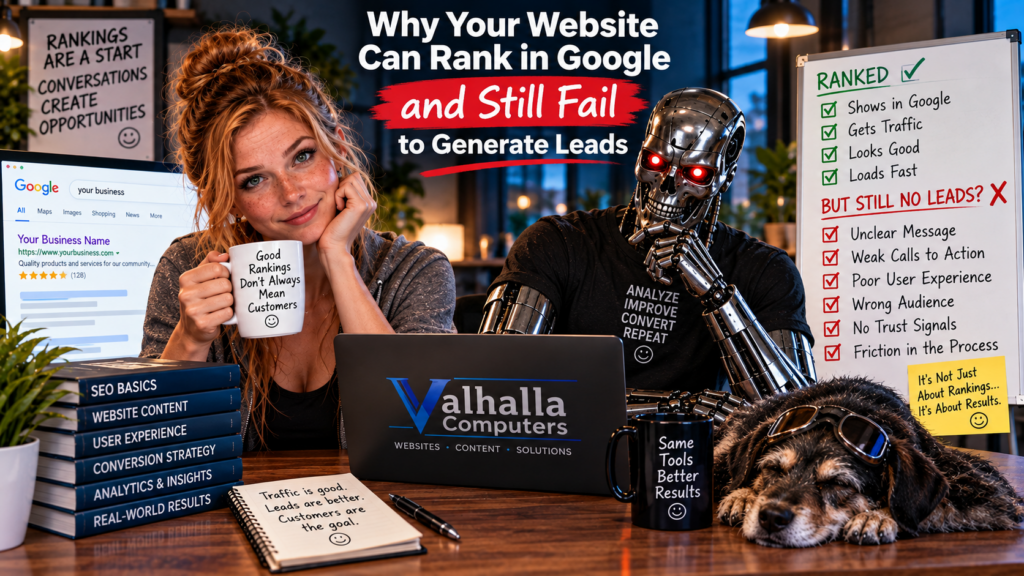
Ranking in Google feels like the finish line because it is easy to measure. You search the important phrase, see the business on the page, and assume the hard part is over. Then the phone does not ring, the contact form stays quiet, and the website analytics proudly report that people are visiting before disappearing.
SEO can bring someone to the door. The website still has to convince that person to walk through it. A ranking page with weak conversion is not an SEO victory; it is a traffic source feeding a leak.
The Searcher May Be Landing on the Wrong Page
A page can rank for a phrase that sounds valuable without matching the visitor’s actual intent. An informational article may attract people who want advice but are not ready to buy. A generic homepage may rank for a service term but fail to explain that specific service clearly enough to earn the call.
Look at the queries and landing pages together. If visitors searching for a particular service consistently arrive on a page that barely mentions it, build or improve the page they should have received.
The Offer May Be Too Vague
“Quality service you can trust” does not tell a customer what happens next. A visitor should quickly understand what the company does, who it serves, the area it covers and what action to take. When the value proposition is foggy, people postpone the decision by returning to search.
Specific language converts better because it reduces uncertainty. Explain the service in ordinary terms. Show what is included. If pricing cannot be public, explain how quotes work. If the job starts with an inspection or consultation, say so.
The Website May Not Look Trustworthy Enough
Customers evaluate legitimacy quickly. Broken layouts, ancient copyright dates, missing contact information, blurry logos, generic stock photos, empty About pages and contradictory business details all create small doubts. None of them alone may kill the lead. Together they make the back button feel safer.
Trust signals should support the decision rather than shout at it. Real photos, useful reviews, clear policies, an actual phone number, a named business, examples of completed work and accurate service information do more than a row of invented badges.
The Call to Action May Be Hiding
Some websites make a visitor solve a puzzle to become a customer. The phone number appears only in the footer. The quote button uses vague text. The contact page asks for twelve required fields. The service page ends without telling the reader what to do next.
Every important page should have an obvious next step appropriate to the visitor’s stage. Call, request a quote, schedule, send photos, download information or ask a question. A call to action is not pushy when it simply tells an interested person how to continue.
Mobile Visitors May Be Getting the Worst Version
A page can rank beautifully while being painful to use on a phone. Tiny buttons, giant popups, slow images, sticky banners and forms designed for a desktop can destroy conversion even when search visibility is healthy.
Test the path with one hand on a real phone. Can you understand the service, find proof, tap the phone number and submit the form without zooming, closing overlays or waiting for decorative elements to load?
The Page May Be Answering Too Little
Visitors often leave because the page creates more questions than it answers. What does the service include? Do you travel to my area? Can you work on my type of problem? How long does it usually take? Do I need to prepare anything? What happens after I submit the form?
Good conversion copy reduces uncertainty before asking for commitment. That does not require writing a novel. It requires knowing what customers repeatedly ask and putting the answers where they can find them.
The Page May Be Too Slow
Speed is both a usability problem and a conversion problem. A visitor who clicked because they were ready to act has very little patience for a page that spends several seconds loading giant images, third-party scripts and animation libraries before displaying the useful information.
Compress images, remove unnecessary plugins and scripts, use caching properly and prioritize the content at the top of the page. A beautiful element nobody waits to see has zero conversion rate.
Traffic Quality Matters More Than Traffic Volume
One hundred visitors who need the service are more valuable than ten thousand visitors who merely found an interesting article. Look at which pages generate calls, forms, appointments or purchases instead of assuming every session is equally useful.
This is where SEO and conversion work meet. Search strategy should attract the right people, and page strategy should help those people make the next decision.
The Bottom Line
Ranking is not the business outcome. It is the opportunity to earn the business outcome. If a page gets traffic but no leads, do not immediately chase more traffic. Inspect the message, trust, speed, mobile experience, offer and next step.
Sometimes the website does not need another hundred visitors. It needs to stop wasting the hundred it already has.