It started as a Something Stinks candidate. Then the damned thing actually worked.
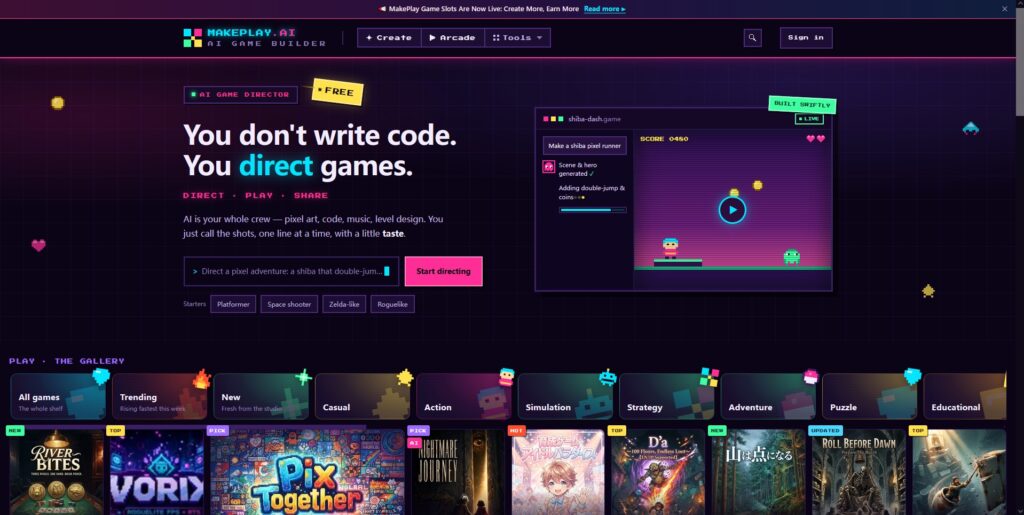
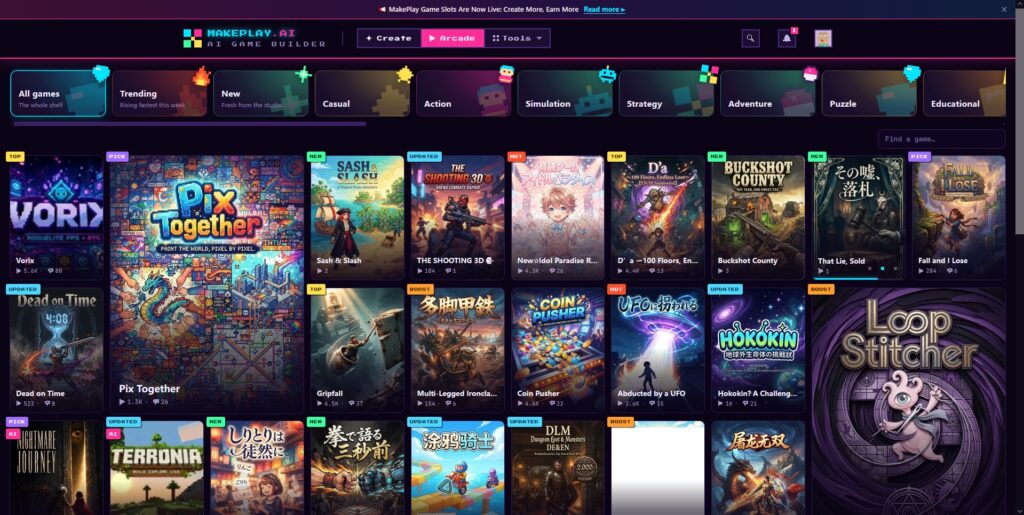
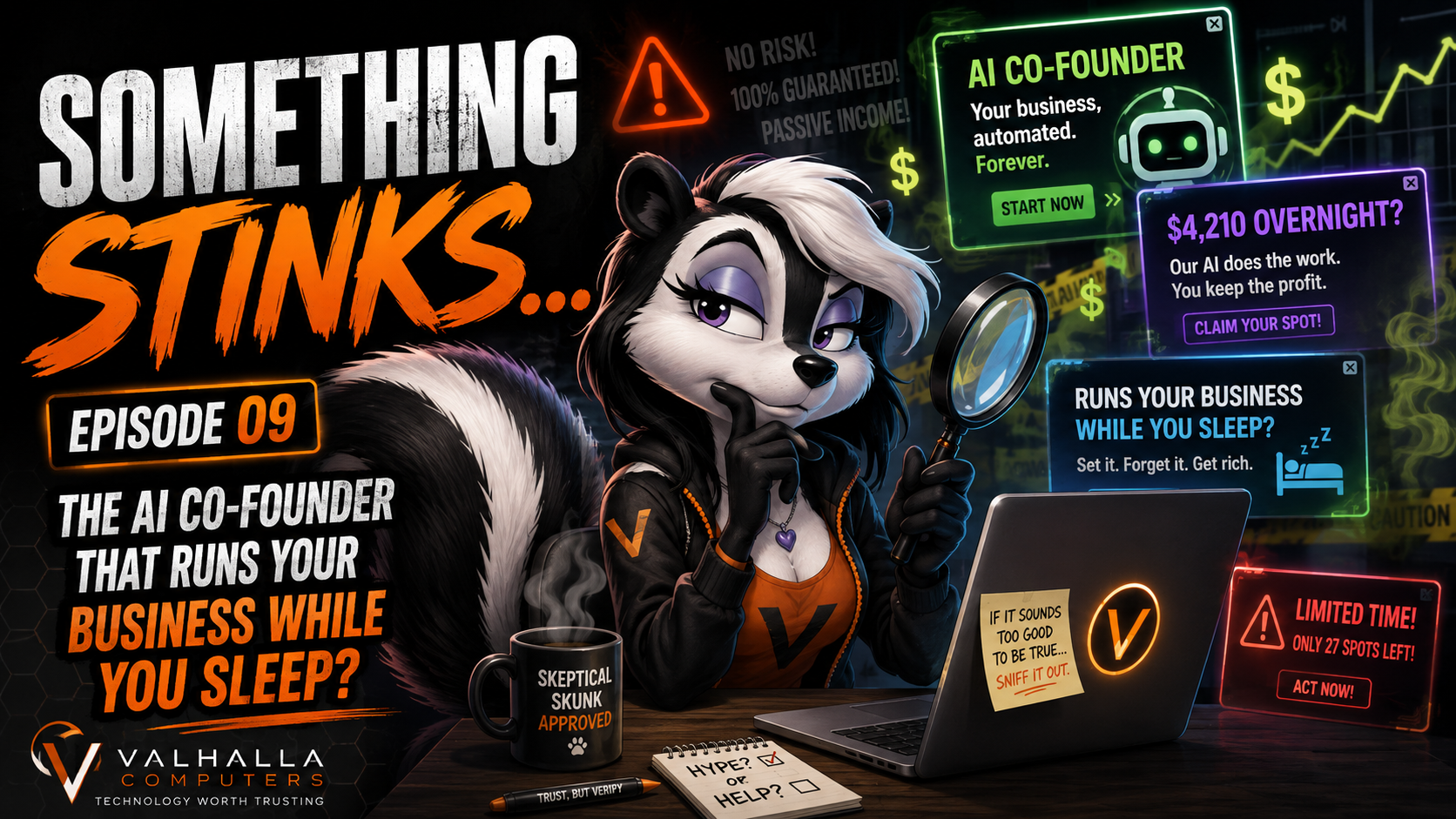
When an advertisement says you can describe a video game in a single prompt and have artificial intelligence create the pixel art, code, music, levels, gameplay and a finished playable game in your browser, my first reaction is probably the same as anyone who has spent too much time looking at AI advertising lately: All right, what part of that sentence are we going to discover isn’t quite true? MakePlay.ai was advertising itself as a free AI game builder with some particularly ambitious language — “Make Games with One Prompt,” “100% Free,” “No Code,” “All in Browser,” and “Complete & Playable.” That was more than enough to attract the attention of our woodland investigation department, and originally this was headed directly toward Something Stinks.
The problem for the skunk is that after spending several hours actually using MakePlay, there wasn’t much stink to report. Instead, the experiment became far more interesting as a Digging Deeper story: what does “one prompt” actually mean, what happens while the AI is building the game, what does the finished result look like, where does the game live afterward, and exactly how “free” is free?
So rather than judging the advertisement from the outside, we opened MakePlay, gave it something considerably more ambitious than “make a character jump over boxes,” and documented what happened from the first prompt all the way through publishing the finished game.
We Gave It Captain Ava Morgan and a Rather Ridiculous Assignment
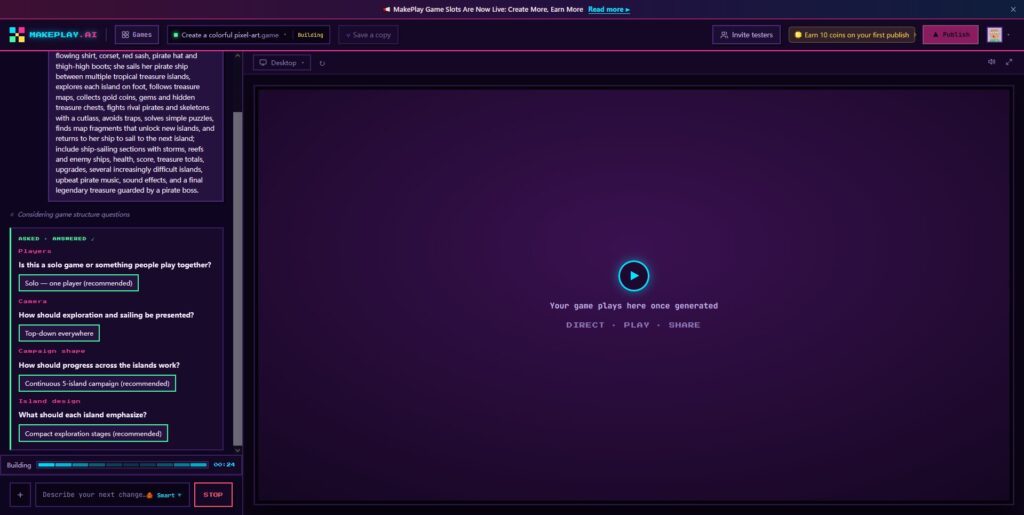
For the test, I wanted something complicated enough to expose the limitations of the system without deliberately asking it to create the next Grand Theft Auto. Since our resident virtual troublemaker Ava Morgan had recently spent some time cosplaying as a pirate captain, she became the obvious subject. The prompt asked MakePlay to create a colorful pixel-art action-adventure game called Ava’s Treasure Run, starring Captain Ava Morgan as a freckled, green-eyed, strawberry-red-haired pirate captain wearing a black coat, white flowing shirt, corset, red sash, pirate hat and thigh-high boots.
The game was supposed to involve sailing between tropical treasure islands, exploring each island on foot, following maps, collecting gold and gems, finding hidden treasure chests, fighting rival pirates and skeletons with a cutlass, avoiding traps, solving puzzles, collecting map fragments, upgrading Ava and her ship, fighting enemy vessels at sea and eventually reaching a legendary treasure guarded by a final pirate boss. In other words, this was not the sort of throwaway prompt designed to make an AI product look good. If MakePlay was going to claim that one prompt could create a game, we were going to give that claim something worth chewing on.
The creation process began simply enough. MakePlay offered a choice between a “Smart” mode and a deeper “Quality” mode that was currently invite-only, so Smart was used for the test. After submitting the prompt, the system immediately began breaking the idea into game-design decisions rather than simply showing a generic loading wheel. It decided on a solo-player format, top-down presentation, a continuous five-island campaign and compact exploration stages. At this point, the experience was surprisingly straightforward: give it the idea, answer very little, and watch it decide how that idea should become a game.
Then the Left Panel Started Doing Things
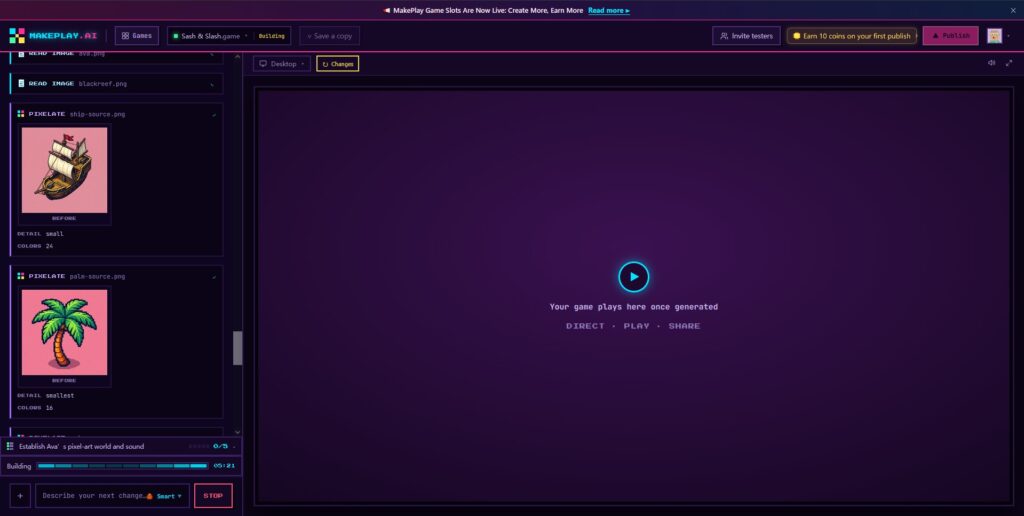
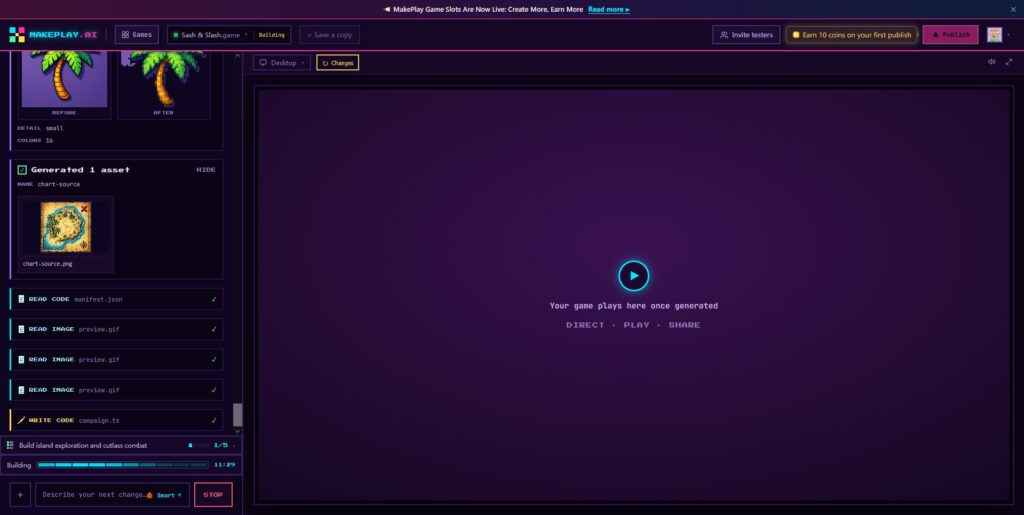
This is where the test became much more interesting. While the main game window remained unavailable during the build, MakePlay continuously displayed what it was doing in a panel along the left side of the screen. It wasn’t merely flashing vague phrases like “AI magic happening.” We could watch the system creating individual pieces of the project.
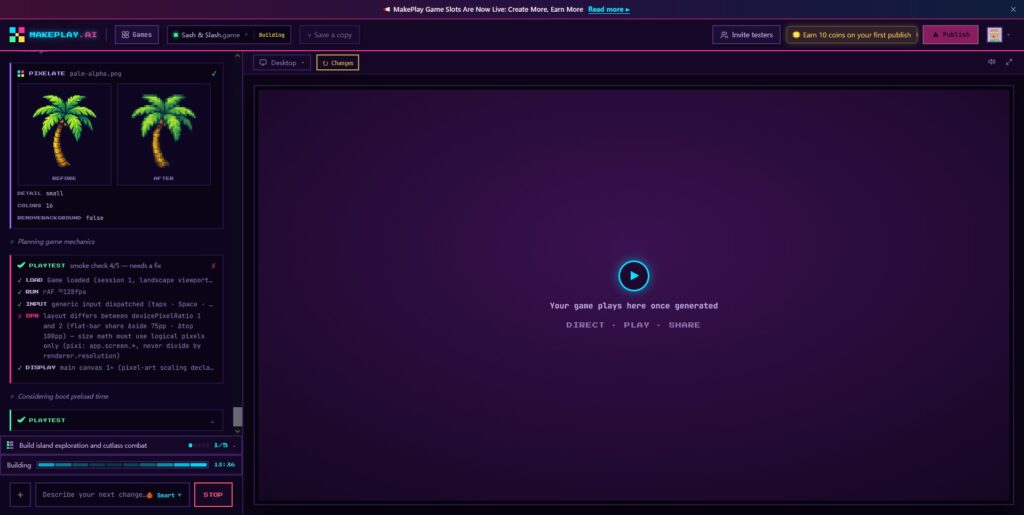
Early in the build it generated source artwork for Ava, skeletons, locations and environmental pieces. It created music files including a pirate theme and danger music. It added a retro game font. Then it began producing individual gameplay sounds for sword swings, hits, treasure pickups, chests, cannons, movement, mechanisms and water. Visual assets such as ships and palm trees were converted into pixel-art versions, while a treasure chart was created for the campaign.
The system eventually moved beyond graphics and sound into actual project construction. MakePlay could be seen reading its project manifest and preview files and writing files such as campaign.ts. The interface also showed the project progressing through specific stages rather than one monolithic generation step. It first worked on establishing Ava’s pixel-art world and sound, then moved into island exploration and cutlass combat, followed by the larger sailing and campaign systems.
That transparency was one of the stronger parts of the experience. Even for someone who isn’t interested in reading code, watching the system move from artwork to audio to game logic makes it much easier to understand why a complex request takes time. The advertisement makes the process look almost immediate. Our experience absolutely was not immediate, but it also wasn’t twenty minutes of staring at a meaningless progress spinner.
It Even Appeared to Test Its Own Work
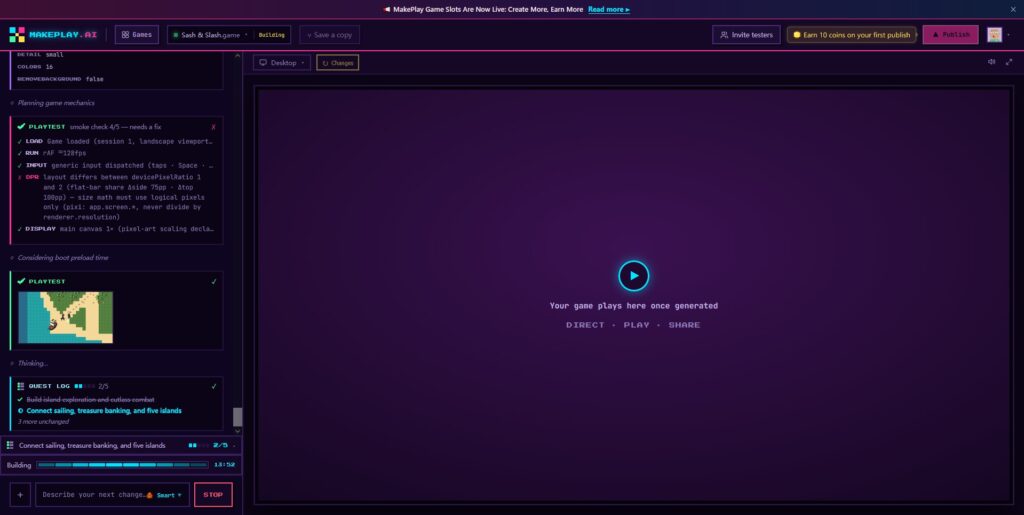
Around thirteen minutes into the generation, MakePlay performed what it labeled a PLAYTEST and reported that its smoke check had passed four of five items but needed a fix. The system identified a display problem involving different device pixel ratios and noted how the layout needed to use logical pixels rather than calculating against the render resolution. Shortly afterward, another playtest showed the game running on an island scene and the project advanced into the next stage.
That may have been the moment this stopped looking like an elaborate template generator and started looking like a genuine game-building workflow. Whatever is happening behind MakePlay’s interface, it was clearly not satisfied with merely assembling the first version and presenting it as finished. The system was generating, testing, identifying at least some problems and continuing to modify the project.
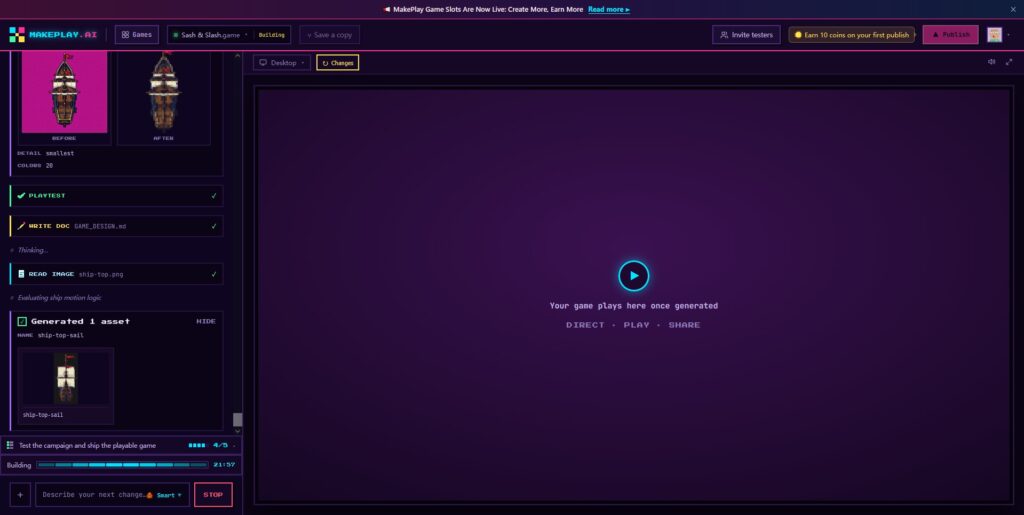
By roughly twenty-two minutes, the build had progressed to its final stages. MakePlay was testing the campaign, evaluating the ship’s motion, generating additional sailing assets, writing documentation and preparing the playable build. The original idea had definitely taken longer to create than the advertising might lead someone to imagine, but considering the amount of material requested in that single prompt, the wait was understandable.
And Then There Was an Actual Game
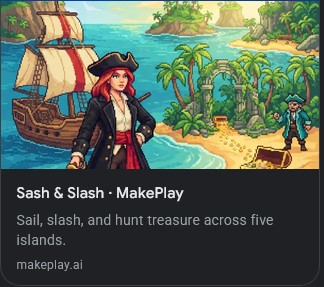
MakePlay ultimately produced a game called Sash & Slash rather than our requested title, Ava’s Treasure Run, but Captain Ava Morgan survived the translation. More importantly, it produced something I could actually play.
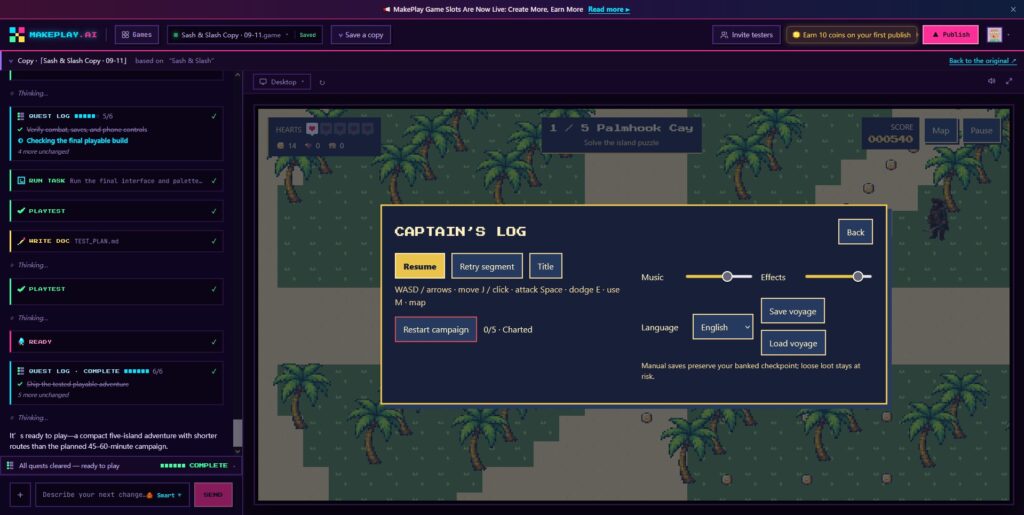
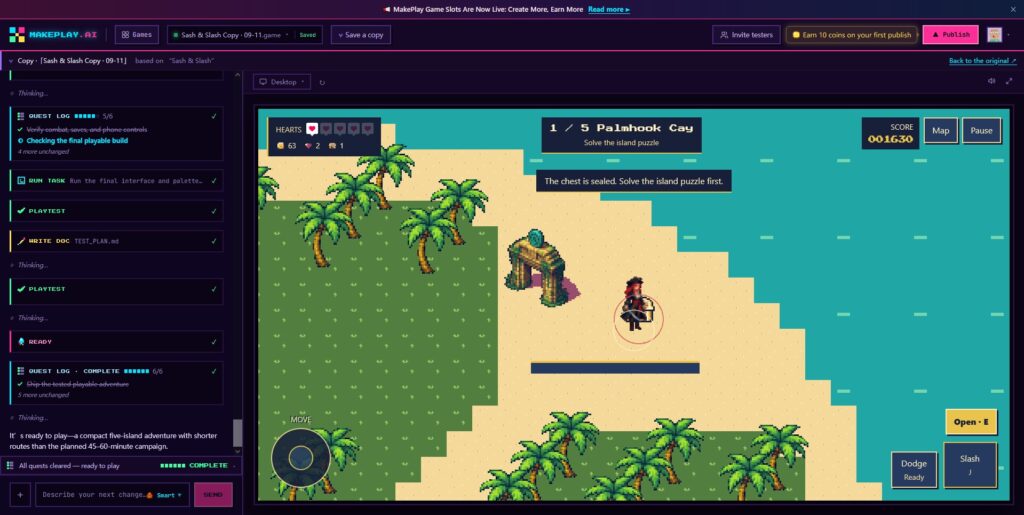
The controls are simple. Arrow keys move the character, while keys such as E and Space perform actions. On the first island, Ava runs around collecting coins while dealing with enemies and environmental obstacles. One of the puzzles requires moving a crate onto pressure plates so that a large chest can be opened. Inside is a chart fragment that must be carried back to the ship before the next part of the adventure becomes available.
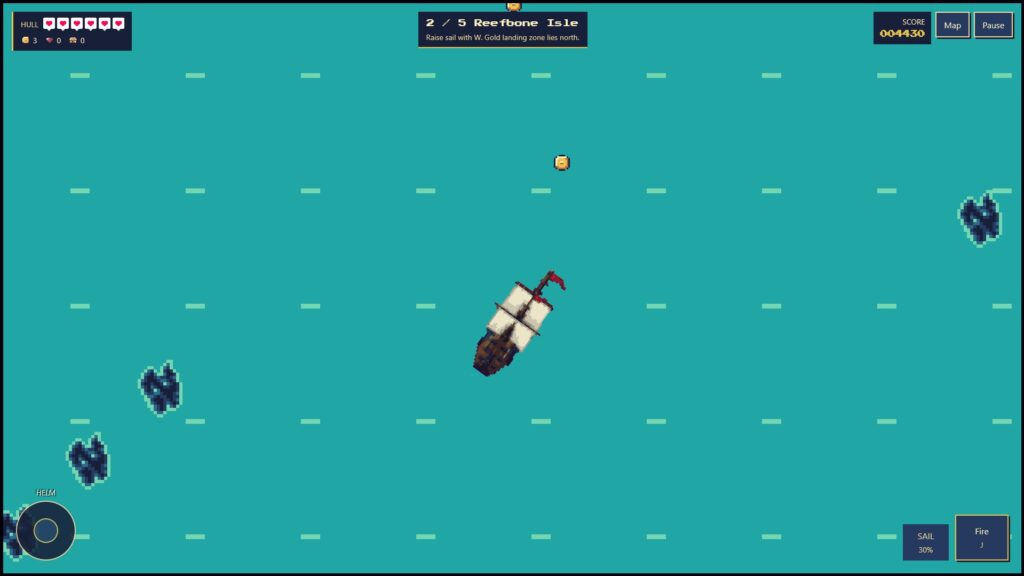
Once Ava returns to the ship, the game changes modes. Instead of simply loading another island, you actually sail there. Coins appear at sea, hazards have to be avoided and other ships can be fought. I did not specifically expect the AI to implement an actual ship-combat section as cleanly as it did, and this became one of the more pleasant surprises of the entire test.
The second island also wasn’t merely a copy of the first. Enemy types changed, traps appeared, and the environment and objectives continued the campaign. MakePlay created a five-island structure consisting of Palmhook Cay, Reefbone Isle, Tempest Key, Ember Lagoon and Crownwreck Atoll, with later areas locked until earlier objectives are completed.
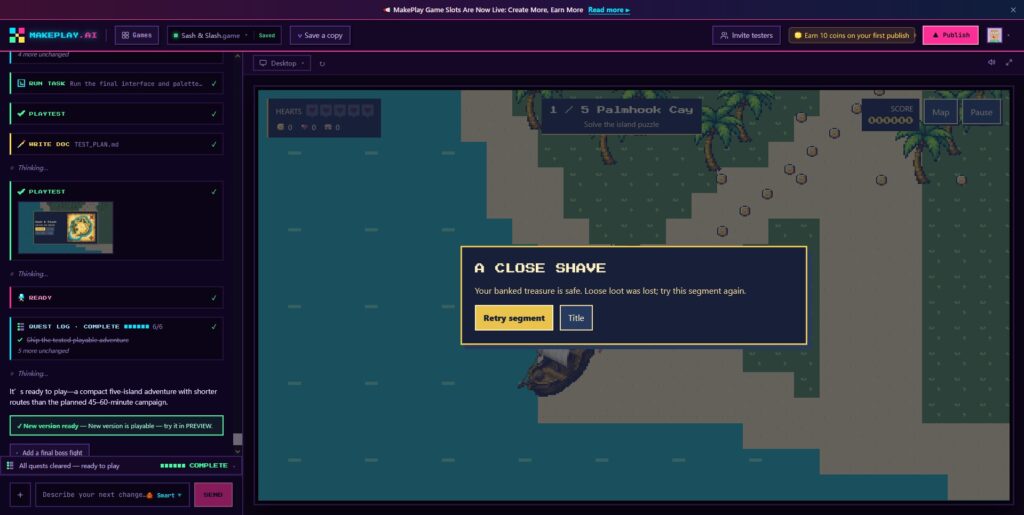
There is also a surprisingly complete upgrade system. Gold can be banked and spent on things such as a Reinforced Coat for additional health, Keen Edge for increased cutlass damage and an Oak Hull for additional ship durability. The game keeps track of banked treasure, lifetime treasure and score, and it includes save and load options. If Ava gets herself killed while carrying loose treasure, the game explains that banked treasure remains safe while the unbanked loot is lost.
It is unquestionably a small game, and MakePlay itself eventually described the result as a compact five-island adventure with shorter routes than the planned 45–60-minute campaign. That is worth mentioning because the system did simplify the original specification. There was also an option after generation to “Add a final boss fight,” suggesting that the requested final boss was not necessarily included in the initial build. This is not a case where every word in the prompt became exactly what was requested.
What matters is that the central claim held together: one prompt resulted in a coherent, playable game with interconnected mechanics rather than a disconnected collection of AI-generated artwork.
The Game Can Be Published and Shared
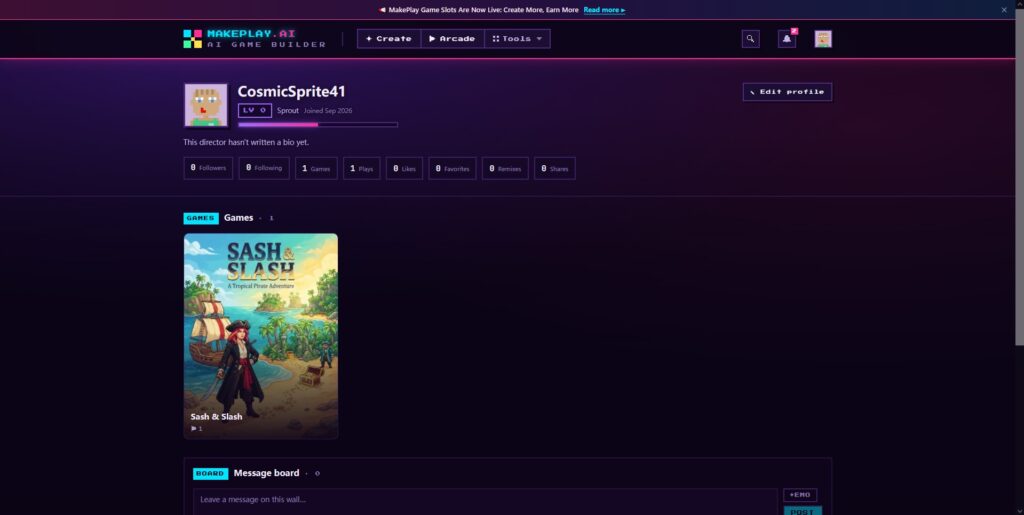
Sash & Slash can be published directly through MakePlay and receives a shareable page that other people can open and play. Our test game is available here:
I also sent the link to Michaela as an external test rather than relying entirely on my own account and browser. The game interface itself includes large virtual movement controls and touch-style action buttons in addition to keyboard controls, which strongly suggests that MakePlay intends the games to work on mobile browsers as well. I am leaving mobile compatibility as something to confirm through actual use rather than declaring it proven merely because the interface looks mobile-ready.
One important limitation did become apparent while digging through the site: I have not found a way to download Sash & Slash as a standalone package or export the finished game for hosting elsewhere. At least in our current test, MakePlay appears to be both the creation environment and the hosting platform. The game is published on MakePlay and shared through a MakePlay link.
For someone who simply wants to make and share a game, that may not matter at all. For a developer expecting to receive source files or upload the finished project to an independent website, Steam page or other platform, this distinction matters considerably. “Create your own game” and “own a portable copy of your game” are not automatically the same thing.
So Is It Really 100 Percent Free?
For the first game we created, yes — remarkably, it was.
During the entire process of creating, generating, testing, playing and publishing Sash & Slash, MakePlay never presented us with a subscription screen, demanded a credit-card number or interrupted the build with an offer to purchase additional AI credits. That is increasingly unusual among AI products that advertise themselves as free.
The catch, if we want to call it one, is not a hidden bill. It is a limit on how many different games a new creator can begin.
MakePlay introduced what it calls Game Slots in September 2026. Every new creator begins with one free Game Slot. Once that game exists, MakePlay says it can continue to be built, updated and improved without limiting the number of versions. Creating additional separate games, however, requires additional Game Slots.
Those additional slots are designed to be earned through participation. MakePlay describes several possible routes, including creating games people actually play, inviting new users to the platform, contributing to the community and eventually unlocking additional slots directly. Their own explanation summarizes the change unusually well: “Free isn’t going away. It’s becoming earnable.”
That means the big “100% FREE” language in the advertisement held up for our test, but it should not be interpreted as unlimited free generation of an endless number of independent games. You get a free creation, and further creation becomes tied to participation in the MakePlay ecosystem.
Coins, Profiles and the MakePlay Ecosystem
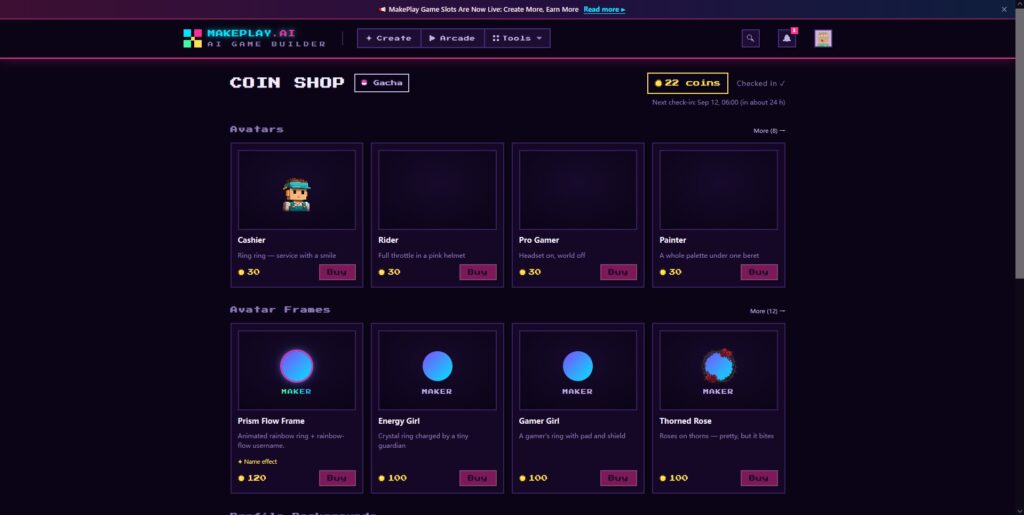
There is another layer to MakePlay that I did not expect when beginning the test. Publishing and participating on the platform earns coins. My account received a welcome bonus, a reward for publishing Sash & Slash and a small daily check-in reward. The profile page also tracks plays, followers, likes, favorites, remixes and other activity.
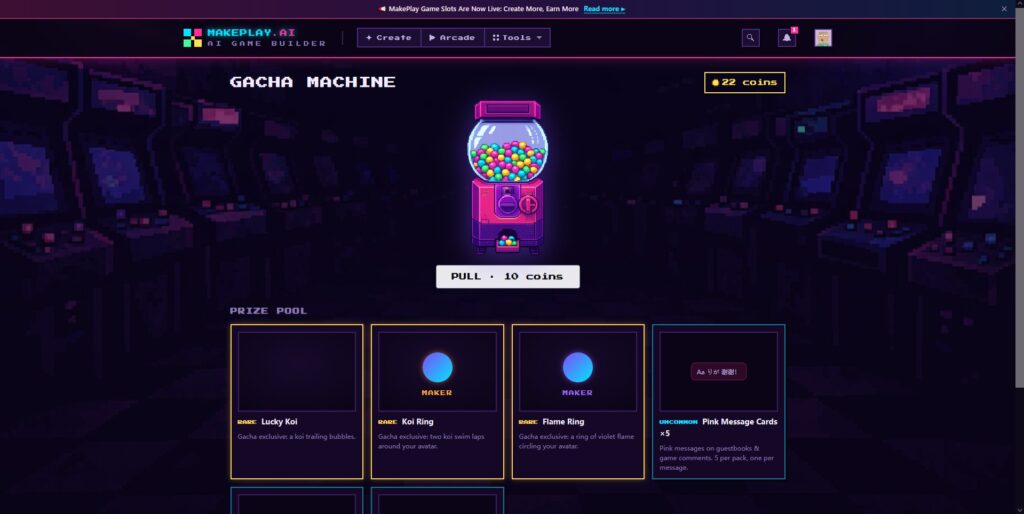
Those coins appear to be primarily part of MakePlay’s internal community system. They can be spent in a Coin Shop on profile avatars, avatar frames and other cosmetic items. There is also a gacha-style machine where coins can be exchanged for randomly selected cosmetic rewards such as profile effects, rings and message cards.
So far, none of this has affected the actual game-building test or required real-world money. It appears to be an engagement system designed to encourage creators to publish games, play other people’s games and participate in the platform. That may change as MakePlay evolves, but based on what was actually available during this test, we found a site economy rather than a hidden payment demand.
This One Changed Departments
This investigation is probably more revealing because of what we didn’t find.
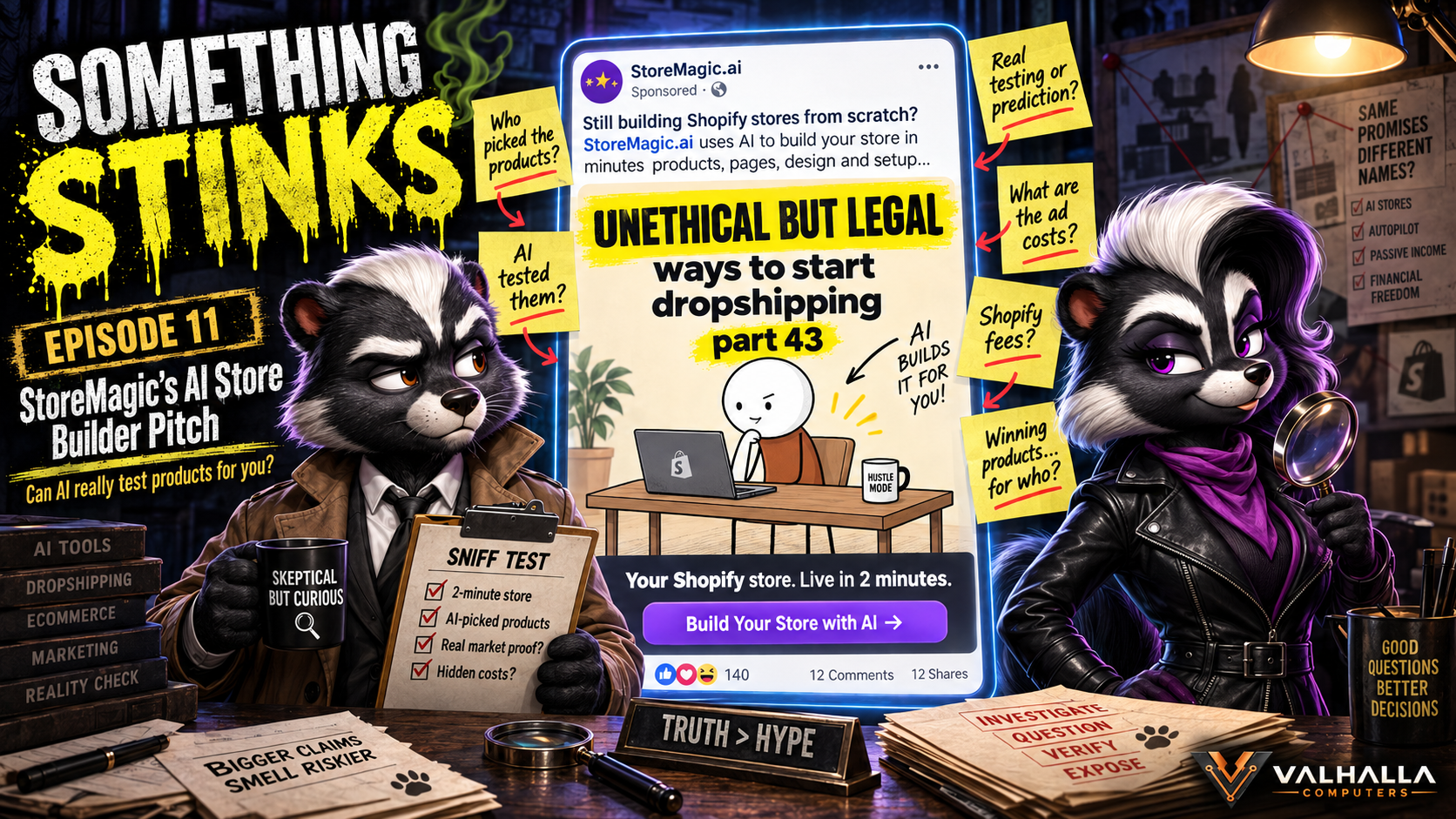
MakePlay arrived on my screen looking like textbook Something Stinks material. “One prompt.” “100% free.” “Complete and playable.” Those are exactly the phrases that usually deserve some skeptical attention because they compress a complicated reality into a beautiful advertising graphic.
But the purpose of these investigations is not to prove that every advertisement is lying. The point is to find out what happens when a normal person actually clicks the button and tries the thing.
In this case, we gave MakePlay a far more detailed prompt than necessary, watched the system spend more than twenty minutes creating assets, composing sounds, converting artwork, writing code, playtesting, fixing problems and assembling a campaign, and then we played the result. It was not the exact game described in every detail. It did not appear to produce a downloadable package. The first creation is free rather than unlimited creation forever. And the longer, more complicated prompt took considerably more time than the advertisement suggests.
Those are all important qualifications.
They also don’t erase what happened.
MakePlay took a paragraph about Captain Ava Morgan sailing around tropical islands hunting treasure, and without us writing a line of code, it created Sash & Slash: an old-school pixel-art pirate game with island exploration, coins, puzzles, enemies, traps, sword fighting, chart fragments, five islands, upgrades, saving, sailing and ship-to-ship combat. It generated a cover image, published the game and produced a link we could send to somebody else.
I went into the test expecting to discover where “make a game with one prompt” stopped being true.
Instead, we discovered that the more accurate warning may simply be:
Bring coffee. It’s going to be a while.
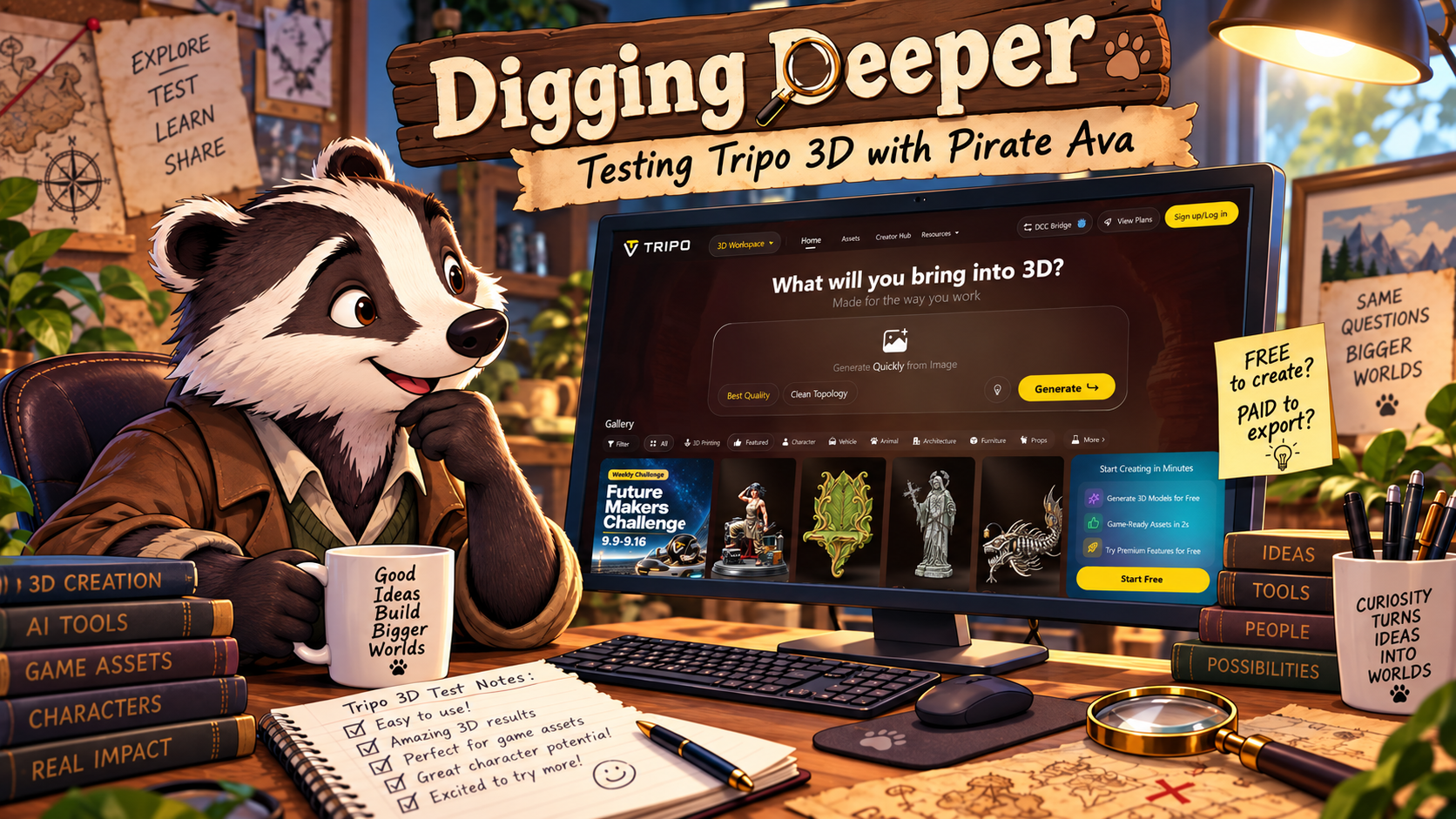
For once, the badger dug underneath an outrageous AI advertisement and came back up holding something other than marketing fertilizer.
He found a game.
Sources Worth Reading
MakePlay.ai — Official AI game builder and Arcade platform.
MakePlay Game Slots Are Now Live: Create More, Earn More — MakePlay’s September 5, 2026 explanation of its Game Slot system and how additional creation capacity is earned.
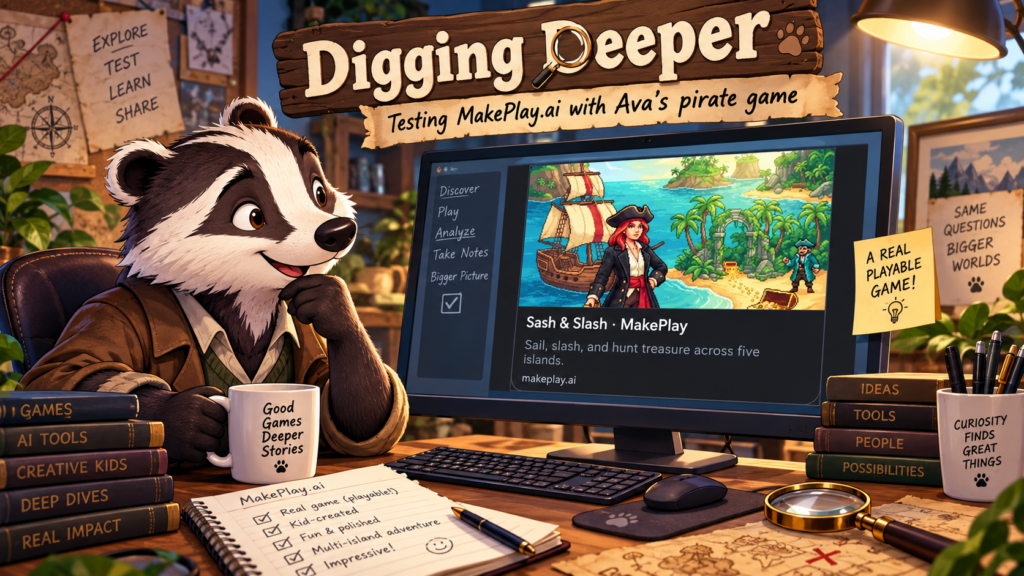
Sash & Slash – MakePlay — The actual game created during this Valhalla Computers hands-on test: https://makeplay.ai/s/HXTZWN4V
All observations regarding generation time, interface behavior, gameplay, publishing, coins, game mechanics and the creation process in this article are based on our direct hands-on test performed September 11, 2026.