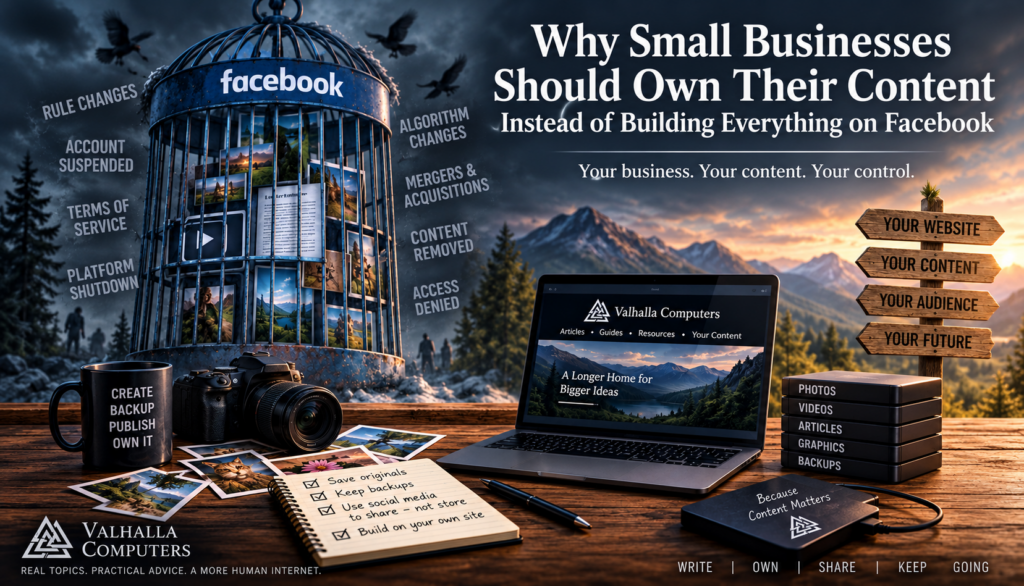
A small business can spend years building something online without realizing that much of what it has built exists entirely inside somebody else’s system. Articles are written directly into Facebook. Photographs are uploaded without local copies. Videos are edited inside an app and published without saving the finished master. Product descriptions exist only inside an ecommerce platform. Customer information lives inside a hosted service. Galleries, blogs, promotional graphics, testimonials, and years of company history accumulate until the business has an impressive online presence — provided the company hosting all of it continues allowing that presence to exist.
Then something changes. The platform rewrites a rule, an automated moderation system decides an account has violated a policy, the company gets purchased, terms of service change, a hosted-site provider stops supporting your industry, a subscription becomes unaffordable, the service closes, or your account gets compromised. That is why the safest long-term rule for a business is simple: own your content whenever possible. Suddenly the business owner discovers the difference between having content online and actually controlling the content the business depends upon.
That distinction is one Valhalla Computers takes increasingly seriously because we have watched it happen more than once. Ava Morgan’s problems with social-media accounts are a recent example, but they are hardly the only one. Hosted websites, social networks, adult-content providers, website-building platforms, image hosts, and countless other online businesses have changed rules, changed ownership, disappeared, or altered what customers are allowed to do. Sometimes users can export everything and leave. Sometimes they discover that the important part of their business existed only inside somebody else’s database. The safest assumption for a small business is simple: if the only copy of something important exists on somebody else’s server, you do not have enough control over it yet.
Posting Something Does Not Mean the Platform Owns It — But That Is Only Half the Story
There is an important distinction here because claims about social networks “owning everything you post” are often exaggerated. In many cases, the user retains ownership of the content while granting the platform broad permissions necessary to host, display, distribute, and operate the service. The bigger practical problem is usually not copyright ownership. It is access.
You may legally own an image while simultaneously losing access to the account where your only copy was stored. You may own the words in a post while no longer being able to reach the page containing it. A platform may remove content or restrict an account when it determines its rules have been violated, and appeals are not guaranteed to restore everything exactly as it was. Copyright ownership and operational control are two different things, and if you upload a photograph, delete the original from your computer, and later lose the account, saying “but technically I still own the copyright” is not going to reconstruct the missing original photograph for you.
This is why Valhalla Computers increasingly uses social media as a distribution system, not as the master archive. The original article belongs on our website. The original featured graphic gets saved separately. The social post points toward the article. If Facebook disappears tomorrow, the Facebook post may be gone, but the article does not disappear with it.
Hosted Websites Can Create the Same Problem
Social media is only the obvious version of this problem. Hosted website services can create exactly the same dependency.
Years ago, it was common to find companies offering complete hosted websites for particular industries. You paid the company, picked a design, uploaded your material, and they handled the rest. It was wonderfully convenient until the provider changed its acceptable-use policies, got acquired, stopped supporting your kind of content, increased prices, or went out of business.
This becomes especially noticeable in industries that large technology companies periodically decide they no longer want to serve. Adult-oriented websites are an obvious historical example. A hosting company or website service can operate perfectly happily with a category of legal content for years and then suddenly announce that its policies are changing. Payment processors can exert pressure, ownership can change, corporate priorities can change, and the rules you originally accepted may not be the rules governing the service five years later.
If the entire site exists only inside that provider’s proprietary website builder, leaving can become painful. The domain may be transferable, your photographs may technically still belong to you, and your writing may still belong to you, but can you export the actual site? Do you possess the original images? Are the videos stored locally? Do you have copies of the product descriptions? Can you retrieve customer-facing pages? Can you reproduce the navigation and structure elsewhere? That is where people sometimes discover that what they thought they owned was actually something they had been renting access to.
Read the Small Print Before the Small Print Changes
Terms of service are boring, but they are also occasionally where the bodies are buried. Most people click I Agree because reading forty pages of contract language before installing a cheap application would consume most of their natural lifespan. Companies know this. That does not automatically mean the terms are malicious, but it does mean customers should pay particular attention when a service will hold something valuable.
Look especially for language concerning ownership, licenses, termination, account closure, data deletion, export rights, cancellation, content reuse, sublicensing, and what happens when the service ends. Do not assume that because you paid someone to create content, you automatically own every copyright connected to it either. Written agreements matter, particularly when dealing with commissioned photography, illustrations, articles, logos, videos, and other material that may become part of the business long term.
If a business hires someone to create original content, the agreement should make clear what rights the business is receiving. Are you buying a finished product for one use? Do you receive a broad commercial license? Are exclusive rights being transferred? May the creator resell the same material to somebody else? Can you modify it? Can you use it forever? Those questions sound unnecessarily legal until the day somebody else starts using your “exclusive” business material because exclusivity was never actually part of the deal.
The $12 Article That Apparently Belongs to Everybody
This leads directly into another problem small businesses have encountered for years: cheap outsourced content.
There is nothing inherently wrong with hiring writers, designers, developers, or other professionals overseas. There are extraordinarily talented people working everywhere in the world, just as there are terrible vendors operating five miles from your house. The problem is anonymous commodity content, wherever it comes from.
A business owner finds a service promising twenty SEO articles for a price that seems almost impossible. The content arrives quickly. The writing is technically acceptable. The business uploads everything and assumes it now possesses a unique library of useful material. Maybe it does. Or maybe the same basic article was slightly rewritten and sold to hundreds of other customers. Maybe the images came from sources the vendor did not have permission to use. Maybe nobody checked the facts. Maybe an article supposedly written specifically for a Florida landscaping company contains advice copied from a site operating in a completely different climate.
Price alone does not tell you whether something is good or bad. What matters is understanding what you are purchasing. At Valhalla Computers, the goal of Human-Tempered Content is not merely to produce words cheaply. The value comes from direction, research, judgment, revision, images, context, and making the final product appropriate for the actual business using it. Ten genuinely useful articles that belong in your company’s library are worth considerably more than five thousand paragraphs everybody else already has.
Unique Content Becomes Part of the Business
This is where content ownership stops being merely a technical or legal subject and becomes a business asset.
Suppose a local company spends several years publishing useful articles about its field. Those articles answer customer questions, explain difficult concepts, demonstrate experience, document projects, and establish a recognizable voice. The photographs show actual work. The videos demonstrate real processes. The promotional graphics reinforce the brand. Over time, that collection becomes part of what the business is.
It cannot be recreated instantly by opening another Facebook account because it took time to build. That is why original content deserves to be treated like any other business asset. If your company spent thousands of dollars on equipment, you probably would not leave it sitting outside overnight with a note saying PLEASE DON’T STEAL. Yet businesses routinely invest hundreds of hours creating photographs, articles, videos, designs, and customer-facing material while keeping the only copies inside systems they do not control.
Digital assets deserve better treatment.
Save the Promotional Graphics Too
People often remember to save articles and forget everything surrounding them. That is a mistake.
Keep the featured images, advertising graphics, logos, banners, source photographs, finished videos, thumbnails, reusable templates, original documents, PDFs, and anything else that would be annoying or expensive to recreate. This is particularly important now that businesses are producing more material with AI-assisted tools. You may generate a fantastic promotional image today and discover six months later that the application you used no longer exists, changed models, removed the feature, or simply cannot reproduce the same result.
The finished asset matters more than the fact that you once knew how to generate it.
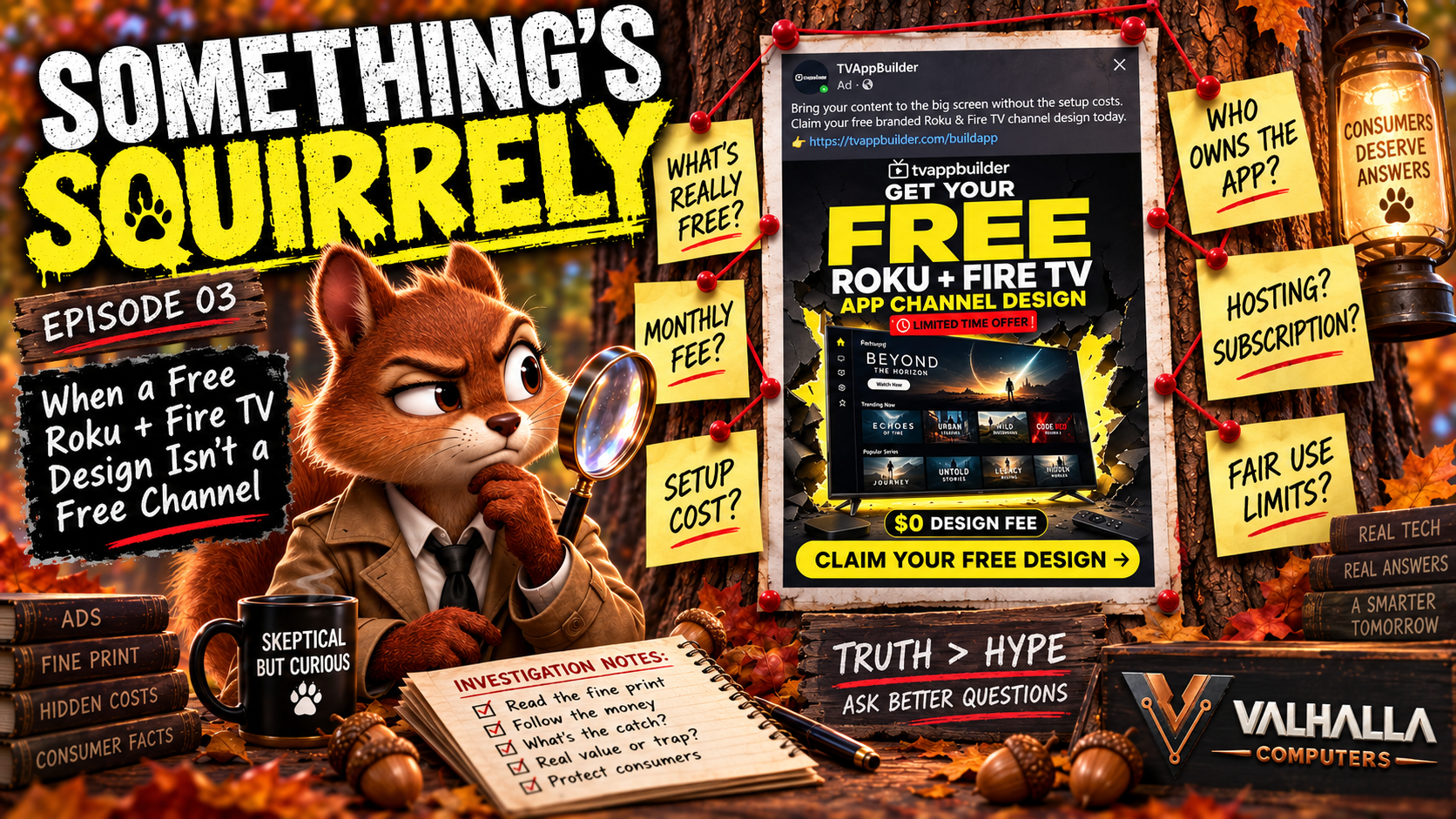
Valhalla Computers now has growing collections of graphics for Something Stinks, Something’s Squirrelly, Digging Deeper, Ava Morgan, Ready Content Packs, blog articles, social posts, experiments, and other projects. Those graphics are not just disposable pictures attached to posts. They are becoming part of the visual history of the business, and they should therefore exist somewhere besides Facebook.
Your Website Needs Backups Too
Owning your website does not magically solve everything. A self-hosted WordPress installation can fail. A plugin update can break something. Malware can damage files. A database can become corrupted. A server can fail. Somebody can accidentally delete the wrong directory. A hosting company can have problems of its own.
That is why ownership needs to be paired with backups.
The important concept is redundancy. If your website and its only backup are both sitting on the same server, you do not have much protection against that server disappearing. If every company photograph exists only on one laptop, that laptop is now a single point of failure. If the only backup drive remains permanently attached to the computer and ransomware hits both, the backup may not save you.
For a small business, this does not require a Pentagon-sized data center. It can be as simple as a reliable scheduled website backup, local copies of important media, an external drive, and a reputable cloud backup or storage destination. The objective is not complexity; the objective is being able to answer one question confidently: if the website vanished tonight, could we rebuild it?
Keep the Raw Material Whenever Practical
The finished article is important, but so is the material used to create it.
If you photographed a product, keep the original high-resolution photograph rather than only the compressed Facebook version. If you produced a video, keep the finished master and important source material. If someone designs a logo, keep useful production versions rather than only a tiny JPEG copied from the website header. If a writer produces an article, keep the original text outside the content-management system. If you build a brochure, save the finished PDF and the editable source when available.
This gives the business options later. A horizontal photograph may become a website banner, a video clip may become part of a future YouTube production, an old promotional image may be useful in an anniversary article, and an original article can be revised years later without scraping it back out of an abandoned platform. Content becomes dramatically more useful when you preserve the source material instead of treating every publication as the final destination.
Do Not Let Facebook Become the Filing Cabinet
Facebook is fantastic at what Facebook is designed to do. It is not your company’s archival storage system. Neither is Instagram, X, TikTok, or YouTube, despite the temptation to treat any of them as permanent free hosting.
Those companies are distribution partners. They provide audiences, discovery, engagement, hosting, recommendations, sharing, and enormous amounts of infrastructure that small businesses could never build independently. Use them, but give them copies.
The website gets the article. Facebook gets a post linking to it. X gets another version. YouTube eventually gets the video. Instagram may get an image. The master files stay with the business. Then if one platform decides tomorrow that Valhalla Computers has offended the algorithmic gods, we lose a channel rather than our history.
Do Not Confuse Convenience With Permanence
This is the central trap. Hosted services are convenient precisely because somebody else handles everything. You do not maintain their servers, manage their software, build their mobile apps, or operate their content-delivery network. That convenience is valuable, but convenience should never be mistaken for permanence.
Companies fail. Companies merge. Companies get purchased. Products are discontinued. Management teams change. Terms change. Industries become unfashionable. Policies that made sense when you opened the account may look completely different five years later.
You cannot prevent those things from happening. What you can prevent is allowing one company’s decision to erase years of your work.
The Human Element Matters Too
Owning content is also about preserving the identity of the business.
Generic outsourced material has always had a tendency to sound generic because the person producing it does not actually know the company. AI has made that problem both better and worse. Used properly, AI can help research topics, organize information, generate ideas, draft material, compare information, create images, and dramatically accelerate production. Used lazily, it can manufacture endless quantities of bland content that could belong to practically anybody.
That is why Valhalla Computers keeps the human in the process. The topic is chosen deliberately. The angle is directed. Research is reviewed. Claims are challenged. Articles are revised. Images are evaluated. Bad ideas are discarded. Sometimes the AI gets told it completely missed the point and we start again. The result becomes specific to the site rather than another anonymous lump of internet content.
That specificity is worth preserving.
Build a Library, Not Just a Feed
One of the biggest changes at Valhalla Computers recently has been thinking less in terms of individual posts and more in terms of a growing library. Something Stinks is a library. Something’s Squirrelly is becoming a library. Digging Deeper is becoming a library. The small-business articles are becoming a library. Ava’s material is becoming its own archive. Ready Content Packs are another collection.
Every individual item contributes something to a larger body of work. That is very different from chasing today’s post and forgetting yesterday’s.
A feed is temporary by design. A library is intended to accumulate.
Small businesses should be thinking about which one they are building.
The Valhalla Computers Bottom Line
Your business content should be able to survive the company currently displaying it. That is probably the simplest way to say it.
Use Facebook, but do not let Facebook hold the only copy. Use Instagram, but keep the photographs. Use YouTube, but save important video masters. Use hosted website tools if they make sense, but understand what can be exported if you leave. Hire writers, designers, photographers, and content creators when they provide value, but make sure your agreement clearly establishes what rights you are actually buying.
Back up the website. Save the graphics. Keep the originals. Preserve the articles. Know where the domain is registered. Know where the site is hosted. Know what happens if you cancel. Know what happens if the vendor disappears. Create enough material that is genuinely specific to your company that somebody cannot replace your entire online identity with five thousand words purchased from a content mill.
Social platforms are useful. Hosted services are useful. Freelancers are useful. AI is useful. But those are tools surrounding the business. The business’s content should ultimately belong to the business, remain accessible to the business, and be recoverable by the business.
Because someday Facebook may change its rules, a hosting company may shut down, a vendor may disappear, a service may be sold, or an account may vanish. When that happens, the goal should not be to sit staring at an empty screen wondering where ten years of work went.
The goal should be much less dramatic: find another platform, restore the backup, and keep going.
Sources Worth Reading
U.S. Copyright Office — Copyright ownership and transfer WordPress — Website backup guidance CISA — Data protection and backup guidance Meta — Terms and intellectual property policies Instagram — Terms of Use