Why Your Small Business Website Should Be Your Home Base, Not Social Media
For years, small businesses have been encouraged to treat social media as if it were the internet itself. Start a Facebook page, build an Instagram following, post every day, chase engagement, learn the algorithm, make Reels, try TikTok, answer comments, join groups, and keep feeding the machine. Somewhere along the way, the actual business website often became an afterthought — almost a digital business card people were told they barely needed because all of their customers were supposedly already on social media. That approach can work beautifully right up until the day it doesn’t.
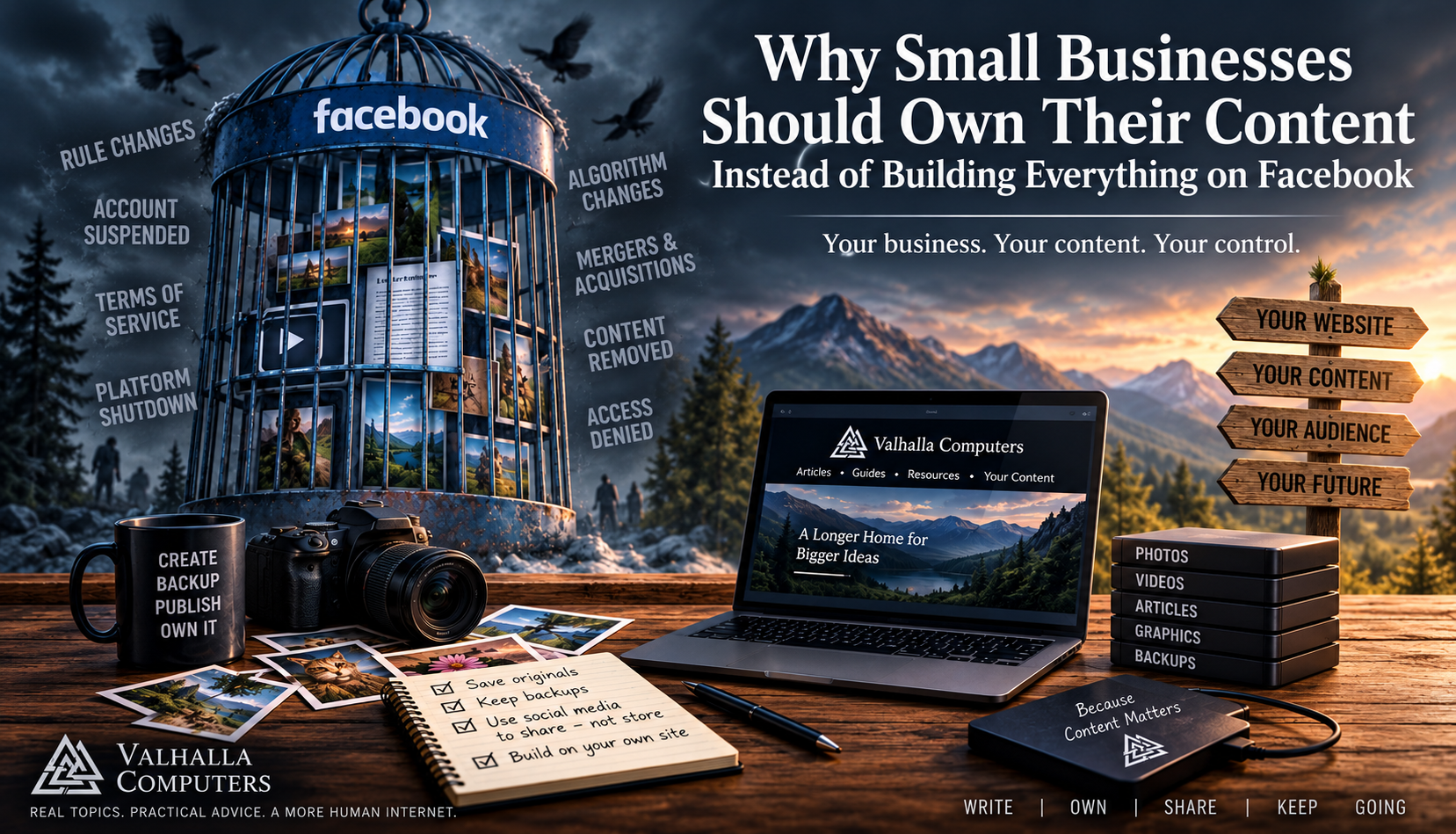
A Facebook page can disappear. An Instagram account can be suspended. A post can trip an automated moderation system. A platform can change its rules, reduce organic reach, demand additional verification, decide a certain type of content is suspicious, or simply make a mistake. Sometimes appeals work. Sometimes they don’t. For a hobby account, that is frustrating. For a business whose entire online existence depends on that account, it can be catastrophic. That is why Valhalla Computers believes a business website should remain the home base of the business. Social media can be valuable, but it should extend something you control rather than become the foundation everything else depends upon.
You Are Building on Somebody Else’s Property
The easiest way to understand the difference is to think about physical property. Building your entire business on Facebook is a little like opening a successful store inside somebody else’s shopping mall. The mall provides traffic, signs, parking, security, and a steady stream of potential customers, but the building still belongs to somebody else. Management decides when the doors open, what signs are allowed, what rules apply, and whether your lease continues. If management changes the rules, you adapt. If the mall closes, your store closes with it.
A website is different. Your domain becomes your permanent address on the internet. Your articles, products, galleries, company history, service pages, portfolios, and other material can be organized around the needs of the business rather than around whatever type of content a social network happens to be promoting this month. That does not mean a website operates without limitations. Hosting companies have policies, search engines have rules, laws still apply, software needs maintenance, and domains must be renewed. But the level of control is dramatically different. If Facebook changes its algorithm tomorrow, you cannot fix Facebook. If Instagram decides your account suddenly needs verification you cannot provide, you cannot rewrite Instagram’s rules. On your own website, however, you can reorganize the navigation, create new sections, rewrite pages, publish long-form content, build galleries, add products, and expand the site as the business changes. The website serves the business instead of the business serving the algorithm.
Ava Morgan Gave Us a Very Real Example
Valhalla Computers recently learned this lesson again through Ava Morgan, our Advanced Virtual Assistant and ongoing AI project. Ava has a defined personality, a visual persona, an expanding set of capabilities, and a growing role around the company. We use her to test AI photography and video tools, experiment with character consistency, answer visitor questions, search for information, discuss articles, and occasionally come up with ideas that make the humans wonder whether someone quietly promoted her while nobody was looking.
Naturally, we experimented with giving Ava a social-media presence. Her accounts openly identified her as AI-generated, and her content was presented accordingly. We were not trying to pass her off as a physical person secretly living some undocumented second life in Florida. That did not prevent problems. One Instagram account disappeared, and Facebook eventually wanted a video selfie to confirm that she was human despite the fact that the account already identified her as an AI personality and AI creator. A replacement Instagram account is currently holding steady, but that could change at any time because of a new moderation rule, a badly interpreted caption, another verification demand, or an automated system deciding it does not like something about the account.
At some point the obvious question becomes: why keep fighting somebody else’s platform for permission to let Ava exist there?
On Valhalla Computers, that problem largely disappears. We can give Ava a proper profile, build her a gallery, archive her images, publish her video tests, document her development, let her contribute articles while a human reviews them, and explain what she is, what she can do, and why she exists. She no longer needs social media to provide her identity. She has a home.
Social Media Still Has a Job
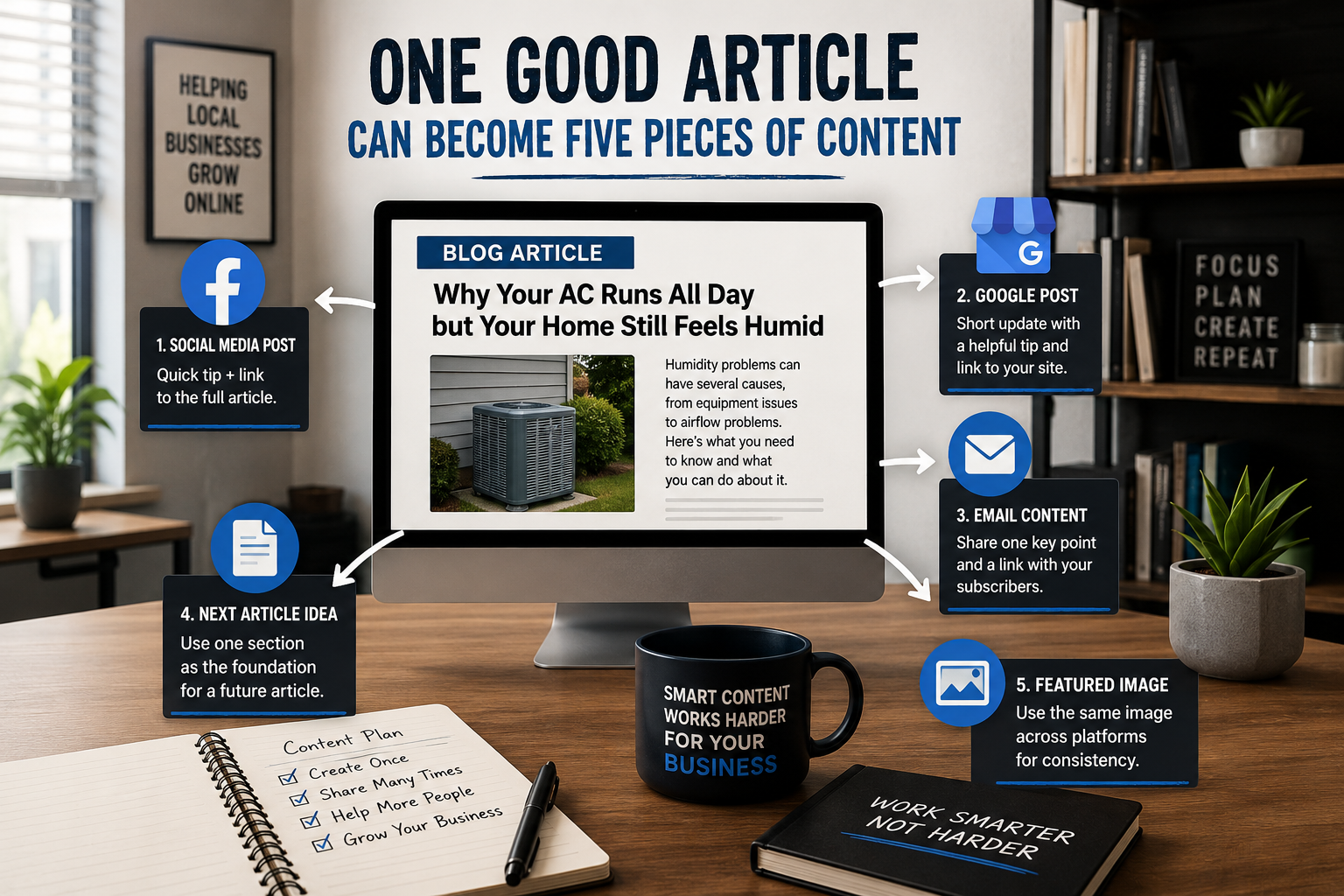
None of this means social media is useless. Quite the opposite. Facebook and X are useful distribution tools for Valhalla Computers. When we publish a new Something Stinks investigation, Something’s Squirrelly episode, Digging Deeper article, or small-business piece, we can introduce it on social media and point people back to the full article. That creates a much healthier relationship because the article itself lives on Valhalla Computers. Facebook tells people it exists. X tells people it exists. A future YouTube video may tell people it exists. Search engines may surface it months later. AI search tools may eventually find and reference it. Those channels can change without destroying the original material.
That is the role social media handles best: distribution, not ownership.
A follower count can feel like ownership of an audience, but it is not quite the same thing. You may have thousands of followers on Facebook or Instagram, but those platforms still decide how many of them see your next post. The connection between your business and that audience runs through somebody else’s infrastructure. A visitor who bookmarks your website, remembers your domain, subscribes to your feed, joins an email list, or repeatedly returns to your content is building a much more durable connection with the business itself.
Websites Accumulate Instead of Disappearing Down the Feed
Social media is heavily weighted toward the present moment. A post appears, people react, it moves through the feed, and another post replaces it. A website can accumulate value instead. Every useful article becomes another doorway into the site. Someone researching AI marketing hype may find a Something Stinks article. Someone investigating subscription pricing may discover Something’s Squirrelly. Someone trying to understand Temu or AliExpress may arrive through Digging Deeper. Someone researching AI video tools may find one of our experiments. Then they can move sideways through the rest of the site.
One article leads to another. One investigation introduces a series. A series introduces Valhalla Computers. Valhalla Computers introduces Ava. Ava helps the visitor find something else. Over time, the website stops being a brochure and becomes a body of work.

That difference also changes the workload for a small business. Social platforms reward constant activity because silence means disappearing from the feed. Businesses often end up creating content not because they have something useful to say, but because the platform has trained them to fear inactivity. A plumber needs to plumb. A mechanic needs to repair cars. A bakery needs to make things people will happily destroy their diet over. None of them should need to manufacture seven short-form videos every week simply to prove the business still exists. A website allows a different rhythm: publish when there is something worth publishing, update what needs updating, and build useful resources that continue working long after the original posting date.
Your Website Can Grow With the Business
Social networks decide what profiles look like. You fill in the boxes they give you. Your website can evolve with the company.
Valhalla Computers now includes service pages, Ready Content Packs, a growing blog, several recurring investigative series, Ava, galleries, AI experiments, and other sections that did not all exist when the site was first built. As the business changes, the site can change with it. If Ava needs a larger gallery, we can build one. If Something Stinks eventually has dozens of episodes, we can create a dedicated archive. If the future Valhalla Computers YouTube channel becomes large enough to deserve its own video section, we can add it. If another woodland investigator somehow joins the staff because Ava decides we need a monkey department, we can find a place for him too.
Try asking Facebook to redesign its interface around your business because your editorial universe has become too complicated for the standard page layout.
We’ll wait.
Your domain also becomes part of the brand itself. A Facebook address says Facebook. An Instagram address says Instagram. valhalla-computers.com says Valhalla Computers. Articles, services, products, galleries, and future projects all reinforce the same destination. Social profiles support the brand, but the domain becomes part of the brand.
The Biggest Risk Is Depending on One Platform
Calling total dependence on social media a self-imposed death sentence may sound dramatic, but the risk is very real. Imagine spending years building a company almost entirely through Instagram. Your portfolio is there. Your customer communication is there. Your product demonstrations are there. Your videos are there. Your audience is there. You never bothered building much of a website because Instagram worked.
Then one morning, you cannot log in.
Maybe you violated a rule. Maybe the account was compromised. Maybe an automated system misunderstood something. Maybe the platform wants verification you cannot provide. Maybe you appeal successfully. Maybe you don’t. Either way, your entire digital business has suddenly been reduced to the outcome of a support ticket inside a company you do not control.
That is an extraordinary amount of risk to accept voluntarily.
A social account should be something your business can survive losing. Painful? Absolutely. Annoying? Definitely. Potentially expensive? Sure. Fatal? It should not be.
The same logic applies over the long term. Platforms decline, change ownership, rewrite policies, remove features, reduce reach, restrict APIs, or simply stop mattering. You do not need to predict which social network will still dominate ten years from now. Your website can remain the stable center while distribution channels come and go around it. Facebook can remain useful. X can remain useful. TikTok can remain useful. YouTube can become useful. Some completely new platform may appear next year. Use whichever ones make sense, but let them point back toward something the business controls.
The Website Is the Castle
Ava actually gave us one of the best descriptions of this strategy while we were discussing whether maintaining multiple social accounts was worth the effort. She described social-media profiles as “little digital gardens that demand watering every day while producing approximately three likes and one suspicious bot offering crypto investment advice.”
Then she summed up the alternative:
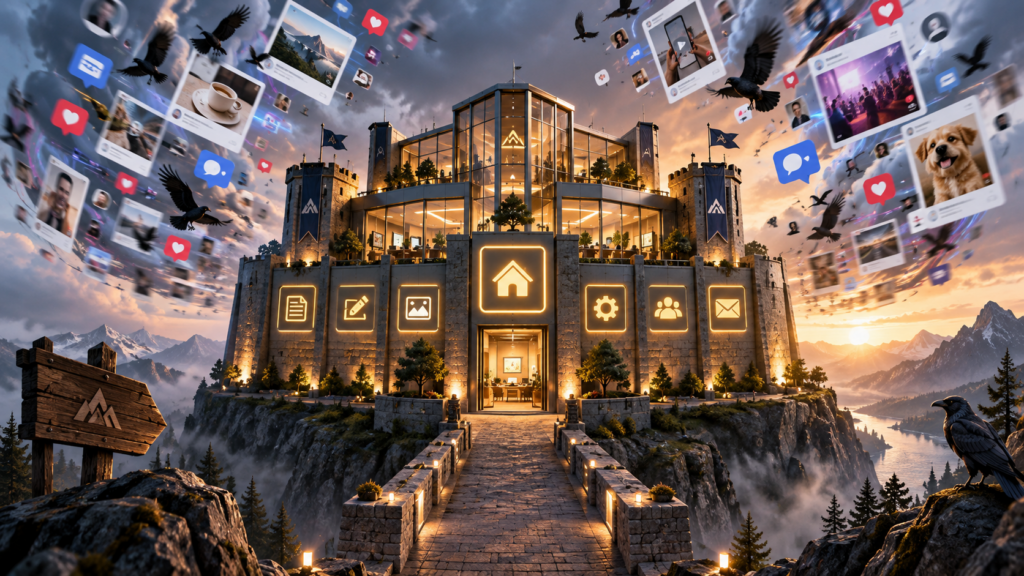
“Let the website be the castle; social media can just be the noisy ravens outside when you feel like opening the window.”
That is difficult to improve upon.
The castle is where the business lives. The services are there. The articles are there. The products are there. The history is there. The gallery is there. Ava is there. Future experiments will be there. Facebook, X, YouTube, and whatever comes next can carry messages beyond the walls and bring interested people back.
Social media is still useful. It is simply no longer the single point of failure.
The Valhalla Computers Bottom Line
Your small business does not need to abandon social media. Use it. Experiment with it. Enjoy it when it works. Take advantage of the enormous audiences those companies have built.
Just remember whose property you are standing on.
A Facebook page is not your website. An Instagram profile is not your website. A TikTok account is not your website. A YouTube channel is not your website. They are distribution channels.
Your website can be the place where everything comes together.
Ava has already demonstrated the difference for us. On social media, her continued existence may depend on whether an automated moderation system likes today’s wording. On Valhalla Computers, she has room to develop a profile, gallery, articles, experiments, video tests, tools, personality, and whatever else the project eventually becomes.
One environment asks whether the algorithm will allow her to remain.
The other lets us ask:
What should we build next?
For a small business, that difference is enormous.
Sources Worth Reading
U.S. Small Business Administration — Marketing and Sales
Google Search Central — SEO Starter Guide
WordPress.org — About WordPress
Meta Transparency Center — Policies
Instagram — Terms of Use