Digging Deeper – Episode 02: The AliExpress Test — Alibaba, the Factories Behind the Listings, and Who You’re Really Buying From
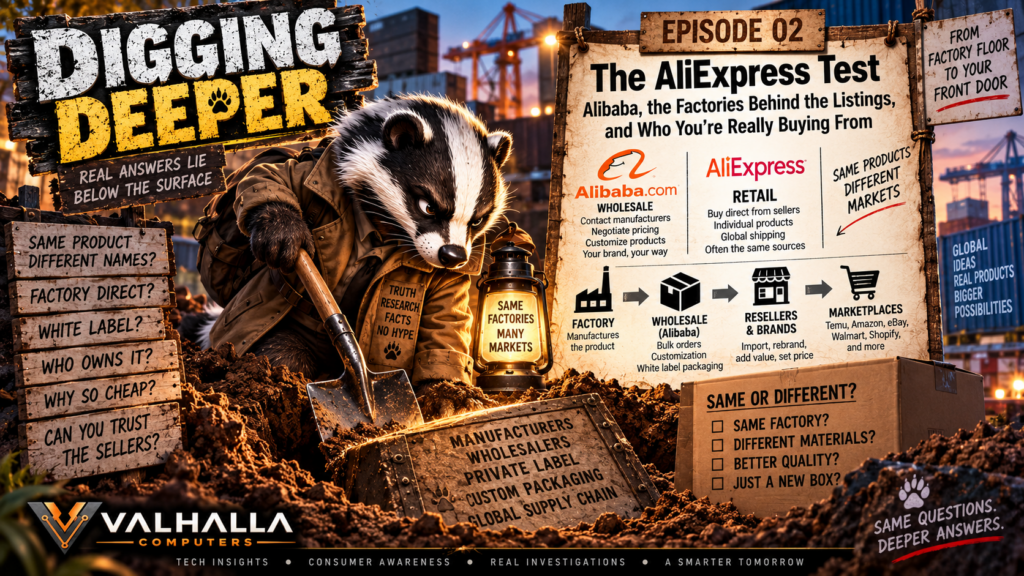
If Temu is the loud new neighbor who arrived with orange boxes, endless Facebook advertising, spinning prize wheels, and prices that occasionally look as though somebody forgot to carry a decimal point, AliExpress is the older house down the street that has been there so long that millions of people recognize the name without necessarily understanding what is behind it. AliExpress launched in 2010 and today operates as one of Alibaba Group’s international retail marketplaces, allowing consumers around the world to buy directly from manufacturers and distributors in China and other countries. Alibaba Group’s own 2026 annual report places both AliExpress and Alibaba.com inside its Alibaba International Digital Commerce Group, but the two platforms serve very different purposes. AliExpress is primarily designed for retail consumers buying individual products or relatively small quantities, while Alibaba.com is an international wholesale marketplace where businesses source goods, negotiate with suppliers, customize products, and purchase inventory for their own operations or for resale.
That difference is where this episode of Digging Deeper gets interesting, because Alibaba.com allows us to walk farther upstream than most consumers ever bother to go. If you have ever wondered why the same oddly shaped flashlight, kitchen gadget, fishing lure, phone accessory, power-tool attachment, storage container, beauty product, or electronic widget seems to appear on AliExpress, Temu, Amazon, eBay, Walmart Marketplace, and half a dozen independent websites under completely different brand names, Alibaba.com provides a pretty good window into how that can happen. Sometimes the products really do come from the same general manufacturing ecosystem. Sometimes a reseller is buying a finished product and simply adding a logo and box. Sometimes a business has negotiated different materials, dimensions, internal components, quality standards, packaging, or features with the manufacturer. The photograph alone generally does not tell you which one happened.
So for Episode 02, the badger is going farther than asking whether AliExpress is legitimate. We are digging into Alibaba Group, AliExpress, Alibaba.com, manufacturers, wholesalers, trading companies, private labeling, white-label packaging, marketplace reselling, product safety, and the surprisingly complicated journey a cheap little gadget can take before it reaches your doorstep wearing somebody’s brand name.
Alibaba and AliExpress Are Related, but They Are Not the Same Thing
Alibaba Group operates a large collection of commerce businesses, and the names can easily become confusing. The company’s fiscal-year 2026 annual report describes AliExpress as an international retail platform that enables global consumers to purchase directly from manufacturers and distributors in China and around the world. The same report describes Alibaba.com as an international wholesale marketplace serving business buyers in more than 190 countries. Alibaba Group’s own business FAQ makes the distinction even clearer: consumers use its retail marketplaces to shop, while business buyers use its wholesale marketplaces to source products for their own businesses or for resale.
That means somebody searching AliExpress for a rechargeable work light might simply buy one light for personal use much as they would from Amazon. A business owner searching Alibaba.com may be looking for 500, 5,000, or 50,000 versions of that light and asking entirely different questions. Instead of simply asking what it costs, the business buyer may ask what it costs at 500 units versus 5,000, whether the housing can be made from a different plastic, whether the battery capacity can change, whether a stronger magnet can be installed, whether the light can be produced in another color, whether their logo can be molded or printed onto it, and whether the supplier can put the finished product into boxes carrying the buyer’s own brand.
Alibaba.com explicitly encourages this type of interaction. Its Buyer Central documentation says buyers can communicate directly with sellers, negotiate prices, request customized products, submit a Request for Quotation, order samples, define detailed specifications, and use production monitoring or inspection services before a bulk shipment leaves the supplier. Alibaba.com says its marketplace includes manufacturers, wholesalers, and distributors rather than one single type of supplier, which is an important distinction whenever someone casually refers to every Alibaba listing as “the factory.”
AliExpress Is the Retail End of a Much Larger Supply Chain
AliExpress is much closer to the experience most consumers already understand. You find an item, look at the seller, check the price and shipping, place an order, and wait for the package. Alibaba Group describes AliExpress as a retail marketplace, while AliExpress’s own policies describe the platform as connecting business sellers with consumer buyers. The platform provides the marketplace and transaction infrastructure, but individual transactions involve sellers offering products to buyers rather than AliExpress manufacturing everything displayed on the website.
That distinction explains why AliExpress can simultaneously produce glowing reviews and horror stories without either side necessarily lying. Buying from AliExpress is not like buying twenty unrelated products manufactured by one company. You may be dealing with twenty unrelated sellers offering products from twenty unrelated supply chains. One merchant may have been selling the same product for years with good quality control and reliable fulfillment, while another may have opened an account recently and selected whichever factory provided the lowest possible quote.
AliExpress has attempted to make parts of that experience more standardized through programs such as Choice, which launched in 2023. Alibaba Group says Choice gives AliExpress greater responsibility for the end-to-end shopping experience and can provide benefits such as free shipping, free returns, and delivery guarantees in qualifying markets. Under that model, sellers can focus more heavily on product development and manufacturing while AliExpress handles more of the logistics and customer experience.
That helps make AliExpress feel more like a conventional retailer, but the marketplace underneath it still contains an enormous range of merchants and manufacturers.
Alibaba.com Is Where You Begin Seeing How the Sausage Is Made
The easiest way to understand why the same products appear everywhere is to spend some time browsing Alibaba.com rather than AliExpress. Alibaba.com describes itself as one of the world’s largest wholesale marketplaces, with more than 150,000 manufacturers, wholesalers, and distributors represented in its sourcing system. Buyers can search existing products or approach suppliers about creating customized versions.
Imagine that you want to start a small brand selling camping lanterns. You could search Alibaba.com for a lantern that already exists, order a sample, test it, and then ask the supplier what changes are available. Perhaps you want black plastic instead of green, a warmer LED color, a larger battery, your logo printed on the front, an instruction sheet with your company information, and a retail box carrying your brand. Depending on the supplier and the order quantity, some or all of those requests may be completely normal.
Alibaba’s own sourcing material encourages buyers to document requirements including materials, dimensions, colors, customization details, logo placement, packaging, target unit price, minimum-order quantities, and delivery schedules before approaching suppliers. The company’s packaging guidance also discusses custom artwork, logo placement, packaging specifications, samples, color standards, and production tolerances.
Suddenly that $29.95 lantern carrying a brand name you have never heard of begins looking a little less mysterious.
From Alibaba Factory to Amazon Listing: How One Product Can Become Five Brands
This is probably the most important part of the entire investigation because it explains a huge amount of what people see across modern online marketplaces. A business can legitimately use Alibaba.com to locate products for resale. Alibaba Group explicitly describes business buyers using its wholesale marketplaces to source goods for use in their businesses or for resale, and Alibaba.com gives buyers the ability to negotiate directly with suppliers before placing orders.
Once a business imports those products, there are numerous possible sales channels. Subject to the rules of the marketplace, intellectual-property requirements, product-safety laws, import regulations, and whatever other requirements apply, a reseller can potentially offer inventory through Amazon, eBay, Temu, Walmart Marketplace, Etsy where the product qualifies, a Shopify store, a company website, local retail locations, flea markets, trade shows, or wholesale to other retailers. The fact that somebody bought inventory from Alibaba.com does not obligate them to turn around and sell it on an Alibaba-owned platform.
That is one reason a generic product can appear everywhere.
Supplier sells generic gadget for $3.50 wholesale. One buyer orders 1,000 and sells them online for $11.99. Another buys 5,000, has them packaged under a new brand, and lists them for $19.95. Another company negotiates a thicker housing and better internal components and charges $29.95. A fourth orders a virtually identical standard model and puts it in a particularly beautiful box before charging $39.95.
From the consumer’s perspective, all four may initially look like the same damned gadget.
They may even use similar supplier photographs.
But without digging deeper, there is no way to know whether they really are identical.
Yes, You Can Have the Factory Put Your Name on the Box
This is where white-label and private-label manufacturing enter the picture. The terms are sometimes used loosely and can overlap in everyday conversation, but the basic idea is simple. A white-label arrangement often starts with an existing generic product that several businesses can purchase and sell under their own brands. A private-label arrangement can involve more customization, while OEM and ODM relationships can go farther still depending on who owns the underlying design and how much product development the buyer controls.
Alibaba.com is filled with suppliers offering custom logo and packaging services. Its own marketplace contains manufacturers selling custom printed cartons, pouches, bags, rigid boxes, inserts, retail packaging, and other branded materials. Alibaba’s sourcing guidance specifically tells private-label buyers to settle details such as artwork, logo placement, packaging files, color standards, samples, setup costs, and lead times before approving mass production.
So yes, the box itself can be part of the order.
A company does not necessarily need a printing press, packaging factory, graphics department, and manufacturing plant to put a professionally branded product on Amazon. The supplier may manufacture the product, another supplier may make the packaging, or one supplier may coordinate everything. A buyer can potentially provide a logo and packaging design and receive finished units already packed into retail-ready boxes bearing the buyer’s brand.
That is not inherently deceptive. Private labeling is an ordinary business practice used throughout retail. Grocery-store brands, cosmetics, tools, electronics, household products, food products, automotive accessories, and countless other categories have long involved manufacturers producing products for someone else’s brand.
The misconception is assuming that because a company name appears prominently on a retail box, that company must own the factory that manufactured what is inside.
Sometimes it does.
Sometimes it commissioned the design.
Sometimes it modified an existing design.
Sometimes it bought the same generic product everybody else can buy and changed nothing but the box.
A White-Label Box Can Make a Generic Product Look Very Exclusive
Packaging has enormous psychological power. Take an unbranded electronic gadget out of a plain plastic bag and it looks like a six-dollar import. Put exactly the same item into a rigid black box with embossed lettering, a fitted foam insert, glossy instructions, a warranty card, and a brand name containing words like Elite, Pro, Tactical, Premium, Ultra, or Max, and suddenly the thing feels like it ought to cost $39.95.
Alibaba.com makes it possible to source that packaging just as easily as the product. Current listings include customized rigid boxes, magnetic boxes, pouches, printed bags, foam inserts, and other packaging carrying a buyer’s logo. Minimum order quantities vary widely depending on the supplier and complexity.
Again, that does not mean the markup is automatically dishonest. The company reselling that six-dollar gadget may also be paying for international shipping, customs duties, storage, inspection, packaging, advertising, marketplace fees, returns, customer support, damaged units, credit-card processing, insurance, employees, and taxes. If the seller holds inventory inside the United States and delivers it tomorrow rather than making you wait several weeks for an international parcel, that convenience also costs something.
But sometimes you really are looking at essentially the same product wearing better cardboard.
That is why tracing the product upstream can be so interesting.
White Label Does Not Always Mean Identical
This is also where internet detectives frequently go too far. Somebody discovers a $6 product on AliExpress that resembles a $30 Amazon product, posts side-by-side screenshots, and announces that the Amazon seller is simply charging five times as much for exactly the same thing.
Maybe.
But appearance alone does not prove it.
Alibaba.com specifically supports customized sourcing. Buyers can negotiate materials, colors, dimensions, packaging, product specifications, and quality requirements with suppliers. Alibaba also recommends samples and detailed purchase orders so the finished goods can be measured against whatever the buyer and supplier agreed upon.
Two externally identical power adapters could contain different electrical components. Two flashlights could use different battery cells. Two wrenches could be made from different steel. Two plastic containers could use different resin. Two electronic devices could have different firmware or internal boards. Two products could come from the same factory but be manufactured to different specifications for different customers.
The opposite is also possible. Two differently branded products really can be the exact same stock model with different logos printed on them.
The badger’s rule is simple: matching photographs are evidence worth investigating, not proof of identical construction.
Are Alibaba Sellers Actually Factories?
Not necessarily, and this is one of the most important things for anyone considering Alibaba.com for business sourcing to understand. Alibaba.com says its marketplace includes manufacturers, wholesalers, and distributors. A business listed on the site may own production equipment, operate a factory, outsource some manufacturing, act as a trading company representing several factories, distribute other manufacturers’ products, or combine several of those roles.
Alibaba attempts to provide additional information through supplier badges. Its Buyer Central documentation explains that a Verified Supplier has undergone additional third-party assessment covering areas such as its company profile, management, production capabilities, products, and processes. Trade Assurance suppliers also participate in Alibaba.com’s order-protection system.
Those indicators are useful, but they should not substitute for due diligence when significant money is involved. Alibaba itself recommends communicating directly with suppliers, obtaining samples, writing detailed purchase orders, and using production monitoring or inspection services where appropriate. A business placing a $300 sample order faces a very different level of risk than a company wiring tens of thousands of dollars for a container full of inventory.
For serious sourcing, the questions change quickly from “How much does this cost?” to “Who manufactures it, where is production located, what exactly are the specifications, what certifications apply, what does the sample look like, what does the contract require, and what happens if the bulk production does not match?”
That is much closer to procurement than ordinary online shopping.
Trade Assurance Is Useful, but the Details Matter
Alibaba.com offers an order-protection program called Trade Assurance. According to Alibaba, qualifying orders placed and paid through its platform can receive protection involving product quality, shipment timing, payment security, and dispute resolution. Alibaba emphasizes that the online order and written communications are important because those records establish what the supplier actually promised to deliver.
That is another difference between casual consumer shopping and wholesale sourcing. If you tell a supplier in a private conversation somewhere else that you want stainless steel, but the actual Alibaba order merely says “metal,” you have created a much harder argument if ordinary steel arrives. Alibaba specifically encourages buyers to keep communication within its system and define product specifications clearly in the protected order.
For anyone considering using Alibaba.com to create a branded product, that is worth remembering. The photograph is not the specification. A sample is not automatically the specification. A salesperson saying “yes friend, same quality” is definitely not the specification.
The written order needs to describe what is being purchased.
Why Can AliExpress Still Be So Cheap?
AliExpress benefits from many of the same economic forces we discussed in our Temu investigation. Consumers can buy closer to the manufacturing and wholesale side of the supply chain, seller competition can be intense, overhead structures differ from traditional retail, and international logistics have been optimized around enormous volumes of small parcels.
One important historical advantage has changed, however. Low-value international shipments entering the United States once frequently benefited from the de minimis exemption, which allowed qualifying shipments worth $800 or less to enter without ordinary duties. That landscape changed dramatically in 2025. U.S. Customs and Border Protection says duty-free de minimis treatment was suspended for Chinese goods beginning in May 2025 and then suspended for qualifying low-value shipments from all countries effective August 29, 2025. Those shipments are now generally subject to applicable duties, taxes, fees, and customs procedures.
That means old explanations claiming AliExpress is cheap simply because every inexpensive Chinese parcel automatically enters America duty-free are no longer current.
International marketplaces are adapting through new logistics, consolidated shipments, domestic inventory, changing seller strategies, and other approaches. The economics continue to evolve, which is another reason these investigations are worth periodically revisiting rather than treating a five-year-old YouTube explanation as permanent truth.
AliExpress Is Legitimate, but That Does Not Mean Every Listing Deserves Equal Trust
AliExpress itself is unquestionably a real Alibaba Group marketplace. Alibaba’s 2026 SEC filing identifies AliExpress as one of the company’s major international retail businesses, and AliExpress has operated globally since 2010.
The more useful question is not whether AliExpress exists. It is how much confidence should be placed in a particular product and seller.
AliExpress’s own terms describe it as a platform connecting buyers and sellers and make clear that AliExpress itself does not manufacture or control every product offered by merchants. That marketplace structure means quality, safety, seller reliability, and product legitimacy can vary from listing to listing.
For low-consequence products, that variation may be perfectly acceptable. If an inexpensive fishing lure turns out to have lousy hooks, you have learned something for a few dollars. If a novelty lamp feels cheaper than expected, life probably continues.
For products where failure can cause injury, fire, electrical shock, or substantial property damage, the calculation changes.
Regulators Have Found Real Product-Safety Problems
This is not merely theoretical. In July 2026, the European Commission fined AliExpress €550 million for violating obligations under the Digital Services Act relating to the assessment and mitigation of risks involving illegal, unsafe, and counterfeit products on its marketplace. The Commission said AliExpress had not adequately assessed those risks and had failed to take sufficiently effective measures to reduce the spread of illegal products.
That followed earlier European regulatory action and binding commitments involving seller verification, illegal-product reporting, advertising transparency, and marketplace safeguards. AliExpress is large enough in Europe to be designated a Very Large Online Platform under the Digital Services Act, with the European Commission currently reporting more than 100 million average monthly active users for the service in the EU.
The United States has its own concrete examples. The Consumer Product Safety Commission announced a 2025 recall involving convertible strollers sold through AliExpress because their restraint systems violated mandatory federal safety requirements and created a serious fall hazard. In March 2026, the CPSC also said AliExpress joined Walmart and eBay in removing dangerous male-to-male electrical extension cords after the agency intervened over electrocution and fire hazards.
Those examples do not establish that AliExpress products generally are unsafe. Traditional retailers and other online marketplaces also experience recalls and dangerous listings. What they demonstrate is that marketplace price should not replace product-level judgment, particularly when the item involves children, electricity, lithium batteries, protective equipment, automotive safety, or anything else where failure can do more than annoy you.
Alibaba.com Can Be Extremely Useful for Small Businesses
After all of that caution, it is worth emphasizing something that gets lost in the usual “cheap Chinese stuff” discussions: Alibaba.com can be an extraordinarily useful tool for legitimate small businesses.
A person with a good product concept does not necessarily need millions of dollars to build their own factory. They can identify existing manufacturers, order samples, compare quotations, negotiate specifications, test different packaging concepts, request private labeling, and gradually develop a product line. Alibaba.com even supports Request for Quotation tools where a buyer describes what they need and suppliers compete for the business.
Someone running a local tackle company might find a lure manufacturer and specify colors appropriate for Gulf Coast fishing. A woodworking business might source measuring tools with its own branding. A pet company might customize bowls, leashes, or grooming equipment. A technology company could source accessories and have them packaged under a house brand. Whether that makes financial sense depends on minimum orders, shipping, tariffs, quality control, product liability, marketplace fees, and a dozen other details, but the manufacturing infrastructure is accessible in a way that would have been almost unimaginable to a small American business forty years ago.
That is a significant part of the Alibaba story.
It is not merely a place where people go hunting for cheap products.
It is an enormous sourcing network.
The Same Supply Chain Can Feed AliExpress, Temu, Amazon, eBay, and Your Local Store
This brings us back to the mystery we started with. When an item appears on several marketplaces, the most useful mental model is not necessarily that one retailer copied another. Instead, imagine a manufacturing network upstream with multiple streams flowing outward.
A factory or supplier produces a product. One merchant sells it directly through AliExpress. Another buyer purchases wholesale quantities through Alibaba.com and places the item on Amazon. Another reseller lists inventory on eBay. Another business, where marketplace rules allow it, could offer inventory through Temu. Another importer buys a larger quantity, adds branded packaging, and supplies independent stores. Another company changes several specifications, creates an exclusive variation, and sells it only through its own website.
Now five products appear online that look almost identical because they may share a common manufacturing ancestor.
That does not prove every one has the same quality.
It explains why they look related.
And it explains why tracing products back to Alibaba.com can occasionally feel like discovering the backstage entrance to online retail.
Before Starting Your Own “Brand,” There Are Responsibilities Too
It is tempting to look at a two-dollar wholesale product, see somebody selling something similar for twenty dollars, and immediately start calculating retirement plans. The missing part of that equation is everything the reseller becomes responsible for once they import and sell merchandise.
A business may need to consider customs duties, freight, warehousing, product testing, labeling laws, certifications, intellectual-property rights, product liability, insurance, marketplace fees, returns, damaged inventory, customer service, advertising, taxes, and compliance with whatever regulations apply to that category. An American business that puts its name on imported electrical equipment does not suddenly escape responsibility because somebody else manufactured it.
Alibaba.com can make access to manufacturing astonishingly easy.
Running a legitimate product business is still work.
That distinction is particularly important with white labeling. Putting a professional logo on a box may make something look like your product, but consumers will also reasonably expect you to stand behind it like your product.
So What Did the Badger Find?
AliExpress becomes much easier to understand once you realize it is only one visible layer of a much larger Alibaba ecosystem. AliExpress is the consumer-oriented retail marketplace where individuals can purchase products from manufacturers and merchants around the world. Alibaba.com sits farther upstream as a global wholesale marketplace connecting businesses with manufacturers, wholesalers, distributors, and other suppliers. Both currently operate within Alibaba Group’s international digital-commerce business.
Alibaba.com is also one of the reasons seemingly identical products can appear under dozens of names across the internet. Business buyers can source finished goods for resale, communicate directly with suppliers, negotiate pricing, request different materials or dimensions, customize products, add logos, design packaging, and create private-label merchandise. Alibaba’s own marketplace even contains enormous categories devoted specifically to custom printed boxes, pouches, bags, inserts, and other retail packaging.
That does not mean every unfamiliar brand on Amazon is secretly somebody sitting in their garage ordering generic products from Alibaba. Plenty of companies design their own products, work extensively with manufacturers, specify unique components, conduct independent testing, maintain domestic inventory, provide warranties, and add genuine value between factory and customer.
It does mean the brand name printed on the box does not automatically tell you where the product originated.
AliExpress also remains a marketplace where seller and product quality can vary significantly. Serious regulatory action in Europe and documented U.S. product recalls demonstrate why safety-critical purchases deserve more investigation than a novelty keychain. At the same time, AliExpress is a legitimate global retail marketplace and Alibaba.com is a legitimate international sourcing platform used by businesses around the world.
The most useful thing we found is not a reason to avoid either platform.
It is a better way to understand what you are looking at.
When you see the same little gadget on AliExpress for $7, Temu for $9, eBay for $14, Amazon for $24, and somebody’s beautifully branded website for $39, do not automatically assume the cheapest one is garbage or the most expensive one is a ripoff. Start asking where each seller fits into the supply chain, whether the specifications actually match, what protections and support come with the purchase, whether the product has been independently tested where necessary, and how much value has genuinely been added between the factory and your front door.
Because if you follow that product far enough upstream, there is a decent chance you will eventually find somebody on Alibaba.com asking:
“Custom logo?”
“Custom packaging?”
“What quantity?”
And somewhere underground, our badger just found another tunnel.
Digging Deeper.
Sources Worth Reading
Alibaba Group’s fiscal-year 2026 annual report provides the clearest current corporate description of AliExpress and Alibaba.com, placing both inside Alibaba International Digital Commerce Group and distinguishing AliExpress’s international retail role from Alibaba.com’s international wholesale business.
Alibaba Group’s business FAQ specifically explains that business buyers use its wholesale marketplaces to source products for their businesses or for resale, while Alibaba.com Buyer Central explains supplier contact, product customization, quotation requests, sampling, inspections, purchasing, and Trade Assurance.
Alibaba.com’s private-label and packaging resources demonstrate how buyers can specify branding, logos, artwork, packaging, materials, dimensions, colors, and other customization requirements when sourcing products.
Alibaba Group’s AliExpress information explains the retail marketplace and its Choice program, while AliExpress’s own policies describe the platform relationship between consumers and third-party sellers.
The European Commission’s July 2026 enforcement decision and U.S. Consumer Product Safety Commission records provide current examples of the product-safety and marketplace-compliance issues discussed in this article.
U.S. Customs and Border Protection provides current information concerning the end of duty-free de minimis treatment for low-value imports entering the United States.